
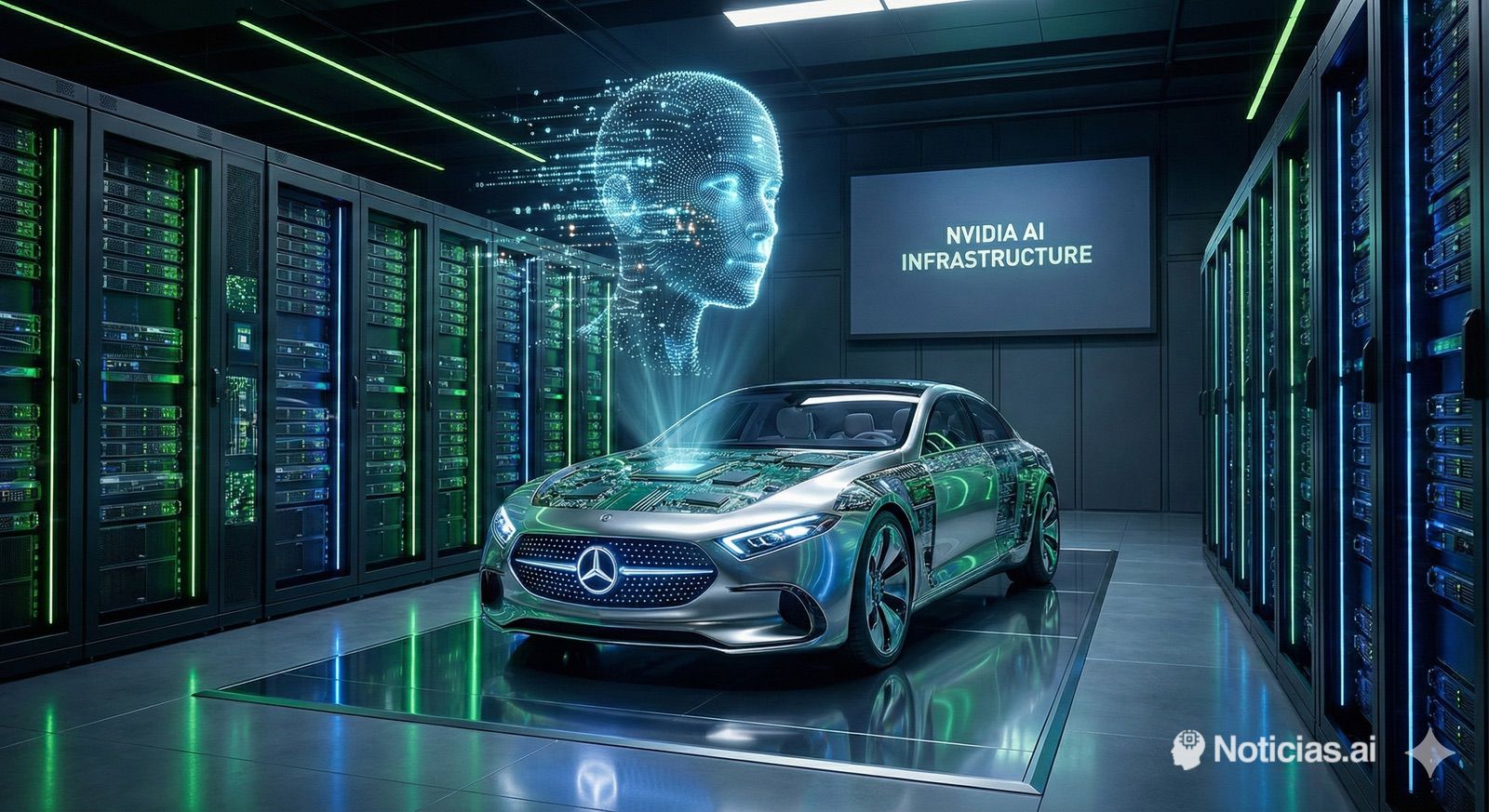
At a time when Artificial Intelligence has become the gravitational center of technology—and increasingly, of industrial geopolitics—Jensen Huang has chosen a rather unusual tone for a CEO of his size: that of a personal anecdote with a financial moral. At the World Economic Forum in Davos, NVIDIA’s CEO recounted how, after going public, he sold shares when the company was valued at $300 million to buy a Mercedes S-Class for his parents. He now admits he regrets the timing.
The story, told naturally, serves as a metaphor for something greater: the vertigo of a technological revolution that has compressed decades of industrial evolution into just a few years. The once-small NVIDIA post-IPO contrasts sharply with the company that, amid the AI surge, has surged close to the threshold of $5 trillion in market capitalization at various points recently.
From Personal Regret to Strategic Message: “This Is Just the Beginning”
The car story wasn’t just nostalgia. Huang used it as a springboard to reinforce a thesis that has been echoed in recent quarters: AI is not merely a software layer but a transformation of the global infrastructure. In the same context, he defended the idea that the world is already immersed in “the largest infrastructure deployment in history”, with “hundreds of billions” invested and “trillions” still to be built.
The key argument is significant: if AI progresses from spectacular demos to ubiquitous technology in businesses and governments, the bottleneck shifts from the prompt to the physical computing capacity—and everything that makes it viable: data centers, networks, energy, cooling, supply chains, and talent.
Table 1 — What “the largest infrastructure deployment in history” entails (practical terms)
| Layer of the stack | What’s expanding | Why it matters for AI | Risks if it fails |
|---|---|---|---|
| Computing | GPU/CPU clusters, acceleration | Large-scale training and inference | Saturation, latency, soaring costs |
| Network | High-performance interconnection | Mobilizing data and synchronizing systems | Bottlenecks, underutilization |
| Energy | Electrical capacity and stability | Intensive computing “consumes” watts | Growth limitations, regulatory tension |
| Cooling | Air and liquid cooling at high density | Maintaining performance without degradation | Downtime, reduced density, higher CAPEX/OPEX |
| Software | Optimized stacks, tools | Maximizing hardware efficiency and deployment speed | Lower ROI, operational complexity |
The Uncomfortable Part: Opportunity Cost and the Psychology of “Selling Too Early”
The Mercedes S-Class anecdote is familiar to any investor: sell to realize a legitimate goal and, years later, discover the asset enters an unexpected growth phase. In Huang’s case, the contrast is stark, because the company itself became a stock market symbol during the AI cycle.
Meanwhile, the market has experienced episodes that reinforce this mindset: companies reducing exposure to NVIDIA before the massive rally, or shifting portfolios to other tech bets. For example, SoftBank announced significant divestments from NVIDIA in recent years, aligning with its own strategic shifts and focus areas.
The takeaway isn’t “buy and never sell,” but understanding that AI is creating a cycle where CAPEX accelerates first, and value capture follows later—unevenly distributed among platforms, integrators, and end-users.
Is Return on Investment Guaranteed? The Question Hanging Over Data Center Boom
The “inevitable deployment” thesis doesn’t eliminate a core concern: whether massive infrastructure investments will translate into sustainable benefits for customers and society. Huang argues that the direction is set by evolving models and applications, and that the growth in demand for computing has not slowed.
However, the market has learned from previous cycles that excess capacity can penalize operators and manufacturers if demand doesn’t materialize as expected. In AI, the nuance is that computational consumption depends not only on training large models but also on serving inferences to millions of users and business processes, with radically different latency and cost requirements.
Table 2 — Two plausible scenarios for 2026–2027
| Scenario | What happens | Typical signals | Likely winners |
|---|---|---|---|
| Sustained Expansion | AI integrates into processes and products with measurable ROI | More inference loads, real automation, adoption in regulated sectors | Infrastructure providers, platforms, managed services |
| Selective Adjustment | Part of CAPEX is postponed due to energy costs or lack of use cases | Regulatory/energy pressure, project consolidation, focus on efficiency | Actors with more efficient technology and clients with better AI governance |
The Key Message: Infrastructure, Yes; But Also Utility
Huang’s testimony grounds the conversation: on one hand, it humanizes the financial narrative (“I also sold too early”); on the other, it emphasizes that AI’s future is played out beyond headlines—in industrial implementation.
Davos was the scene, but the message has momentum: if AI is driving the largest contemporary technological cycle, the key question isn’t just who makes chips, but who transforms computing capacity into productivity, services, and measurable competitive advantages.
Frequently Asked Questions
What did Jensen Huang mean by “the largest infrastructure deployment in history”?
He referred to the cumulative and projected investments in data centers, accelerated computing, networks, and energy—necessary to sustain large-scale AI growth.
Why has the Mercedes S-Class anecdote attracted so much attention?
Because it illustrates the opportunity cost of selling shares before an extraordinary expansion phase and offers a rare personal example from the leadership of an AI leader.
Has NVIDIA really approached a $5 trillion valuation?
Recently, the company has been described as nearing that threshold, with references to market caps around $4.89 trillion and approaching the milestone of $5 trillion.
What is the main risk of this wave of AI infrastructure investment?
That part of the capacity is built faster than useful adoption matures—especially if energy, regulatory, or operational cost limitations come into play.
via: wccftech
