
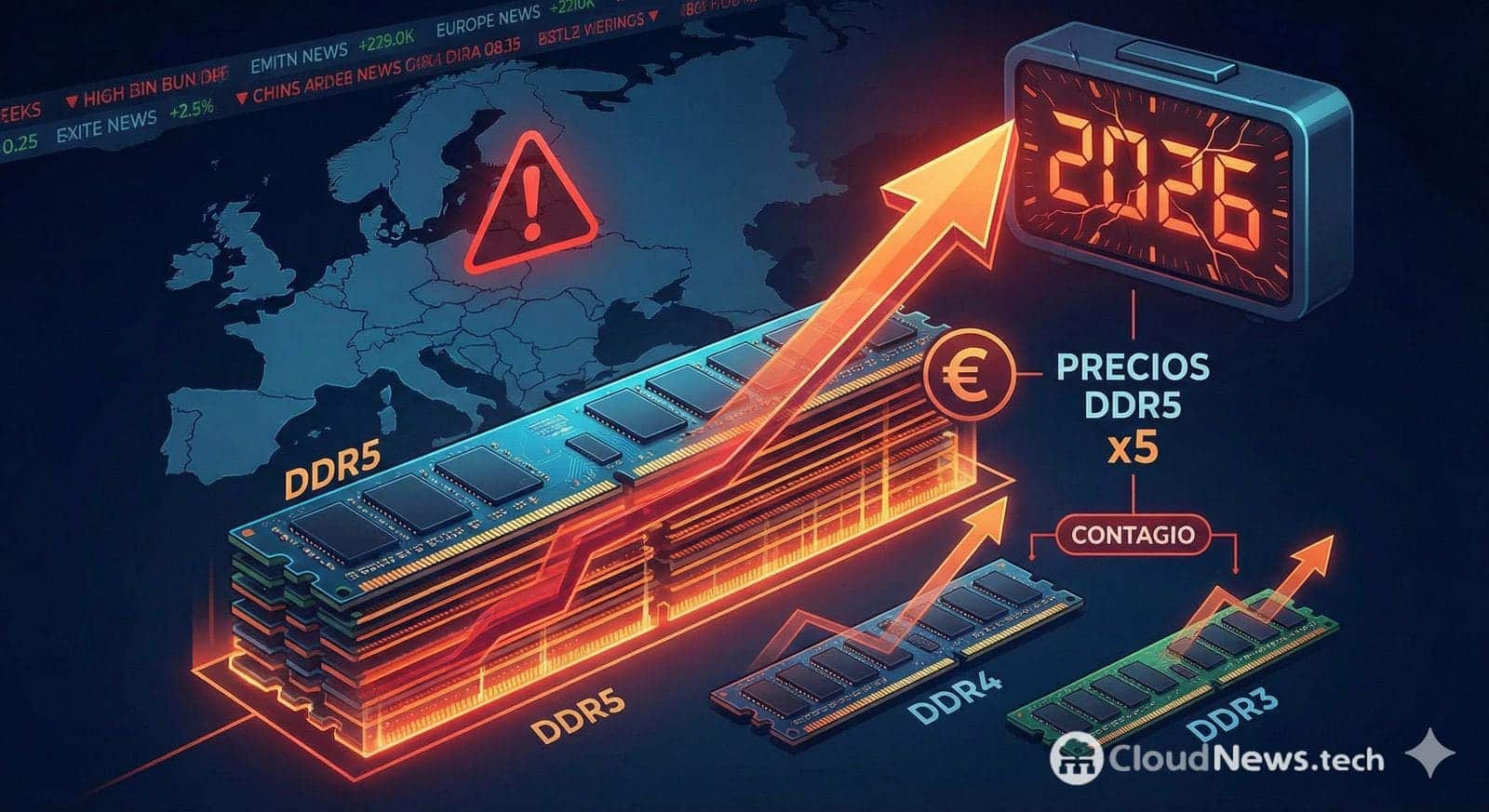
The rising prices of memory are experiencing a new episode in Europe, threatening to turn a simple RAM upgrade into a purchase that’s hard to justify for many users. A reference tracking conducted by 3DCenter —based on a basket of monitored modules on marketplaces like Amazon and eBay— depicts a particularly aggressive jump in DDR5 since summer 2025, with average increases well above normal and peaks that practically mean “quintupling” the initial cost on certain models.
The most notable: DDR5 on the rise… and DDR4/DDR3 contagion
According to 3DCenter’s “Speicherkrisen-Preisindex,” DDR5 has experienced an average increase of 340% since July 2025, with cases reaching up to 427%. Translated into simple terms: a +427% means paying 5.27 times the reference price. The surge isn’t limited to the current generation: DDR4 shows an average increase of 262.8%, and despite being an older platform, DDR3 is also rising with a +89.5%.
Behind this domino effect is a market reality that has been repeated: when a critical component becomes more expensive or scarce, demand shifts to “plan B” (DDR4), and by extension, even to niche markets (DDR3) tied to refurbished systems, home labs, or legacy platforms still useful for specific tasks.
A key clue: AI “siphons” capacity and shifts priorities
The industrial context helps explain why this phenomenon is more than just a “price cycle.” TrendForce, cited by Mobile Europe, suggests that in Q1 2026 contract prices for conventional DRAM could increase by 55–60% quarterly, with server DRAM surpassing 60%; simultaneously, NAND Flash could grow by 33–38% quarterly. The clear message: large players’ buying pressure (hyperscalers and AI supply chains) influences overall balance, leaving less room for segments like PCs, laptops, and mobility.
In other words, even if end users aren’t buying “AI memory,” they’re indirectly competing with that demand cycle: when part of capacity and advanced nodes are redirected to higher-margin products (servers and HBM), the rest of the market faces less relative availability and more rigid prices.
It’s not just RAM: SSDs and HDDs also rise, while GPUs are holding… for now
The same 3DCenter index shows increased costs for other components:
- HDD: +53.6% since July 2025
- SSD: +79.1% since July 2025
- GPUs: +7.5% since July 2025
Although GPU prices are, for now, the least dramatic, the worrying pattern for builders and users is the “pinch point” in core components: memory and storage. If both rise simultaneously, the total cost of an upgrade (or a new PC) heats up even without changing the CPU or GPU.
Quick table: how much have components increased (according to the index)
| Component | Average increase (Jul 2025 → Jan 2026) | What it means in practice |
|---|---|---|
| DDR5 | +340% | Price reference multiplied by 4.40 |
| DDR5 (peaks) | +427% | Price reference multiplied by 5.27 |
| DDR4 | +262.8% | Price reference multiplied by 3.63 |
| DDR3 | +89.5% | Price reference multiplied by 1.90 |
| HDD | +53.6% | Price reference multiplied by 1.54 |
| SSD | +79.1% | Price reference multiplied by 1.79 |
| GPU | +7.5% | Price reference multiplied by 1.08 |
Note: multipliers are a direct conversion from percentages (for example, +340% = 1 + 3.40 = 4.40). Actual evolution varies by model, capacity, brand, and sales channel.
A simple example to understand the impact on your budget
| If in July 2025 you paid… | With +340% (average DDR5) you’d pay… | With +427% (peaks DDR5) you’d pay… |
|---|---|---|
| €100 | €440 | €527 |
| €150 | €660 | €790.50 |
| €200 | €880 | €1,054 |
This example is illustrative: it doesn’t specify actual prices for a particular model, but helps demonstrate the magnitude of the jump when talking about +340% or +427%.
What can an “average” user do in this scenario?
Without alarmism, several practical decisions already being made by builders and experienced buyers include:
- Prioritize necessary purchases, not “vanity” specs. If your system works, now might not be the best time to jump from 32 GB to 64 GB “just in case.”
- Avoid mixing loose modules. In tense markets, compatibility (and returns) can be an hidden cost: closed and verified kits usually cause fewer issues.
- Consider total platform cost. Sometimes, a DDR5 upgrade can be so expensive that it makes more sense to rethink the build (or extend the life of your current system with SSD upgrades, thermal cleaning, and adjustments).
- Compare channels and timings. If trends are volatile, small week-to-week differences might matter more than usual, especially at high capacities.
Frequently Asked Questions
Why is DDR5 so expensive in Europe?
Because of tighter supply in certain ranges, demand peaks, and a market that prioritizes higher-margin products (servers/HBM), putting pressure on other segments.
Does it make sense to buy DDR4 to save costs on an upgrade?
It depends on your system: if it’s DDR4-compatible, it may be a way to keep costs down… although the very demand for refuge is also raising DDR4 prices.
Why is DDR3 increasing if it’s “old”?
Partly because of active second-hand hardware niches and older platforms still useful for specific tasks; when demand concentrates, shortages become apparent quickly.
Will storage prices also increase in 2026?
They’re already rising in the index (SSD and HDD). Also, market analyses project a contractual increase in NAND in Q1 2026, which often translates — with nuances — to consumer channels.
Sources:
- 3DCenter — “Speicherkrisen-Preisindex” (January 2026 update).
- Mobile Europe — “Soaring memory prices dampen sentiment as AI swallows output” (January 6, 2026; includes TrendForce forecasts).
