
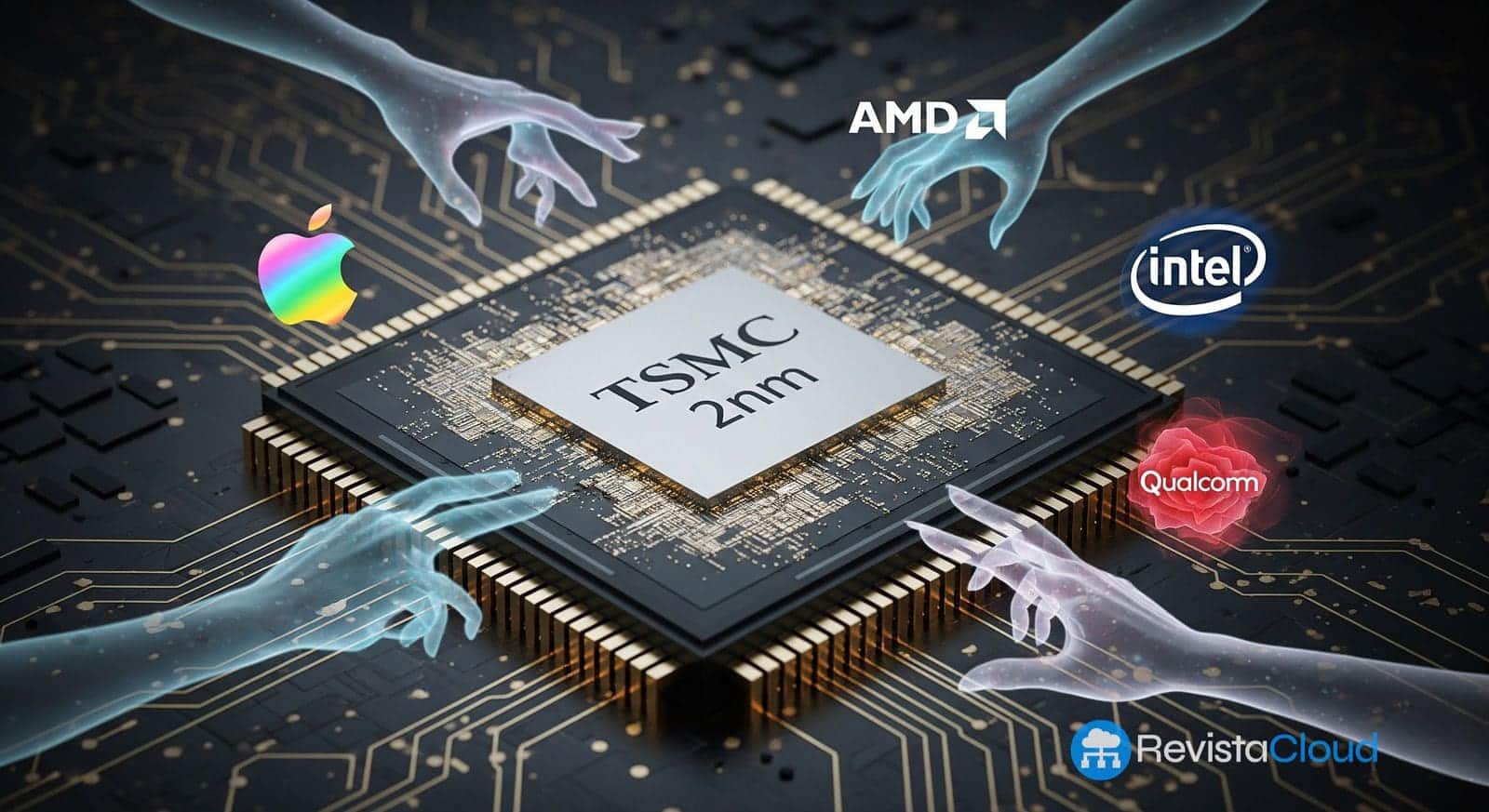
For over a decade, Apple has been the “anchor” client in the advanced semiconductor industry: its volume, predictability, and launch schedule pushed suppliers—and especially TSMC—to expand capacity at the pace demanded by the iPhone. However, that balance is now shifting. The primary driver of investment in cutting-edge manufacturing is no longer smartphones but Artificial Intelligence infrastructure: GPUs, accelerators, and data center systems that consume wafers, advanced packaging, and memory at scales difficult to match.
The warning sign for Cupertino isn’t that they’re about to run out of chips—this scenario remains unlikely—but rather that the era of guaranteed priority is over. As analyst Tim Culpan summarizes on his blog Culpium: Apple now competes “toe-to-toe” with AI-focused clients like NVIDIA and AMD, and this competition is felt most acutely where it hurts: in the most advanced nodes and in the bottlenecks associated with producing cutting-edge silicon.
Why AI is Changing the Game Rules
The first factor is purely physical and economic. An AI accelerator (or a large-scale training and inference GPU) typically takes up much more wafer area than a mobile system-on-chip (SoC). Put simply: even with fewer units, chips for AI can absorb a disproportionate share of the most advanced manufacturing capacity.
Adding to this dynamic is a second element: added value. In an AI-dominated industrial cycle, the clients driving investment plans—those willing to pay premiums for priority—tend to be infrastructure providers and hyperscalers. This capital flow shifts capacity allocation and rearranges the hierarchy of foundry customers.
TSMC Confirms the “AI Moment” with Record Results
The shift is also reflected in TSMC’s financials. The company announced strong growth driven by semiconductor demand for AI applications, posting a 35% jump in net profit for Q4 2025, reaching 505.7 billion New Taiwan Dollars (around $16.01 billion USD), according to some international media outlets.
Meanwhile, Culpan notes that the growth of the high-performance computing segment (which includes AI chips) clearly outpaces that of smartphones. He reports that this segment’s revenue grew 48% last year compared to 58% the year before, whereas revenues tied to smartphones increased just 11%, below the 23% rise the previous year.
Table: Divergence Between “HPC/AI” and Smartphones at TSMC
| TSMC Segment | Most Recent Year-over-Year Growth | Previous Year-over-Year Growth | Market Interpretation |
|---|---|---|---|
| High-Performance Computing (including AI) | +48% | +58% | Structural demand, focus on data centers |
| Smartphones | +11% | +23% | Mature market, flatter cycles |
The Most Disconcerting Sign: Apple Is Losing Its Gravitational Center
In this context, industry messages are clear: Apple remains huge, but no longer sets the pace alone. Business Insider describes this as a loss of “grip” on the tech supply chain: negotiation power is shifting toward AI giants and hyperscalers, capable of locking in capacity commitments, prepay supplies, and sustain multi-billion-dollar infrastructure investments.
Culpan goes further, suggesting that NVIDIA may have surpassed Apple as TSMC’s largest revenue customer in one or two quarters of 2025, though he notes that the final ranking will be confirmed when TSMC releases its annual report detailing major clients.
This potential shift is significant because, when capacity is tight, priority is often secured through a combination of margin, growth, and long-term commitments. And in this regard, the economics of AI have an advantage.
What Does This Mean for the iPhone (and Apple’s Margins)?
The immediate takeaway isn’t a unit shortage but rather cost pressure. If advanced capacity becomes more expensive—due to increased demand willing to pay—Apple might face more costly silicon in future generations, just as cutting-edge nodes drive up wafer costs and manufacturing complexity.
From a business perspective, this scenario offers several options, all nuanced: absorb the margin impact, pass some costs onto the final price, or redesign calendars and configurations to optimize the use of the most advanced node. None of these decisions are made in isolation; they intersect with product strategy, the iPhone’s annual schedule, and competitive pressures in a market that’s no longer growing as fast as a decade ago.
Nevertheless, the core message remains: Apple is likely to continue manufacturing what’s needed to meet its roadmap, but it will no longer operate from an unquestioned privileged position. In a world where AI has become the major chip consumer, the supply chain prioritizes where explosive growth is visible.
Frequently Asked Questions
Why do AI chips “take away” capacity from iPhone chips if they’re produced on similar nodes?
Because many AI accelerators and GPUs occupy more wafer area per unit and also require critical resources (advanced capacity, packaging, validation) that compete with other major launches.
Does Apple risk not being able to launch iPhones due to chip shortages?
Currently, analyses point more toward price and priority pressures rather than outright shortages. Apple remains a huge customer, but it now competes against a rapidly growing demand block from AI.
Which segment is driving TSMC’s growth—smartphones or data centers?
The trend, both analysts and business evolution indicate, favors high-performance computing, driven by AI, over the more mature smartphone market.
How could this impact device prices in Europe?
If the cost of advanced silicon continues to rise, it could lead to narrower margins or higher prices on premium devices, depending on commercial strategies and exchange rates during each cycle.
