
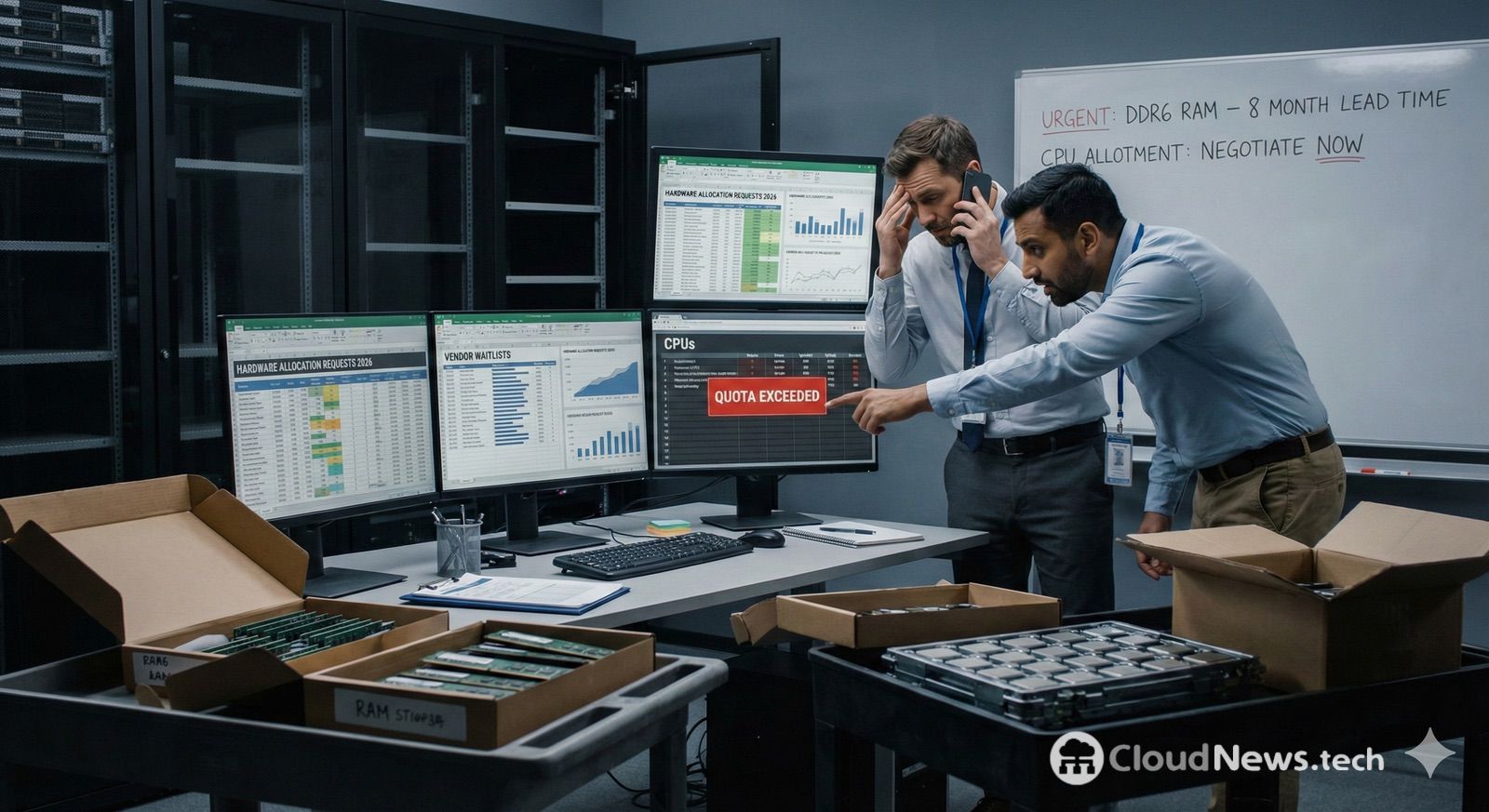
In IT departments and procurement desks at many companies, an uncomfortable feeling is taking hold: the component market is no longer behaving like a catalog with relatively stable prices and reasonable lead times. By 2026, every server budget, RAM upgrade, and infrastructure renewal is starting to resemble more of a debate over quotas than a straightforward vendor comparison.
The root of the problem isn’t a single bottleneck, but an entire chain that has been tightened simultaneously. Demand driven by Artificial Intelligence is reshaping industrial and commercial priorities, and this realignment is already evident in the actual computing economy: increases in memory and storage, shortages (or allocations) of server processors, and delivery times stretching to the point where they are incompatible with traditional planning. TrendForce, for example, projects a highly aggressive rise in contractual prices for the first quarter of 2026: a +55–60% quarterly increase in “conventional” DRAM, and a +33–38% in NAND Flash; for servers, their own analysis suggests increases exceeding 60% for DRAM and more than 40% for client SSDs.
It’s not “lack of demand”—it’s lack of time (and capacity)
For years, the industry got used to cycles: excess supply, price drops, recovery, and starting over. Today’s picture looks less like a classic cycle and more like a structural reallocation. Memory manufacturers are prioritizing high-margin products linked to data centers and, especially, HBM (high-bandwidth memory), because that’s where the money and growth are. Even on the supply side, it’s acknowledged that this tension could last a long time: Micron has warned in its earnings reports that tight conditions in DRAM and NAND could “persist through and beyond 2026.”
When memory prices rise, everything else gets affected. A server isn’t just a CPU: it’s a combination of RAM, SSDs, controllers, boards, modules, power supplies, networks, and increasingly, parts conditioned by material availability and advanced manufacturing. Meanwhile, the consumer GPU market has also begun articulating the same symptom (“memory supply is constrained”), indicating that this stress isn’t limited to one type of chip but is affecting the memory industry as a whole.
CPUs: the scarce good shaping the timeline
Adding to memory pressure is a factor that completely disrupts logistics: the availability of server CPUs. Intel has already been explaining that it faces capacity and substrate constraints, and that it will prioritize data center CPUs over consumer products, with possible price adjustments in a “tight capacity” environment expected to extend into 2026.
While Intel recalibrates production and mix, the market is filled with reports indicating that CPU capacity for 2026 is “almost exhausted” in the server segment, with the inevitable consequence of rising prices if demand remains high. Practically, this results in a growing phenomenon in the channel: budgets that don’t last, delivery windows shifting weekly, and projects moving from “we order this month and it arrives in six weeks” to “no guaranteed delivery date.”
Even supply chain analysts have started to describe how “server lead times continue to stretch” as supply remains tight. This aligns with many companies’ own experiences: suddenly, some integrators prefer not to commit, and suppliers outright respond with “no stock” or “we can’t provide accurate estimates.”
The real problem: infrastructure is becoming “financiarized”
This is where the most concerning shift emerges for CIOs and financial managers: when hardware stops being abundant and predictable, computing begins to behave like an asset to be reserved. That is, it gets “locked in” before it’s needed. What in public cloud is understood as consumption commitments or capacity reservations, is increasingly extending to dedicated servers and private cloud: those arriving late pay more, wait longer, or simply get shut out.
This has serious implications. In an environment of rising memory costs and CPU shortages, the total cost of ownership can increase without any actual expansion— just by market friction. The typical annual plan—to renew a percentage of hardware, expand RAM when needed, buy servers for a new service—becomes fragile. Technology, which has always been a lever to accelerate, now becomes a bottleneck requiring anticipation.
What can a company do when the market is like this
In this context, the advice is no longer just “compare vendors,” but to change procurement and capacity strategies:
- Preempt purchases or contracts to reserve capacity
If the project is real and growth is expected, delaying the decision usually becomes more expensive. In tense markets, capacity reservations (in private or dedicated cloud) act as insurance: locking in price, lead time, and availability. - Shift from one-off purchases to framework agreements
Negotiating batch orders, delivery windows, and expansion options— even if not all are executed— reduces the risk of missing critical parts (RAM/SSD/CPU) when needed most. - Design with alternatives from the start
Not everything requires the “latest socket.” For projects that allow it, accepting previous generations, extending life cycles, or introducing diversity (different equivalent models) can unlock schedules. - Optimize before expanding
Rising costs don’t mean everything should be bought more: consolidation, adjusting oversizing, cleaning underutilized environments, and serious FinOps practices can free up internal capacity when the market fails to deliver. - Capitalize on the refurbished market judiciously
For certain roles (firewalls, backup nodes, labs, secondary environments), quality refurbished equipment can serve as a bridge. It’s not a universal solution, but it acts as a buffer.
The underlying message is uncomfortable but clear: the risk isn’t just paying more—it’s being unable to execute. In a world where infrastructure underpins the business—AI included—not having capacity isn’t a technical delay; it’s a loss of competitiveness.
Frequently Asked Questions
Why are RAM and SSD prices expected to rise so much in 2026?
Because the industry is prioritizing memory and storage for data centers and AI workloads (including HBM), which reduces the supply for other segments and drives up contractual prices.
How does CPU scarcity from AMD and Intel impact dedicated servers?
When manufacturers prioritize certain clients or lines, the channel suffers from allocations, reduced availability, and longer lead times. This ultimately translates into budgets that expire quickly and less predictable deliveries.
What does “reserving computing” in a private cloud mean?
It involves contracting capacity (CPU/RAM/storage) in advance to guarantee future availability, usually with agreed conditions for expansion and lead times, avoiding reliance on current stock levels.
If a supplier says “no stock,” what realistic alternatives are there?
Exploring equivalent configurations, older generations, phased agreements (partial delivery plus later expansion), or temporarily using private/dedicated cloud services until the supply chain normalizes.
