
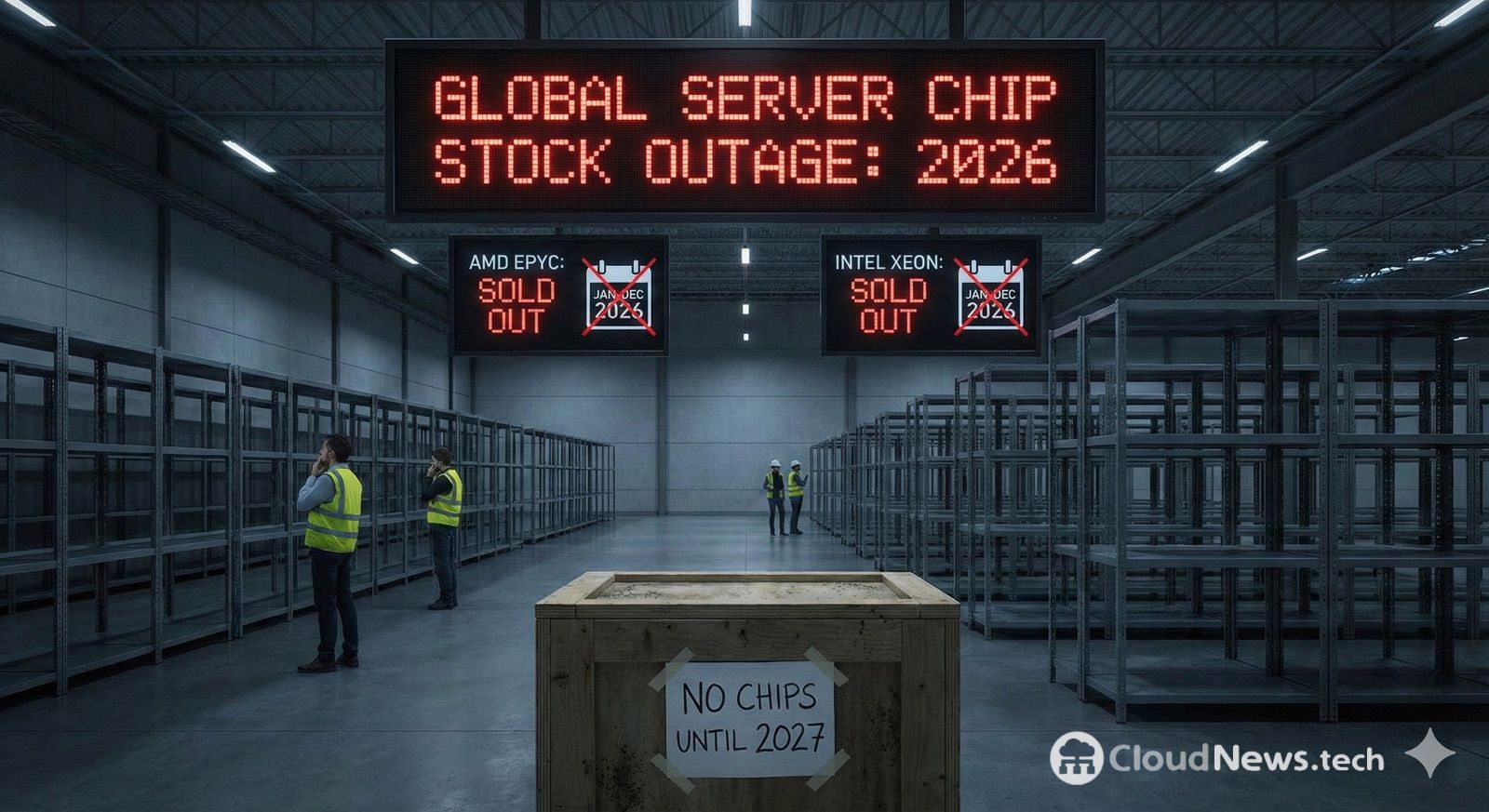
The server market kicks off 2026 with a symptom that often signals upcoming cycle changes: the capacity of “general purpose” CPUs is becoming a scarce resource, just as many companies thought that the main bottleneck in the AI era was solely the GPU.
According to supply chain checks and analyst notes cited by various media outlets, a large portion of the server CPU volume expected for 2026 is already committed, especially driven by demand from major cloud platforms (the so-called hyperscalers). In this scenario, AMD and Intel are considering implementing price increases in the range of 10% to 15% starting in the first quarter of 2026, more as an adjustment mechanism related to availability than as a simple commercial strategy.
A “boom” in traditional servers… driven by AI
The public narrative has revolved for months around accelerators, interconnections, and advanced packaging. But beneath the surface, demand for traditional servers has also reactivated strongly for three recurring reasons in industry estimates:
- Lifecycle refresh toward the latest server CPU generations (marketly on the radar are EPYC “Turin” and Xeon “Granite Rapids,” among other current platforms).
- Growth in AI inference, which doesn’t always require high-end GPUs but does need massive deployments of CPUs, memory, and storage to serve models, data, and microservices.
- “Catch-up” investment: some spending that was deferred when Capex focused heavily on AI is now returning to general-purpose infrastructure.
The result is a market where customers purchasing in volume and planning ahead —cloud providers— secure supply, while those buying later —many traditional businesses— face longer timelines, higher prices, and less favorable alternatives.
From competing on performance to competing on availability
When a manufacturer’s future production is heavily committed, price stops being just “discounts for market share” and instead functions as a rationing tool. This is the logic several analyses are highlighting: if demand exceeds supply and major clients have already reserved a significant portion of the capacity, negotiations become tougher for the rest.
From a purchasing perspective, this shifts the playing field:
- Longer lead times for new acquisitions or expansions.
- Less flexibility to “wait for the next generation” if deployment cannot be delayed.
- Increased pressure for alternatives: hardware reuse, cloud contracts, virtualization optimization, or hybrid architectures (x86 + Arm, as appropriate).
In Spain, tech media are already translating this into practical terms: 2026 may not be an “easy” year to purchase server CPUs unless planning is finalized well in advance.
Projections fueling the debate
In the absence of public confirmations from manufacturers about specific prices, the most influential factors are shipment estimates and growth projections, which describe an accelerating market:
| Indicator (analyst estimates) | Expected magnitude |
|---|---|
| Potential CPU price increase (Q1 2026) | +10% to +15% |
| Server shipment growth in 2026 | +16% to +17% |
| Cloud shipment growth in 2026 | ~+25% |
| Enterprise segment in 2026 | flat or slight decline |
| Estimated Q4 2025 server shipments (QoQ) | revised upward to +6% |
| Estimated Q1 2026 server shipments (QoQ) | ~+2% |
These figures are based on analyst notes and third-party summaries, and should be read as projections, not as official guidance from AMD or Intel.
What does this mean for companies and partners in 2026?
For financial media, the key isn’t just “if prices go up,” but who holds negotiation power and how margins are redistributed:
- Winner: manufacturers with committed capacity, integrators with guaranteed quotas, and cloud providers passing costs via tariffs/contract terms.
- Losers: companies that purchase “just in time,” projects with rigid upgrade windows, and those relying on highly specific configurations (approvals, certifications, standardized racks).
- Collateral opportunity: secondary and refurbished markets (with risks around warranties, energy efficiency, and support), plus consolidation strategies (virtualization, containers, rightsizing).
At the same time, this shift reinforces an uncomfortable idea: “non-AI” infrastructure will also become more expensive due to AI, as it competes for industrial capacity, budgets, and planning.
Frequently Asked Questions
Why is server CPU demand rising if “everything” is GPU-based AI?
Because production AI requires significant CPU resources for orchestration, microservices, databases, networking, security, queues, caches, and less intensive inference. Not all workloads are massive training runs.
How can a company prepare for server purchases in 2026?
Finalize planning early, negotiate quotas in advance, consider consolidating loads (virtualization/containernet), and evaluate hybrid strategies (on-premises + cloud) for peak demand.
Are the 10%–15% increases certain?
No: these are ranges noted by analysts and third-party reports. It’s wise to interpret this as a risk of upward pressure on prices and lead times, not as an official announced rate.
What alternatives exist if the desired configuration is out of stock?
Expand compatibility (other SKUs within the same platform), consider earlier generations with support, opt for reserved cloud instances, or explore alternative architectures (depending on software and requirements).
via: Jukan on X
