
MSI has chosen CES 2026 to showcase an idea that is already permeating the entire PC industry: in the era of Artificial Intelligence, the “product” is not just performance, but the sum of design, experience, and a complete ecosystem that spans from laptops to routers, monitors to storage, and increasingly, energy efficiency. Under the slogan “Innovate Beyond”, the company unveiled a broad lineup of new products including laptops, mini PCs Copilot+, QD-OLED monitor, AM5 motherboards, power supplies, Wi-Fi 7 mesh, PCIe Gen5 SSDs, and a new wave of peripherals designed for ultra-fast response.
The showcase is also split between two exhibition spaces in Las Vegas, a strategic move: MSI aims to strengthen its image as a provider of advanced computing hardware, while also emphasizing a second pillar related to charging solutions for electric vehicles and sustainable energy. The message is clear: the PC is being reimagined around AI, and the energy context — including consumption, stability, and hardware protection — becomes part of the conversation.
A catalog designed for “AI PCs” and users who don’t want to choose between power and portability
In the laptop segment, MSI focuses on two audiences that often clash: professionals demanding lightweight, discreet equipment, and users requiring graphical and thermal muscle for creation or gaming. The Prestige series, refreshed, aims for that premium aesthetic: full aluminum chassis, rounded lines, and a productivity-focused design that adds an Action Touchpad and an included MSI Nano Pen, elevating portability beyond just specs. MSI emphasizes that these models have been recognized at the CES Innovation Awards, reinforcing the “thin but serious” narrative for work and content creation.
On the other end is the Raider 16 Max, MSI’s most aggressive 16-inch gaming laptop. The company highlights its Cooler Boost Trinity with Intra Flow thermal system, featuring 3 fans, 6 heat pipes, 5 exhausts, and phase-change thermal compound. The key figure: up to 300 W of combined power for CPU and GPU, targeting an audience that measures experience in sustained watts, not promises.
Blending both worlds is the Stealth 16 AI+, which plays with contradiction: a slim laptop that still offers “desktop-grade” connectivity. MSI reports its body is just 16mm thick and weighs 1.9kg, with a thermal redesign that delivers up to 20 W more power to the GPU despite its slim profile. For those moving between desk and backpack, a practical highlight is its ports: 2 USB-A, 2 Thunderbolt 4, and notably, RJ-45 even in a thin-and-light model.
Claw 8 AI+: the gaming portable grows up and debuts in “Glacier Blue”
MSI also showcased an aesthetic update of its portable gaming line at CES 2026 with the Claw 8 AI+ Glacier Blue Edition. Aimed at users who want to game “anywhere” without sacrificing a serious display experience: 8 inches, FHD+, 120Hz, and VRR. Its technical core includes an Intel Core Ultra 200V and Arc Xe2 graphics, powered by an 80 Wh battery and Hall Effect controls—a nod to durability under heavy use. Beyond the color, MSI aims to solidify the Claw as a stable platform amid increasing competition in this segment each year.
A QD-OLED monitor at 360Hz that claims to “take care of itself”
In displays, MSI revealed the MPG 341CQR QD-OLED X36, an ultrawide 34-inch monitor with UWQHD (3,440 x 1,440) resolution in 21:9 format and a 360Hz refresh rate. The standout feature is the new 5th-generation QD-OLED panel and a RGB Stripe subpixel layout, reducing color fringing. MSI emphasizes the integrated AI Care Sensor within OLED Care 3.0, which uses an NPU-based algorithm to detect user presence in real time and optimize power management to extend the panel’s lifespan. In a market still concerned with burn-in and OLED health, MSI aims to incorporate preventive maintenance into the product itself.
Cubi NUC AI+ 3MG: a 0.51-liter Copilot+ PC with dual 2.5G network support
For compact desktops, MSI introduced the Cubi NUC AI+ 3MG, a Copilot+ PC housed in just 0.51 liters. It supports Intel Core Ultra 9 Series 3 processors and offers outputs for up to four displays via dual Thunderbolt 4. Two features appeal to professional users: dual 2.5G LAN ports (focused on connectivity and security) and a power button with fingerprint reader. MSI adds further versatility with a tool-free design for easier maintenance and the use of PCR (post-consumer recycled) materials, reflecting its commitment to sustainability.
AM5 “MAX” motherboards, GPU-protecting power supplies, and a PCIe Gen5 SSD at 14,000 MB/s
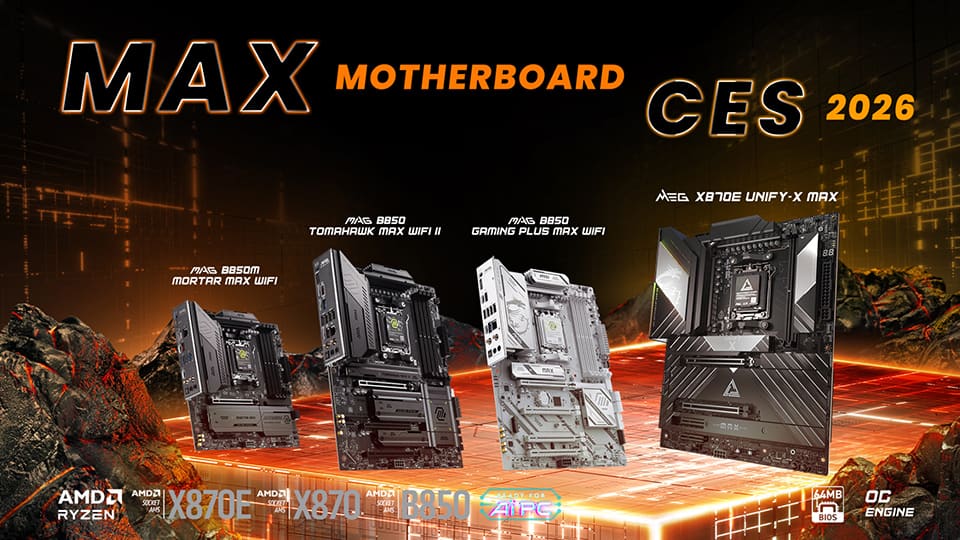
In components, MSI unveiled its new AM5 “MAX” motherboards based on chipsets AMD X870(E) and B850, designed for easy overclocking and hassle-free assembly. They feature an OC Engine, a 64MB BIOS ROM, and EZ DIY improvements, claiming up to a 15% overclocking gain in “elite” setups—claims backed by MSI’s own testing configurations.
On the power supply front, MSI introduces new models with GPU Safeguard+, a technology geared toward “most demanding graphics,” including the MPG Ai1600TS PCIE5 and MAG A1200PLS PCIE5. Notable enhancements include improved +12V rail stability and cooling via 135mm FDB fan in the Platinum version.
MSI’s storage lineup features the MSI SPATIUM M571 DLP SSD, their flagship PCIe Gen5 SSD offering speeds of up to 14,000 / 11,000 MB/s. MSI highlights two key aspects beyond raw speed: a 6nm (TSMC) controller that reduces power consumption by up to 50%, and Data Loss Protection (DLP) to safeguard data during unexpected power failures.
Wi-Fi 7 and “8K-ready” peripherals: when the bottleneck shifts from the PC to the ecosystem
MSI also addressed a rarely discussed but crucial aspect: home networking. The company announced the Roamii BE Pro mesh system, featuring Wi-Fi 7, tri-band connectivity, adaptive roaming, and integrated FortiSecu protection—plus a triangular design with RGB lighting to blend seamlessly into living rooms or gaming setups.
For competitive gamers, MSI introduced “8K-ready” peripherals, including the Versa 300 8K Wireless and Versa 500 8K Wireless mice, emphasizing precision and responsiveness, with a magnet-based Hall-effect scroll wheel offering dual modes on the Versa 500. The keyboard lineup features the Strike 700 HE 8K Wireless, equipped with Hall-effect switches, along with the Maestro 500 wireless headset and the GK600 series.
Two pavilions, one strategy: AI in the PC… and energy as a second major focus
CES 2026 runs from January 6 to 9 in Las Vegas, and MSI clearly outlined its dual approach: at Venetian Expo (Veronese 2.403–2.406), it will showcase laptops and computing hardware; at LVCC West Hall (#5067), the focus will be on charging solutions for electric vehicles and sustainable energy. It’s a sign of the times: AI hardware pushes power consumption and thermal demands, and brands that offer high performance increasingly emphasize protection, stability, and efficiency as integral to the overall experience.
FAQs
What does it mean that MSI presents “Copilot+ PC” in a mini PC like the Cubi NUC AI+ 3MG?
MSI is targeting this device for AI-enabled Windows ecosystem experiences in a ultracompact format (0.51 liters), ideal for office use, creators, or advanced home setups.
Is it worthwhile to get a PCIe Gen5 SSD like the MSI SPATIUM M571 DLP for video editing and AI workflows?
For projects involving very large files (video, textures, datasets), a Gen5 drive with speeds up to 14,000 / 11,000 MB/s can reduce load and transfer times; actual benefits depend on the rest of the system and workload specifics.
What does a 34-inch 360Hz QD-OLED monitor like the MPG 341CQR QD-OLED X36 offer?
Combines an ultrawide UWQHD format with high refresh rates for competitive gaming, along with a QD-OLED panel optimized for image quality. MSI incorporates OLED care features with presence detection to manage power and extend panel lifespan.
Practically, what are the benefits of deploying a Wi-Fi 7 mesh network like the Roamii BE Pro at home?
It improves coverage and stability throughout the residence, especially in multi-story homes or many rooms, and helps reduce drops and congestion when gaming, streaming, and multiple devices are active simultaneously.
via: msi
