
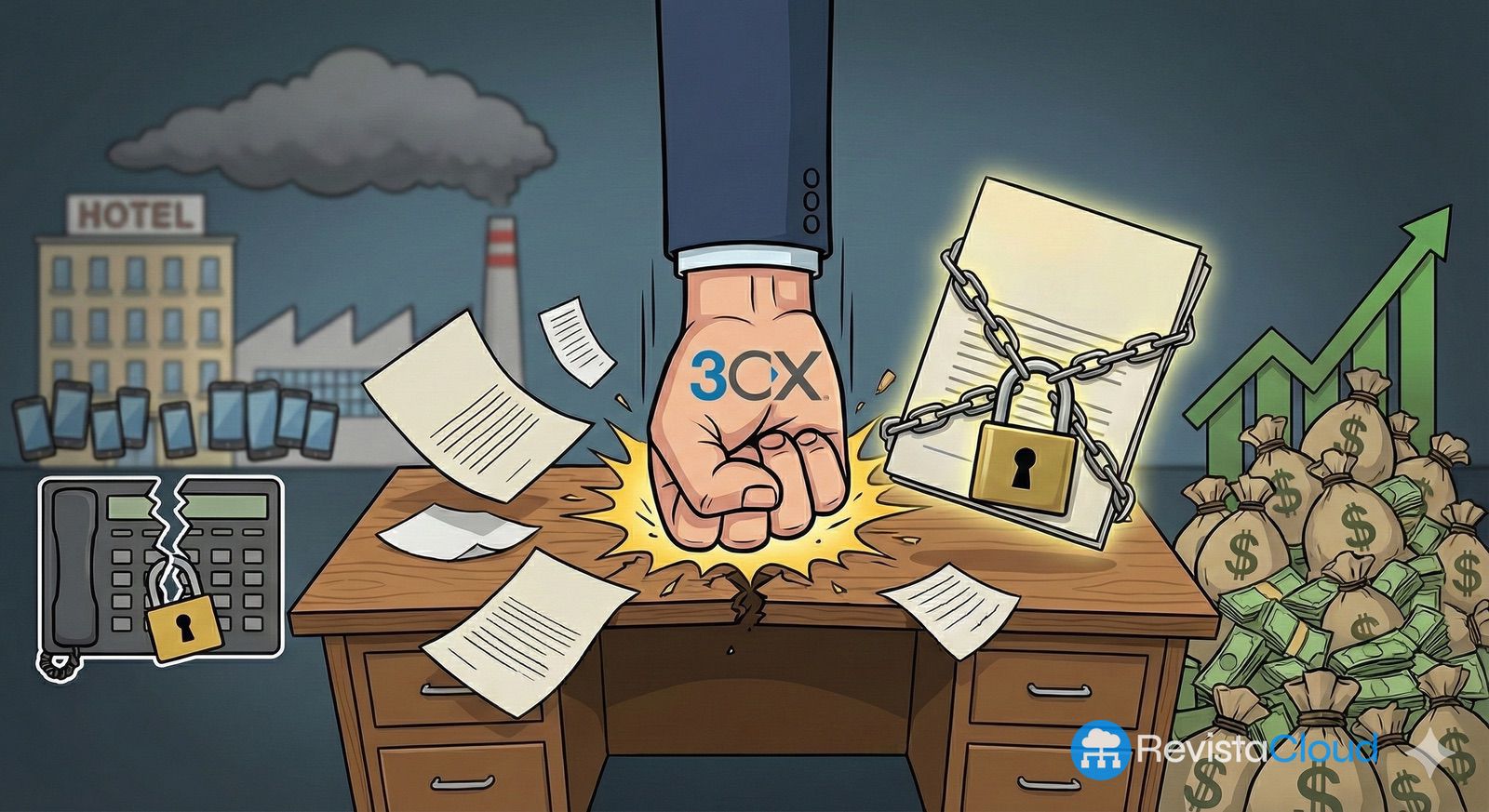
For years, 3CX has carved out a significant space in hotels, educational centers, factories, and organizations with many extensions but low actual call traffic — based on a simple idea: pay for concurrent calls (CC) and not for number of extensions. This approach allowed, for example, a hotel with hundreds of rooms (and therefore hundreds of extensions) to pay a relatively modest license fee if, in practice, it only needed a few concurrent calls.
Now, that balance is shifting. 3CX has confirmed it will implement a maximum limit on extensions per concurrent call license, with ranges of between 5 and 8 extensions per CC, phased in progressively with a deadline set for April 2026.
Spanish VoIP-focused blog Sinologic has highlighted the “from the trenches” impact for administrators: large deployments designed for low concurrency are shifting from being ideal use cases to profiles most penalized by the new policy.
What exactly has changed (and why does it matter)
3CX maintains that it has always published recommended extension ranges, historically around 3–4× the number of simultaneous calls. The key difference now is that these ranges are becoming maximum limits explicitly formalized within a “fair use” policy, with the argument that only about 15% of customers would be affected and that widespread price increases would be avoided.
Additionally, 3CX clarifies an important detail: system mailboxes do not count toward the total, and the company acknowledges that many setups have inflated extension counts for auxiliary uses (like voicemail boxes for queues) due to historical configuration limitations. Alongside the tightening, the company promises improvements to reduce “fictitious extensions” and streamline administration (e.g., more flexible queue voicemail, better integration with Microsoft 365).
Timeline: when will it impact you
Although the announcement and the table are already published, 3CX emphasizes that the reference to limits is informational until a minimum date, but signs are increasing to prompt adaptation:
- From Update 8 (V20): the system displays informational warnings if limits are exceeded to help identify and remove unused users/extensions.
- From January 1, 2026: during renewal processes, if the system exceeds limits, a warning will appear indicating that at some point in 2026, users will need to upgrade the license or reduce extensions.
- From at least April 1, 2026: 3CX lays the groundwork for the enforcement, with grace periods to make adjustments, and a particular concern for IT departments: unsupported systems could lose technical support.
Indicative table: maximum concurrent calls, extensions, and price
3CX published a table of “maximum extensions per license” (updated on October 30, 2025) with prices in euros and a comparison example against per-user alternatives. Some representative tiers (excluding taxes/VAT, subject to change):
| License (CC) | Max extensions | Price (€/year, excl. VAT) |
|---|---|---|
| 8 | 40 | €350 |
| 16 | 80 | €750 |
| 32 | 176 | €1,395 |
| 64 | 384 | €2,895 |
| 96 | 576 | €4,495 |
| 128 | 768 | €5,995 |
A practical impact can be understood with a common example: an installation with 400 extensions that previously could run on a 8 CC license (if actual concurrency was low) now, according to the table, would need to jump to the 96 CC tier (max 576), thus increasing the annual cost from €350 to about €4,495 (excluding VAT). This is precisely the type of scenario Sinologic highlights as most affected in Spain: many extensions, low concurrency, and a historical incentive to choose 3CX for its flexible model.
3CX’s perspective: “fair usage” to prevent price hikes across the board
The company frames this change within an updated Fair Usage Policy as of October 2025, which establishes usage limits including, among other things, a maximum number of extensions per license type.
In public statements, 3CX suggests that some issues stem from administrative practices (such as extensions created automatically in bulk syncs with M365, or used as mailboxes) and promises technical adjustments to reduce “unnecessary extensions”.
Market perspective: a shift that reopens the “pay-per-user” comparison
Practically, the change introduces a rigid cap that brings the final cost closer to the “pay-per-user/extension” model in many environments, even though the metric remains called CC.
This has led community discussions and forums to focus less on the “fair use” theory and more on two specific frictions:
- Disrupted planning for low-concurrency deployments: hotels, hospitals, schools, or administrations with many endpoints where the actual call ratio does not grow proportionally with extension count.
- Operational risk regarding support: the possibility of losing support if limits are exceeded and not corrected, creating pressure for integrators to either migrate or modify the license.
What IT and integrators should do now
With April 1, 2026 approaching, a pragmatic operational recommendation is clear:
- Audit actual versus necessary extensions: identify “dormant users”, inherited extensions, or extensions used as quick fixes like voicemails, etc. (the warnings in Update 8 are meant for this).
- Separate “extension” from “mailbox/queue” when possible: leverage improvements announced by 3CX to avoid “consuming” extensions with auxiliary functions.
- Review renewal plans for 2026: if the system exceeds maximums, the renewal warning from January 2026 onward already addresses this.
- Plan scenarios: clean up/increase the license or consider alternatives, especially in large setups where the cost jump could be significant.
In summary, 3CX is trying to protect its pricing structure by limiting “extreme case” scenarios — especially those benefiting most from its flexible model. But in doing so, it also touches on one of the key reasons it became a dominant choice: the elasticity of extensions in low-concurrency scenarios. The coming months will be critical to see if the market perceives this as a normalization… or as a turning point towards migration.
Source: sinologic.net and 3cx
