
At CES 2026, marked by the fever of Artificial Intelligence in PC and increasingly demanding components — in power, temperature, and complexity — MSI revealed a showcase that goes beyond the typical parade of loose parts. The Taiwanese company speaks of a “PC building ecosystem”: a coherent set of motherboards, power supplies, cases, cooling solutions, and mounting tools designed to make assembling, upgrading, and customizing a system easier, safer, and, naturally, more spectacular.
This idea is no accident. The market faces a paradox: never before has it been so easy to buy components online, and never before has it been so easy to make a mistake on a detail that ruins the experience. Users investing in high-end graphics cards encounter connectors and power demands that require precision. Enthusiasts pushing their CPUs face BIOSes growing more complex and memory speeds accelerating as if in a competition. Content creators, meanwhile, demand stability, silence, and aesthetics because their PC is also a “studio” for work and streaming. MSI aims to address these combined needs with a strategy that blends performance, EZ DIY (simplified mounting), and active hardware protection.
AM5 “MAX” Motherboards: Direct Overclocking and a BIOS That Looks Ahead
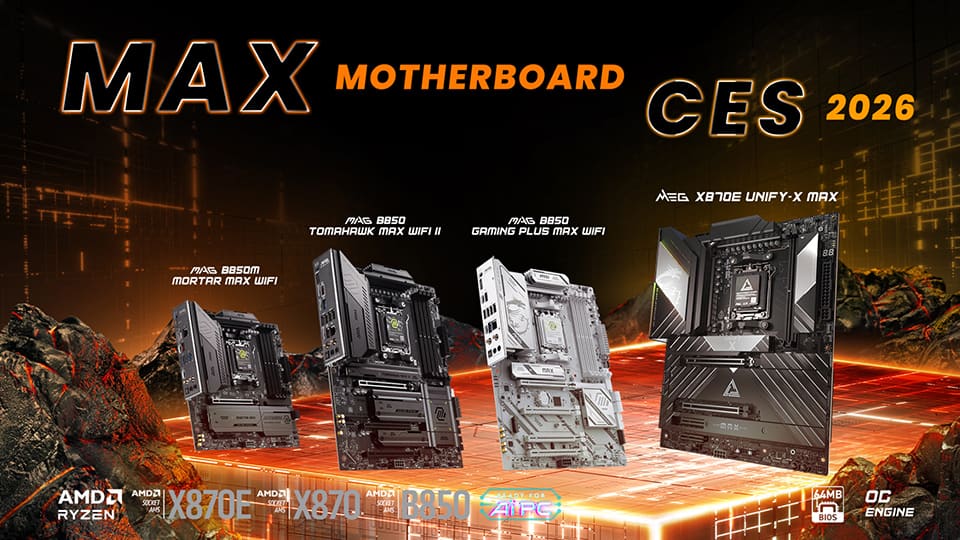
The core of the proposal centers on the new AMD X870(E) and B850 MAX motherboards, designed — according to MSI — to cover everything from high-performance setups to value-focused builds. The common factor is an OC Engine that enables asynchronous BCLK control for more precise frequency adjustments, promising up to 15% more gaming performance “in compatible scenarios.” Additional tools are included to ease tuning: a Direct OC Jumper allows real-time BCLK adjustments from the OS, and a BCLK Booster offers a “one-click” approach for those who don’t want to delve into menus.
An understated but long-term-oriented detail: the MAX boards include a 64 MB BIOS chip, increasing ROM capacity to support a more complete firmware experience and compatibility with current and future processors within the AM5 ecosystem.
MEG X870E UNIFY-X MAX: a nod to “Record” Overclocking
MSI positions the MEG X870E UNIFY-X MAX as a high-end model tailored for extreme overclocking. It combines the OC Engine with a 2-DIMM layout designed to maximize CPU and DDR5 memory performance. MSI complements this with a beefed-up thermal solution — including direct contact heat pipes and M.2 shields — and a physical control element, the Tuning Controller, for quick actions like clearing CMOS, safe mode entry, or restoring saved settings without navigating menus.
MAG B850 MAX: Wi-Fi 7, 5G LAN, and Tool-Free Assembly
Within the B850 segment, MSI highlights three models: MAG B850 TOMAHAWK MAX WIFI II, MAG B850M MORTAR MAX WIFI (micro-ATX), and the new MAG B850 GAMING PLUS MAX WIFI in white finish. The focus here isn’t just overclocking; it emphasizes smooth assembly: EZ PCIe Release for easy GPU removal with a click, EZ M.2 systems for tool-less SSD installation, and an EZ Antenna that eliminates the “screw in and pray” Wi-Fi antenna hassle. In connectivity, MSI boasts Wi-Fi 7 and 5G LAN support to cater to the increasingly hybrid demands of gaming, streaming, and work.
Memory Breakthrough: 128 GB CUDIMM 4-Rank Modules and Over 10,000 MT/s in Tests
Beyond AMD, MSI reserved a technical headline for Intel platforms: the company claims to have achieved the first motherboard capable of supporting 128 GB CUDIMM 4-Rank modules, allowing for 256 GB in a 2-DIMM configuration. Validation includes burn-in tests exceeding 10,000 MT/s in single-Rank setups, a figure directly addressing the often conflicting goals of capacity and speed.
MSI reports that at CES, a prototype setup demonstrated 256 GB 4-Rank modules with an overclocking performance increase of “over 63%,” using a prototype motherboard with an Intel chipset. If these advances transition into commercial products and become widely available, they could open exciting possibilities for compact workstations demanding lots of RAM without moving to HEDT platforms or multiple-slot formats.
GPU Safeguard+: When the Power Supply Becomes a “Warning System”
The most “timely” aspect of the announcement involves power supplies and a focus on safety. MSI introduced GPU Safeguard+, a technology designed to monitor in real-time the delivery of power through the 12V-2×6 connector. If it detects anomalous current fluctuations, the user receives immediate alerts via MSI Center (pop-up notifications) and an integrated audible alarm.
The context is important: in recent years, the PC ecosystem has been rife with discussions about overheating incidents and connector issues in high-power configurations, especially in the premium segment. MSI aims to position itself as a preventative solution: not just “more watts,” but more control to prevent costly or hard-to-diagnose hardware damage.
MPG Ai1600TS / Ai1300TS and MAG A1200PLS / A1000PLS: Efficiency, Silence, and Alerts
In the enthusiast lineup, MSI highlights the MPG Ai1600TS PCIE5 and MPG Ai1300TS PCIE5 power supplies, both with Titanium efficiency, dual native 12V-2×6 connectors, SiC MOSFETs, and a noise-optimized profile. For the MAG series, the A1200PLS and A1000PLS focus on Platinum certification, 135 mm FDB fans, and alert schemes that also cover fan failure (Fan Safeguard), reinforcing the message of active protection and preventive maintenance.
An Exhibition-Ready Case and Curved 6.67” OLED Liquid Cooler: PC as Showcase… and Interface
MSI also presented at CES 2026 a clear vision: high-end PCs no longer hide under the desk. The MEG MAESTRO 900R is a panoramic case with triple glass, designed to showcase hardware from multiple angles and support demanding configurations: custom liquid cooling, high-density mounts, and even dual GPU setups. Its rotating motherboard tray aims to simplify work outside the case, reducing friction during complex builds.
In liquid cooling, the star is the MEG CORELIQUID E15 360, featuring a curved 6.67-inch OLED display and a 110° curvature. MSI envisions the display as an information and aesthetic hub — with visual effects and telemetry — while internally, performance is enhanced with a 31 mm radiator and fan design aimed at turbulence reduction. Installation is made straightforward with the EZ Conn connector, consolidating fan, ARGB, and USB signals into a cleaner cable setup.
Premium Air Cooling with a Screen: COREFROZR AP15 and AP17, from Monitoring to “Dashboard”
For air cooling enthusiasts, MSI introduces the MPG COREFROZR AP15 and AP17, both with dual-tower designs. The AP15 features a Digi Display for real-time monitoring and is optimized for AMD X3D processors. The AP17 ups the ante with a larger, customizable 6-inch LCD, and a reinforced thermal scheme with eight 6 mm heat pipes and a nickel-plated copper base. The message is clear: even air coolers are part of the “observable” PC system, where users want to see what’s happening without complex software.
DigiME: “Hardware-Free” VTuber and Voice Assistant as a Product Expert
Amongst metal and watts, MSI reserves space for creators. DigiME is presented as a ready-to-use VTuber platform with multilingual support, Voicemod integration, avatar options, and virtual backgrounds. It allows presets or importing designs from Ready Player Me and VRoid files. An eye-catching feature is MIA, a voice assistant described as “MSI’s expert” to guide and troubleshoot in real time, and to enable voice customization. This reflects a market where digital identity and streaming have become professionalized, and where software begins to integrate into the “building ecosystem” as much as the motherboard.
Frequently Asked Questions
What does an MSI AMD X870(E) or B850 “MAX” motherboard bring compared to a standard AM5 motherboard?
MSI’s key differentiators are the OC Engine for asynchronous BCLK control, direct adjustment features like BCLK Booster, a 64 MB BIOS chip, and EZ DIY improvements that allow tool-less GPU and SSD installation.
What is GPU Safeguard+ and why is it important for power supplies with a 12V-2×6 connector?
It’s a real-time monitoring and alert system for the 12V-2×6 power connector. MSI designed it as a preventive measure against current anomalies, notifying users via MSI Center and an audible alarm to reduce hardware damage risk in high-power setups.
What’s the purpose of a liquid cooling system with a curved OLED display like the MEG CORELIQUID E15 360?
Beyond cooling, the curved OLED display acts as an informational and aesthetic panel: it shows system data and allows customization, integrating “telemetry” directly into the PC experience.
What does MSI’s support for 128 GB CUDIMM 4-Rank modules and 256 GB in 2-DIMM motherboards mean?
It aims to combine high capacity with high performance. MSI supports 128 GB modules (256 GB in 2-DIMM configs) with validations over 10,000 MT/s, potentially opening new avenues for compact workstations demanding lots of RAM.
via: msi
