
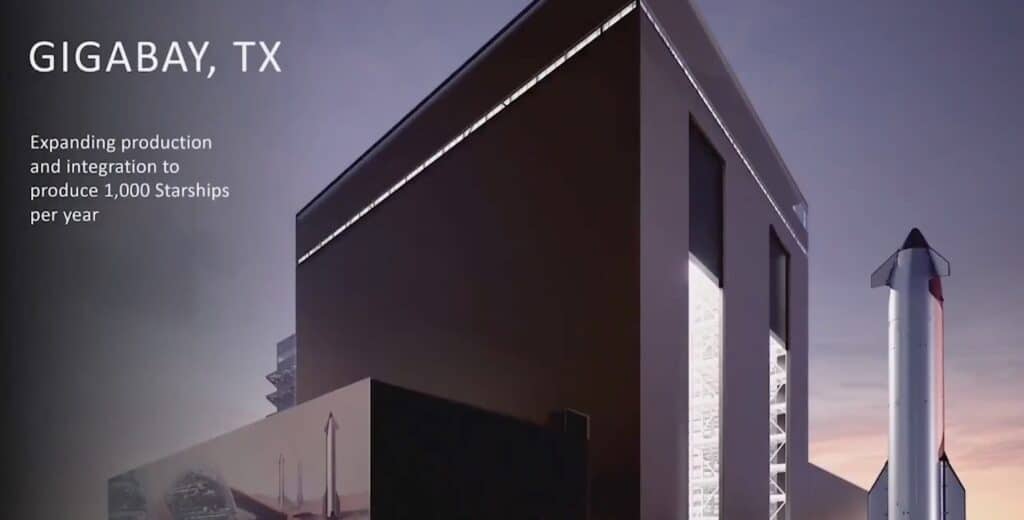
For years, the space industry has lived with a paradox: increasingly powerful and ambitious rockets, yet built with rhythms and methods closer to industrial craftsmanship than to a modern assembly line. SpaceX has been trying to break that cycle with Starship, its high-capacity launch system with full reusability. And now, it’s doing so with a word that has already become a symbol within the company: Gigabay.
The idea is as simple as it is disruptive: build manufacturing and assembly infrastructure capable of supporting a production volume typical of the aerospace industry, not the space sector. In practice, this means ships that are integrated, inspected, and prepared to fly with a cadence that, until recently, was unthinkable for a superheavy launch vehicle.
A “vertical” factory to scale Starship
At Starbase (Texas), SpaceX is constructing a facility called GigaBay that local authorities describe as a key piece for the region’s industrial growth. The city of Starbase has promoted its bid to be designated as a Texas Enterprise Zone, a incentives program that, if approved, would allow the company to seek sales and use tax refunds for five years.
According to information shared in this context, the project is associated with an estimated investment of $506 million and the creation of more than 500 jobs during the incentive period. The classification SpaceX aspires to—“triple jumbo project,” the highest—requires exceeding $250 million in investment and generating 500 new jobs.
Beyond the incentives, what matters operationally is what this represents: the Gigabay is envisioned as an integrated manufacturing plant designed for very high-volume production and assembly of the Starship system. A project description document cited by local press mentions a high-volume production facility aiming to complete construction by December 2026.
The defining figure: up to 1,000 Starships per year
The number that’s made headlines—and explains the comparison to aviation—is the capacity: Elon Musk has stated that the Gigabay will be able to produce up to 1,000 Starships annually. This goal, due to its scale, aims not just to increase launches, but to normalize processes, reduce downtime, and make reuse truly routine.
It’s important to understand the industrial logic behind this figure: it’s not just about building “more units,” but about ensuring those units are produced with repeatable standards, controlled tolerances, and optimized workflows, similar to how aircraft or large industrial structures are manufactured. For SpaceX, Starship isn’t just another rocket; it’s a system designed to fly, land, be inspected, and fly again quickly.
The “aircraft” model isn’t just about manufacturing: it’s about integration and refurbishment
The move to “aerospace-like” production also involves another key term: refurbishment. In a true reuse approach, the capability to integrate and maintain vehicles and engines is as important as welding sections or sealing fuselages.
Alongside Texas, SpaceX has detailed that it is also building a new Gigabay in Florida, as part of its expansion to operate Starship from the East Coast. According to the company, this structure will offer 815,000 square feet of workspace (an enormous scale even by industrial standards), with cranes capable of lifting 400 tons, and will be focused on integrating, maintaining, and refurbishing both Starships and Super Heavy boosters. The goal is for it to be operational by late 2026.
The strategy is clear: if SpaceX manages to have production, integration, refurbishment, and launch at two hubs (Texas and Florida), it reduces logistical friction and increases its capacity to ramp up cadence. In fact, the company plans to transport finished units from Texas to Florida via barge until Florida’s infrastructure is ready.
Why now? Cadence, costs, and geopolitical pressure
The underlying message is that the space business is shifting phases. Satellite constellations, institutional demand, and strategic pressures (defense, communications, technological autonomy) are pushing toward an environment where cadence and availability matter as much as raw performance.
In this context, “aircraft-style” production offers direct advantages:
- Industrial scale: as demand grows, responses aren’t just about better design but about manufacturing faster and with less variability.
- Sustainable reuse: reuse transitions from an exceptional event to a scheduled maintenance process.
- Reducing bottlenecks: huge facilities (like Gigabay) enable parallel work on integration, inspections, and modifications—key for increasing flight rates.
- Planning and flexibility: a “production line” allows scheduling batches, spares, and upgrades with an industrial mindset.
SpaceX has also linked this expansion to its ambition to turn Starship into the first fast and fully reusable large-scale launcher, with the goal of significantly increasing its manufacturing and flight tempo.
The big question: from “can” to “get it done”
The leap from promise to reality will be measured in two areas: timelines and operations.
- In terms of timeline, the benchmark is 2026: both the Starbase Gigabay and Florida’s are expected to be operational and complete by then.
- Operationally, the real test will be whether the system can chain flight and refurbishment cycles with minimal friction—something that has historically been a Achilles’ heel in the space industry.
What’s undeniable is the shift in paradigm: SpaceX is no longer just building rockets, but is creating the infrastructure to produce, maintain, and scale them with advanced manufacturing principles. If this effort succeeds, space will cease to be “just a mission” and start resembling more an industrial service with cadence. And in historical terms, that may be as significant as any altitude or payload record.
