
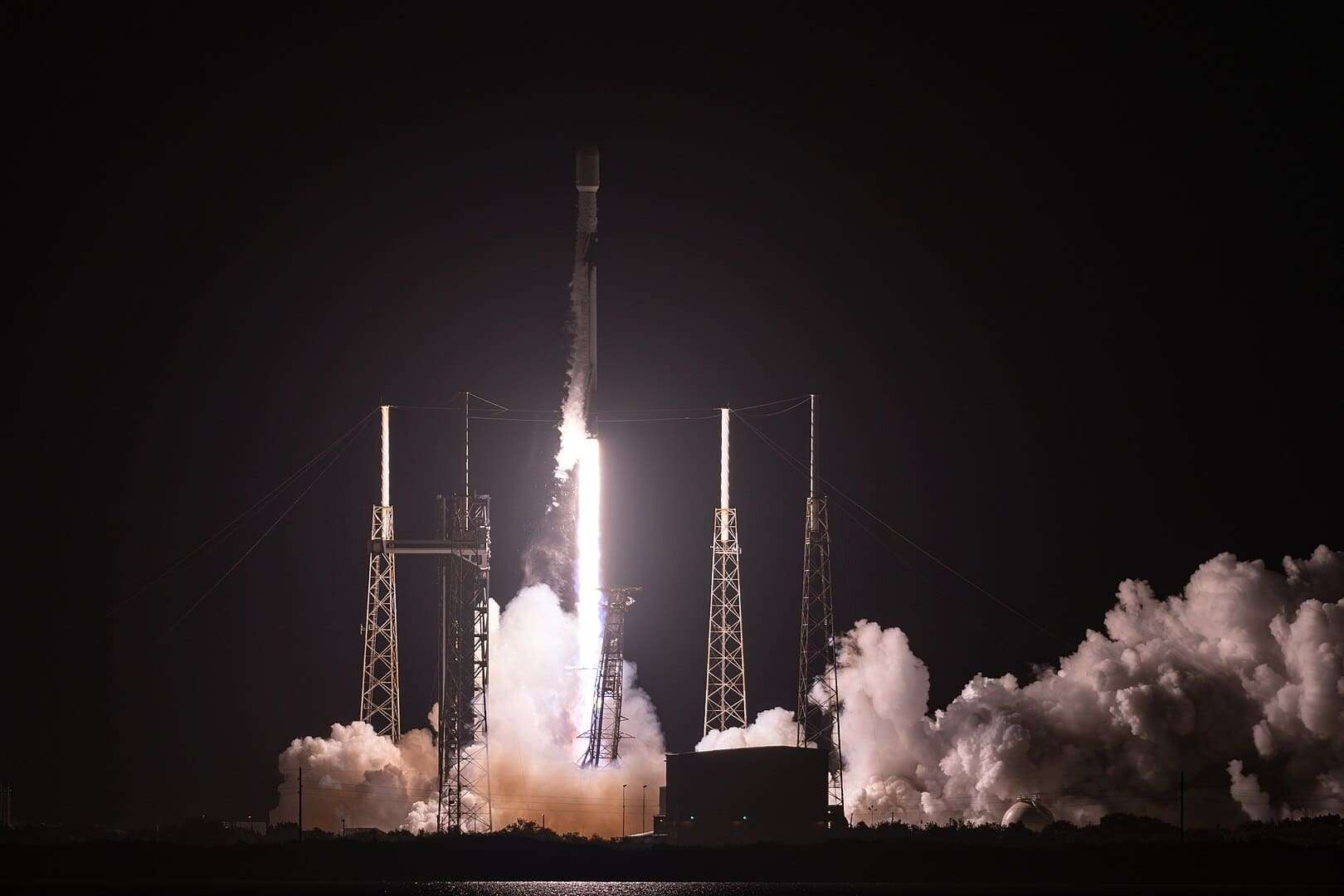
SpaceX has once again pushed the concept of space “cadence” to a level that, just a decade ago, would have sounded like science fiction. The company closed 2025 with 165 orbital launches, a figure that not only sets a new annual record for the company but also consolidates a streak of six consecutive years beating its own mark: from 25 launches in 2020 to 31 in 2021, 61 in 2022, 96 in 2023, 134 in 2024, and now, 165. In real-world terms: almost one launch every two days.
Behind this headline lies a change in scale. What was once an industry of “launch windows” and lengthy campaigns is increasingly resembling an industrial operation with regular rhythms, repeatable procedures, and a clear goal: making access to space routine, predictable, and, above all, cheaper compared to the historical standard.
A record that can’t be explained without reusability
The most revealing data point from 2025 is that all 165 orbital launches were carried out with Falcon 9, SpaceX’s workhorse. And during such an intense year, reusability was not just a slogan: the first stage successfully returned and landed 162 times, failing only in three cases due to very specific reasons.
Two of the exceptions were “by design”: especially demanding missions, such as Spainsat NG satellites on a geostationary transfer orbit, where the rocket used so much fuel during ascent that there was no margin left for recovery. The third exception was a different case: a Falcon 9 touched down on a drone barge in the Atlantic, but ended up capsizing after a fire was declared, damaging a landing leg.
In other words: the reusability system works so well that what’s now noteworthy is not that it lands, but when it doesn’t.
Starlink, the engine of the “launch factory”
If there is one word to describe SpaceX’s 2025 manifest, it’s Starlink. The satellite internet constellation was not just present; it dominated the calendar. Of the 165 orbital flights, 123 were Starlink missions, collectively deploying more than 3,000 satellites in a single year.
This volume explains why SpaceX can maintain an almost industrial cadence: when the main customer is “SpaceX itself,” planning is simpler, priorities align, and the logistics chain is optimized around a single product repeated hundreds of times. The result is a constellation that already exceeds 9,300 active satellites, with a growth rate that, on its own, is reshaping the global connectivity market, Earth observation, and even the conversation around orbital congestion.
The uncomfortable comparison: SpaceX versus entire countries
The record isn’t just internal. 2025 produced a statistic illustrating the size of the gap: SpaceX conducted almost twice as many orbital missions as China that year, and its activity accounted for roughly 85% of all U.S. orbital launches.
This imbalance has implications beyond corporate pride. For the U.S. ecosystem, SpaceX has become critical infrastructure: deploying commercial satellites, supporting national security missions, transporting cargo and crew, and maintaining a pace that other providers still cannot match. Dependence also increases with success: when a single company concentrates so much capacity, any incident—be it technical, regulatory, or industrial—becomes systemic.
More milestones in a colossal year
The annual record was accompanied by other symbolic milestones confirming the operational maturity of the model:
- SpaceX reached its 500th landing in 2025.
- It also celebrated its 500th launch of a reused rocket, a key indicator: reuse is no longer “sometimes,” but “by default.”
- It continued increasing the record for the number of launches by a single Falcon 9 booster, which now stands at 32 launches.
These numbers are shifting the sector’s narrative: hardware is no longer “throwaway” but begins to behave as an asset that amortizes with each additional flight.
And Starship? Five tests pointing to 2026
Although the headline refers to orbital flights (Falcon 9), 2025 was also a year of progress for Starship, the fully reusable vehicle with which SpaceX aims to leap to another level. The company conducted five suborbital test flights with Starship during the year. According to the published report, the first three tests resulted in at least one of the two stages being lost, while the last two, in August and October, were considered complete successes.
The message is clear: Falcon 9 is the productive present; Starship is the bet to multiply scale. If 2025 was a year of routine, 2026 promises to be the year of ambition: more tests, more iteration, and if the program matures, the start of a new cycle of capacity and cost reduction for much larger payloads.
Frequently Asked Questions
Why can SpaceX launch so much more than other companies?
Because it has industrialized the process with systematic reusability of Falcon 9, optimized logistics, and a manifest dominated by its own missions (Starlink), which reduces commercial friction and speeds planning.
What percentage of SpaceX launches in 2025 were for Starlink?
The majority: 123 out of 165 orbital flights were Starlink missions, deploying more than 3,000 satellites during the year.
What does it mean that a Falcon 9 has flown 32 times?
It means the same first stage can be reused at scale, reducing marginal costs per launch and enabling a sustained cadence. It signals system maturity and “aviation-style” maintenance.
Is Starship already replacing Falcon 9?
Not yet. In 2025, Falcon 9 set the orbital record. Starship remains in suborbital testing, although the latest missions of the year point to rapid evolution for 2026.
