
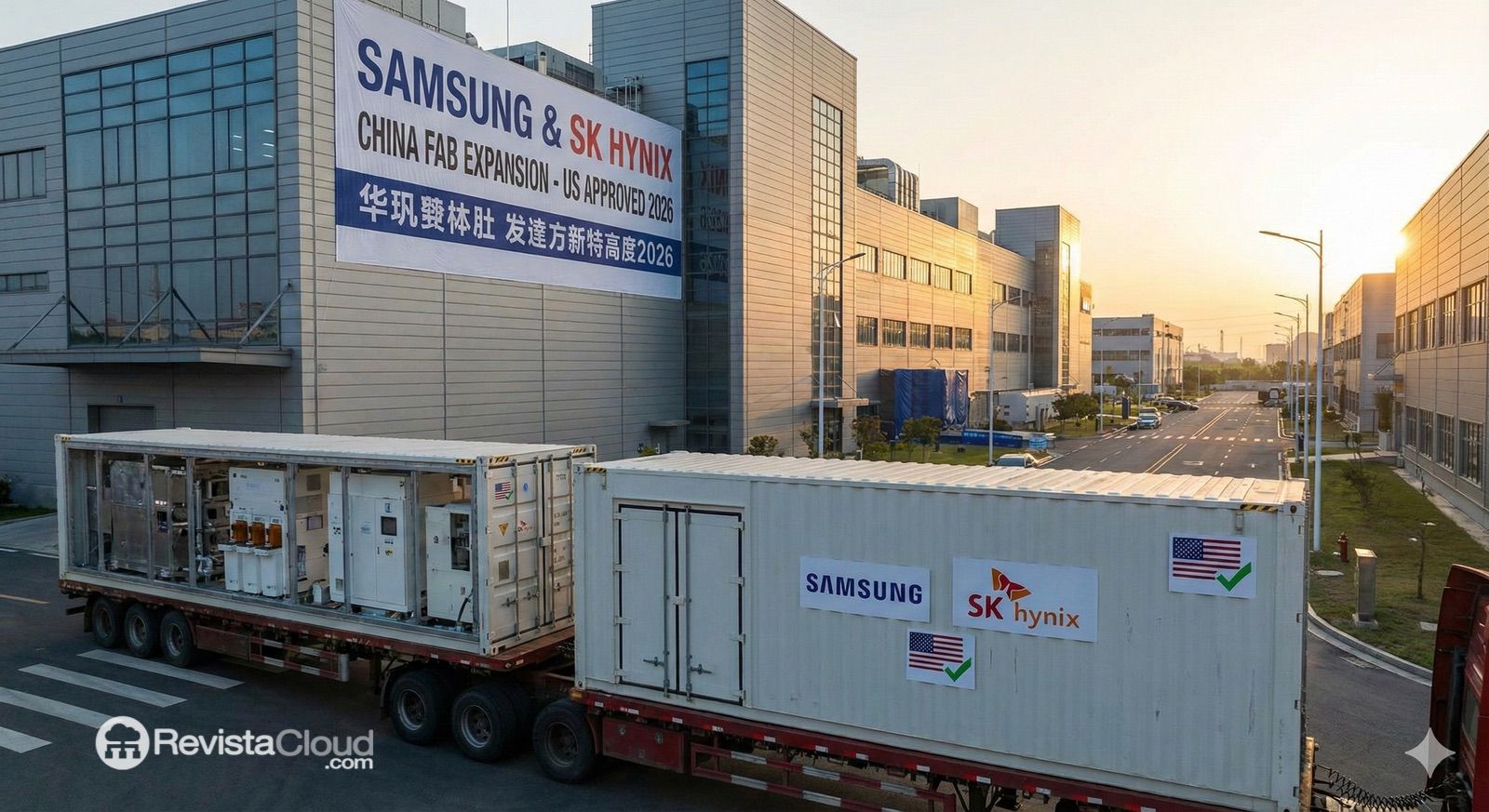
Washington has provided a temporary reprieve to Samsung Electronics and SK Hynix: both companies have received an annual license that will allow them to introduce semiconductor manufacturing equipment into their production facilities in China throughout 2026, at a time when the global memory supply chain is experiencing a new phase of tension due to demand linked to artificial intelligence.
The decision comes just as the previous framework, which had allowed several multinationals to operate with less friction in Chinese territory, has expired. According to sources familiar with the process, the United States has opted to replace the previous “waivers” with a system of annual approval for certain equipment shipments, reinforcing case-by-case control in a sector considered strategic. Under this new approach, the permit is not a “blank check”: it is a time-limited authorization that can be renewed — or not — depending on how the technological standoff between Washington and Beijing evolves.
End of “Validated End-User”: a game-changing rule shift
The key point is that the “Validated End-User” (VEU) status —which benefited Samsung, SK Hynix, and also TSMC— expires on December 31, 2025. From that date, shipments of U.S. tools to factories in China become subject to export licenses, unless authorized under the new annual system.
Practically, this introduces a pace change for major manufacturers: where there was previously a relatively stable path for operations and maintenance, now there is a scenario more conditioned by periodic reviews. For companies, the cost is not only administrative; it also impacts capacity planning, line expansion schedules, and the availability of spare parts or updates for critical tools.
Samsung and SK Hynix declined to comment, while TSMC did not respond immediately to requests, consistent with their usual approach on sensitive export control matters. The U.S. Department of Commerce also had no immediate comment outside of business hours.
Memory for AI: the backdrop pressing the industry
The move occurs against a particularly delicate backdrop for the memory market. Samsung (the global leader) and SK Hynix (the second-largest player) rely heavily on China as a production base, especially for more “traditional” memory technologies that remain essential for servers and storage systems. And although public debate often centers on GPUs and accelerators, the reality is that without sufficient DRAM and NAND — and at reasonable prices — sustainable scaling of AI data centers is unattainable.
In recent quarters, the sector has experienced price increases and forecasts of further rises, driven by a combination of AI infrastructure demand and supply adjustments. Analysis firms like TrendForce have anticipated increases in DRAM contracts and pressures on NAND, with a clear narrative: the balance between capacity and demand remains fragile, and industrial expansion cycles are not shortened by decree.
In this context, any additional restriction on the flow of tools to factories — even if temporary or partial — carries a clear risk: if the ability to expand or even maintain maximum performance lines in China is hindered, the market could become more strained, impacting costs for server manufacturers, integrators, and ultimately companies deploying AI at scale.
Industrial geopolitics: control without disrupting the market
The annual license reflects the uneasy balance Washington seeks to maintain: limiting Chinese access to advanced technologies, but avoiding an immediate shock that could completely destabilize global production — including that of allied companies — or further raise costs for critical components.
This “surgical” approach has a straightforward interpretation: restrictions are not only aimed at advanced chips but also at the manufacturing ecosystem (tools, metrology, processes, know-how). At the same time, the fact that major international manufacturers need U.S. approval to move equipment to China illustrates how intertwined the supply chain is with industrial and national security policies.
And here lies the most important nuance for 2026: with an annual system, the industry will need to adapt to an additional variable in their models —the periodic renewal of permissions— prompting the development of contingency plans, diversification of lines, and more conservative inventory and spare parts strategies.
Frequently Asked Questions
What does the end of the “Validated End-User” (VEU) status mean?
It means that a broader authorization framework ceases to apply, and from January 1, 2026, shipments of U.S. tools to factories in China will depend on export licenses, unless specific approvals are granted under the new annual system.
Does this annual license allow Samsung and SK Hynix to expand factories without limits in China?
Not necessarily. The license provides a temporary relief to allow certain shipments during 2026, but it does not imply full freedom: U.S. export control policies remain in effect, and permission is conditioned by U.S. regulatory frameworks.
Could this affect memory prices (DRAM and NAND) in 2026?
It could exert indirect pressure: if equipment availability limits expansions, maintenance, or ramp-up, the market could tighten. Analysts already foresee a cycle of firm prices and possible increases driven by AI demand.
Why is China relevant for this company’s memory production?
Because China is a key industrial hub for their memory and related operations. Any additional friction in tools or expansion plans becomes a risk factor for global supply, especially as demand for data centers continues to grow.
