
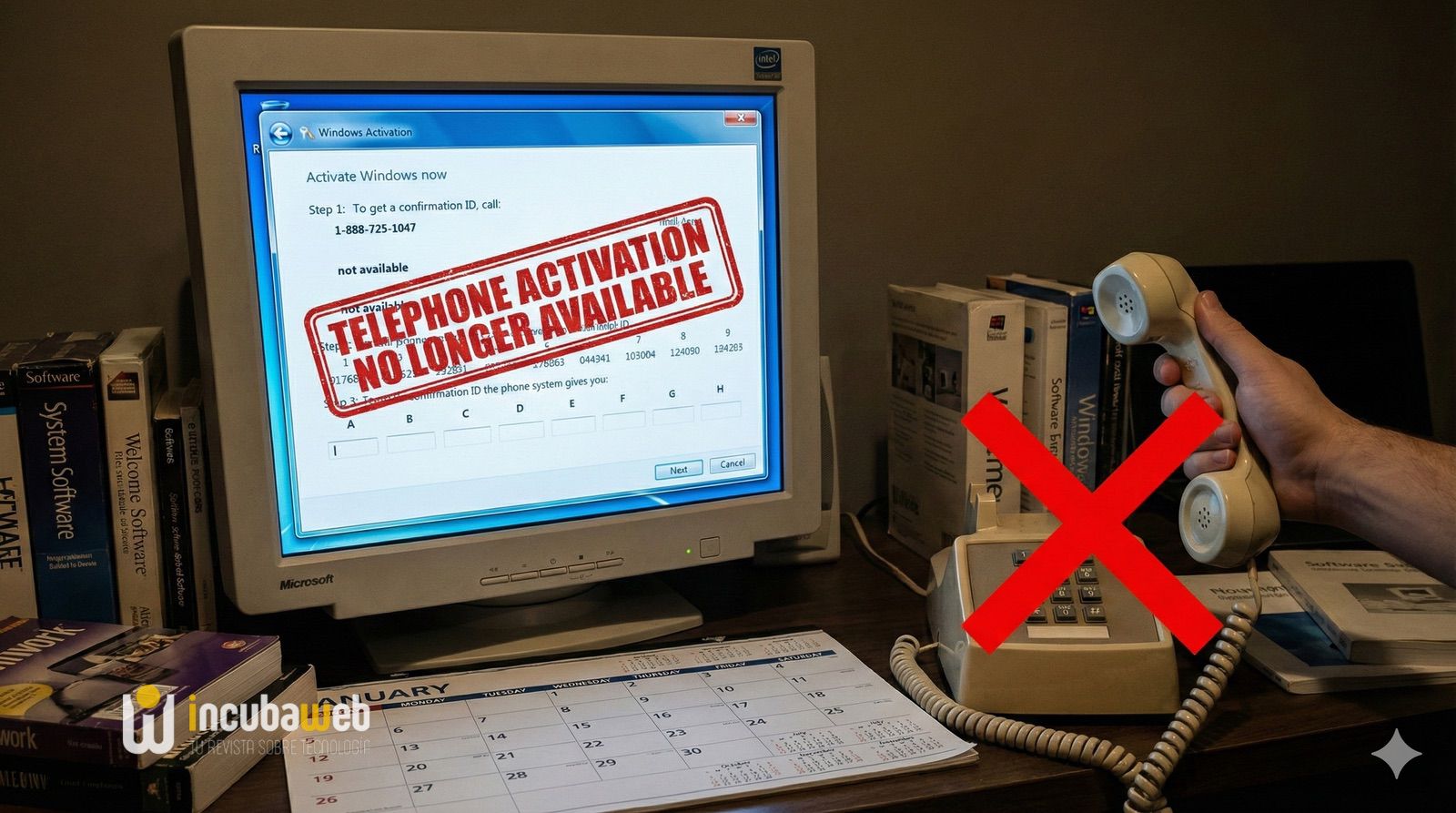
For years, phone activation has been many administrators’ favorite “Plan B”: when a machine couldn’t (or shouldn’t) go online — isolated labs, industrial environments, testing VMs, legacy equipment — the fallback was always the telephone assistant and the classic Installation ID / Confirmation ID. That cushion is starting to deflate.
In recent weeks, reports have multiplied indicating that the “lifetime” flow no longer provides voice confirmation. Instead, the automated system redirects the user to an activation web portal, sending an SMS link to complete the process from the browser. A well-discussed case in the community describes this exact shift: call, hear that activation is “online,” and end up at the modern portal with authentication (sometimes using Microsoft Authenticator in certain scenarios).
The notable point: Microsoft still documents phone activation
Here’s the clash: in its own support documentation, Microsoft continues to describe Windows activation as a process that can be done online, by phone, or via support, even mentioning the classic step of executing SLUI 4 if the “activate by phone” option doesn’t appear.
In other words: on paper, the route exists; in practice, more and more users are finding that the “phone” acts as a gateway to the web, not as an autonomous channel.
What really changes for sysadmins (and why it matters)
1) Reduced margin for offline environments
The historical goal of phone activation was resolving activations without relying on connectivity (or with limited connectivity). If the flow ends up requiring a browser, authentication, or a device capable of receiving SMS, the concept of “offline” is significantly compromised.
This particularly affects:
- Old systems (e.g., Windows 7 or Office 2010 in legacy setups).
- Isolated networks (air-gapped) where even temporary Internet access is not permitted.
- Mass provisioning / golden images: repeated activations after hardware changes (UUID, BIOS, TPM/vTPM), snapshots, or cloned templates.
2) Increased operational friction and more “human dependencies”
The phone process was straightforward: call → dictate/type IDs → confirm.
The new pattern introduces variables that complicate real-world operations:
- Compatible browsers, cookies, ad blockers,
- Additional authentication (accounts, authenticators),
- Reception of SMS (BYOD policies, coverage, etc.),
- And above all, traceability: which technician activated which device, when, and from what identity.
3) Strategic signal: fewer “legacy” pathways, more portal and account-based workflows
This is not just a technical detail; it’s a direction: Microsoft increasingly pushes toward linking the software lifecycle to online flows and managed identities. Recent reports align with this trend, even though Microsoft still references phone activation in some documentation.
What IT teams should review now
Audit your current activation methods (and pain points)
- How many devices rely on “alternative” activation (phone, manual)?
- How many are in restricted networks?
- What percentage are VMs that are frequently recreated?
Rethink activation strategies in corporate environments
Without resorting to shortcuts or questionable practices: a sustainable approach for companies is volume activation (per licensing agreement and channel), with infrastructure and policies capable of handling hardware/virtualization turnover without constant manual tickets.
Prepare an incident “runbook”
If phone activation no longer fully resolves issues, it’s wise to document an emergency flow:
- Minimum requirements (device for SMS, supported browser, identity),
- Responsible personnel and record-keeping,
- And alternatives if the portal fails or policies block it.
Reading between the lines
The fact that the phone system now acts as a “redirect” to a portal isn’t just modernization; it shifts the balance between operational control and provider dependency. For a home user, this may be a minor inconvenience; for an admin managing legacy fleets or sensitive environments, it can pose a continuity problem.
And the most uncomfortable part is the ambiguity: Microsoft still describes phone activation as an option, but increasingly clear evidence shows that this path is transforming into something different: guided access to web activation, layered with extra identity checks.
