
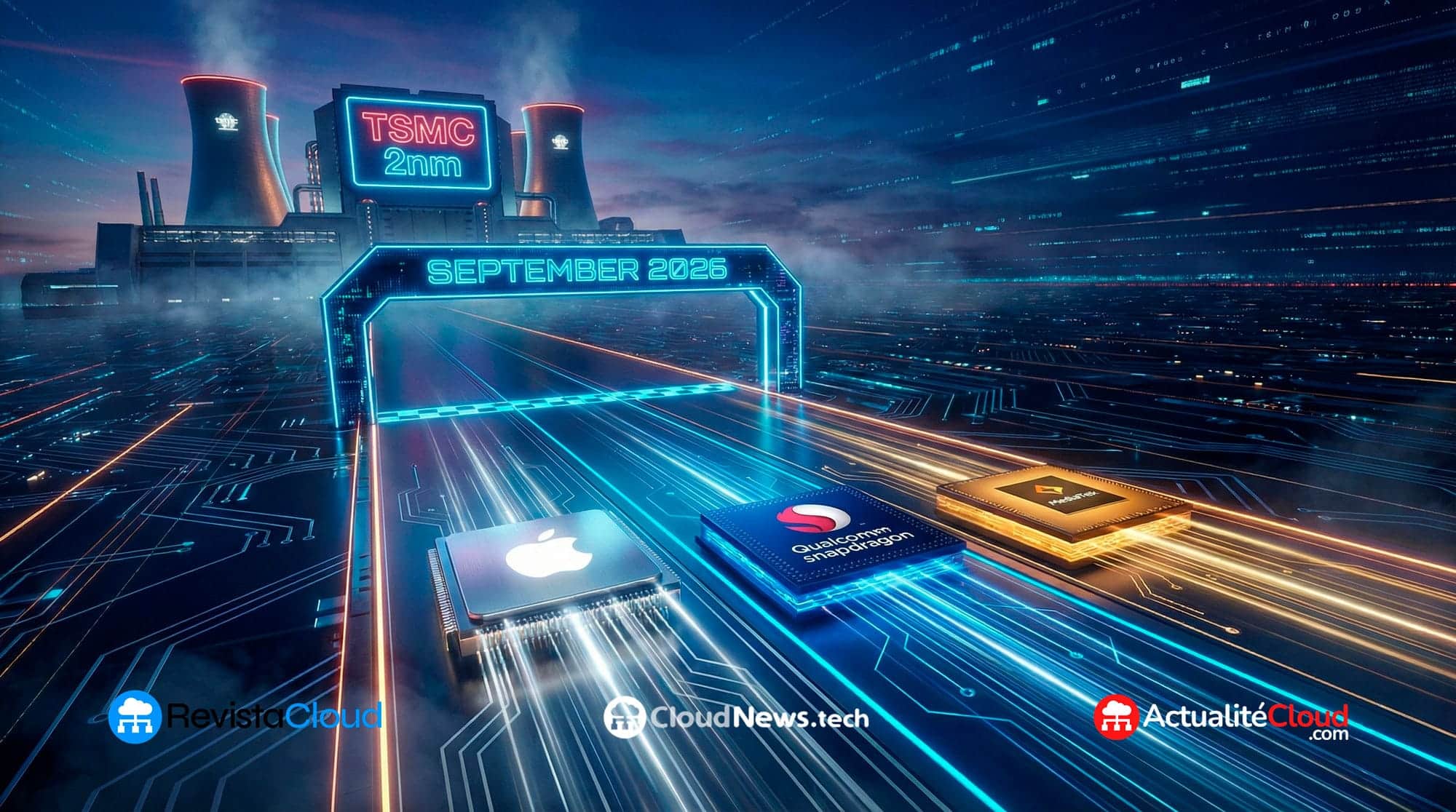
The mobile industry is preparing for a cycle shift that’s more about a real performance per watt adjustment than a marketing jump: the move to 2 nm from TSMC. And if the rumors are correct, Apple, Qualcomm, and MediaTek could focus their announcements in a surprisingly close window — possibly even in the same month — thanks to the N2 node schedule and product planning driving an unusual alignment.
Behind this headline are two forces that explain almost everything: on one side, market pressure for energy efficiency (AI on device, more capable NPUs, more aggressive thermal designs, batteries that don’t grow at the same pace); on the other, industry realities: capacity, ramp-up, yields, and manufacturing cycles that don’t always match the timing of a “September launch.”
What changes when moving to 2 nm (and why it matters more in 2026 than in 2025)
TSMC positions the N2 node as a major inflection point due to its adoption of GAAFET / nanosheet transistors, a transition that the industry has been anticipating for years and that should improve the balance between performance, power consumption, and density. In reports gathered by financial press, the leap from N2 to advanced 3 nm nodes has been described with improvements around 10–15% in performance or 25–30% reduction in power consumption (depending on configuration), along with increased density.
But the market’s key concern isn’t just the technical promise: it’s when it will actually reach products. Currently, TSMC has been targeting N2 production toward the end of 2025, with more tangible revenues in 2026, while continuing to push a roadmap with further evolutions and subsequent nodes.
“Same month” release: more plausible than it seems
The idea of concentrated announcements isn’t born out of nothing. In 2025, Qualcomm and MediaTek have already played with the release week concept: Qualcomm announced its event for Snapdragon 8 Elite Gen 5, and MediaTek scheduled theirs around the same dates, reinforcing a media “duel” pattern.
Looking ahead to 2026, media and leaks point to a similar scenario with the next generation: a Qualcomm launch in September 2026 for its flagship line (rumors even mention Snapdragon 8 Elite Gen 6) fitting the traditional Android industry calendar.
Meanwhile, MediaTek has highlighted something even more relevant: the tape-out of a future 2 nm chip with explicit references to N2P (an evolution of the node), promising performance and efficiency improvements over previous generations.
Apple, on the other hand, operates with a different logic: it doesn’t need to “win” the Android news cycle, but it’s usually one of the biggest clients ready to adopt leading-edge nodes when they’re available. Still, the “exact month” of its first 2 nm device remains, as of today, speculation.
Quick table: how N2 and its evolutions fit into the calendar
| TSMC Node | Key Change | Expected Arrival Window | Impact Notes |
|---|---|---|---|
| 3 nm (N3 family) | Refinements on FinFET | Already on the market | Foundation for current/recent flagship devices |
| 2 nm (N2) | GAAFET / nanosheet | Late 2025 → 2026 | Major transition in efficiency/performance |
| 2 nm (N2P) | Evolution of N2 | Second half of 2026 | Adjustments for maturity, performance, power | A16 (beyond 2 nm) | New step | Second half of 2026 (industry target) | Next milestone in roadmap |
And what about the “longer production cycle”?
Here, it’s useful to distinguish two things:
- Manufacturing cycle time (from wafer start to finished process).
- Actual industrialization time (yield, validation, packaging, supply chain, binning, firmware, drivers, SoC integration, etc.).
Recent analyses of N2 suggest that the wafer cycle spans several months, and it may not necessarily be “shorter” than what’s seen in 3 nm.
That doesn’t automatically confirm the rumor’s argument (“longer cycle means earlier completion and coinciding announcements”), but it reinforces an important idea: when entering a new node, calendar margins tighten. Many brands prefer to synchronize their announcements even if the product arrives a bit later in stores, to avoid giving rivals months of narrative advantage.
Practical consequences if 2 nm launches “align” in release timelines
1) A much more competitive (and costly) fall 2026.
If multiple vendors announce nearly simultaneously, the battle shifts from “who arrives first” to “who optimizes best”: sustained performance, actual efficiency, ISP, NPU, and thermal management.
2) Increased pressure on capacity and priorities.
The leading node’s demand isn’t just for mobiles: AI push (HPC/accelerators) influences the semiconductor industry and fab expansion. TSMC is already expanding its industrial muscle around 2 nm.
3) More visible differences through software.
With efficiency improvements on paper, the real winner could be the device that manages schedulers, DVFS, NPUs, and AI frameworks “on-device” most effectively. By 2026, this will weigh as much as GHz performance.
4) Ripple effect into PCs and servers.
Although this discussion is about mobile, process advances and AI libraries eventually influence NPUs in laptops, edge devices, and later, silicon for infrastructure.
