
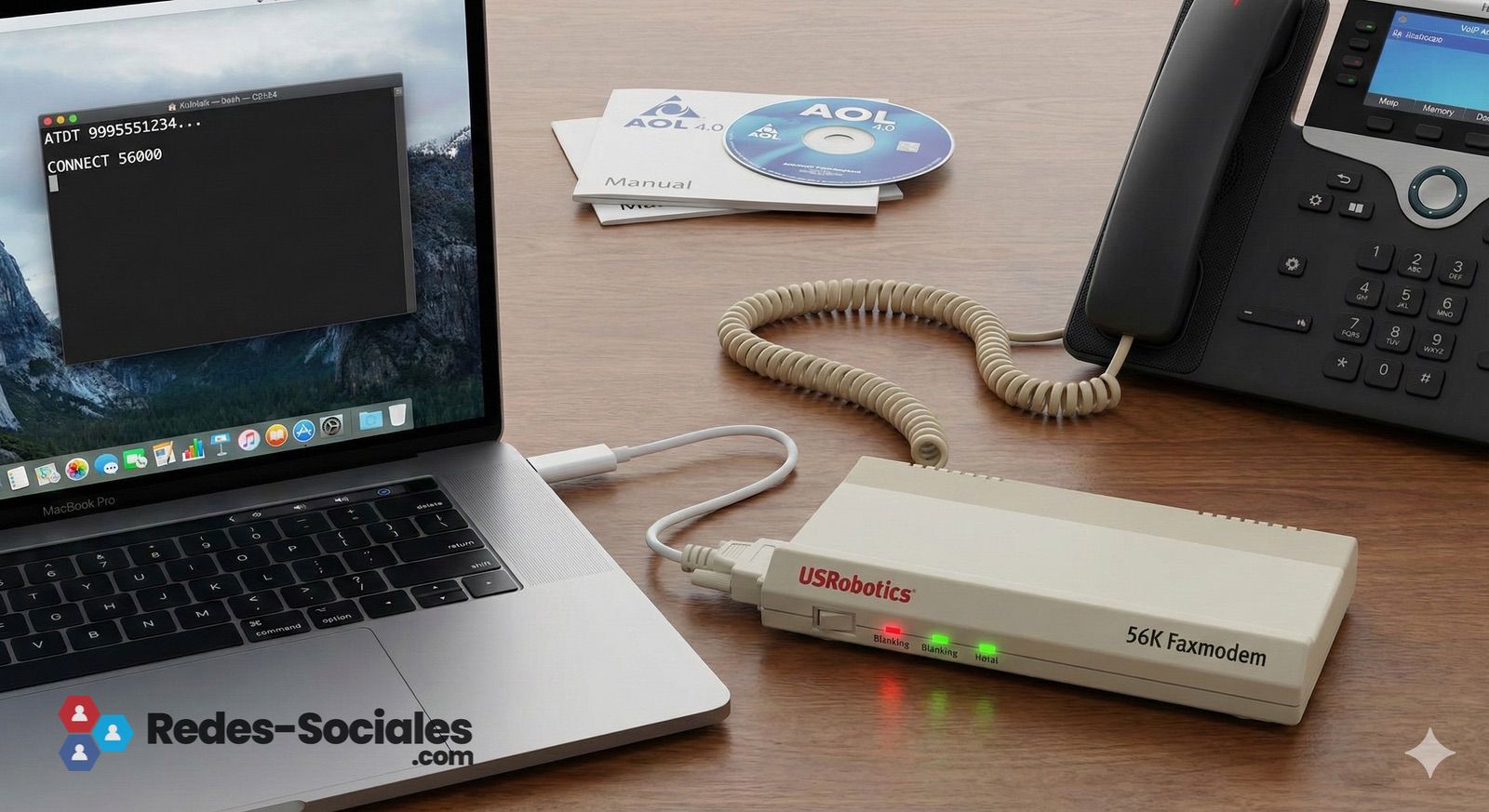
For years, dial-up Internet access seemed like a technological fossil: something from Windows 98, BBSs, and that endless wait while the modem “sang” over the line. However, at the end of December 2025, a thread on the Bandaancha.eu forum reopened the door to a nostalgic yet revealing experiment: connecting a RTB (basic telephone network) modem through a current fiber optic landline (FTTH) and checking if it’s still possible to browse as we did two decades ago.
The starting point was a concrete discovery: an access number that, according to participants, still responds in Spain: 901 904 020, along with “generic” credentials (a typical username like your@orange and password free). The first surprise arrived quickly: the difficulty is no longer finding a modem, but getting the call to “ring” clean enough so the modem can complete the handshake.
Why dial-up in 2025 doesn’t look like it did in 2005
The paradox is clear: Spain is experiencing a record deployment of fiber, but many landlines are no longer purely analog. Often, the landline service is delivered as VoIP (Voice over IP) inside the router or ONT. And that’s where the problem arises: analog modems are extremely sensitive to variations in delay, jitter, compression, and certain audio treatments (like echo cancellation or filters), which are common in VoIP.
The thread reveals this generational clash: one user tries connecting from a VoIP line and the handshake fails; others report that they can establish a connection, though at lower speeds than the “classic” dial-up promised.
Connecting “can be done”… but the real bar drops to 19.2 kb/s
Several participants describe results that sound almost absurd today, but actually align with current voice transmission limitations. Notably, one achieved a connection at 19.2 kb/s from an FTTH landline, while 56 kb/s was not possible. Another recounts that, after trying with a Movistar router, they managed to join the 19,200 baud club, but no faster, with pages loading very slowly before the session dropped.
The interesting part of these reports isn’t just the speed data, but what it suggests: the route of the call matters as much as the modem. Depending on how the operator routes the call (and how many VoIP segments it passes through), the connection can be viable… or it can break.
Nostalgia also has a cost: calling a 901 number isn’t “just another call”
The number shared by the forum members is a 901, a prefix in Spain typically associated with specific costs and not always included in flat-rate plans. In the thread, a user provides approximate prices (including VAT in some cases) when calling that number from different operators:
| Operator (per user reports) | Establishment | Price/minute | Example 10 min |
|---|---|---|---|
| O2 | 0.0968 € | 0.0484 € | 0.5808 € |
| Vodafone | 0.12 € | 0.18 € | 1.92 € |
| Orange | 0.06 € | 0.024 € | 0.30 € |
Beyond the experiment, this note has practical value: if someone tries it “out of curiosity,” it’s worth checking the tariff beforehand, because a long dial-up session in 2025 could end up costing more than a modern subscription.
Dial-up speeds: what they mean today (and why they seem “broken”)
A part of the charm in revisiting RTB is remembering that, back then, every kilobit mattered. To put it in context, here are typical modem speeds and their theoretical equivalents in kilobytes per second:
| Modem Speed (kb/s) | Theoretical Max (KB/s) |
|---|---|
| 9.6 | 1.2 |
| 14.4 | 1.8 |
| 28.8 | 3.6 |
| 33.6 | 4.2 |
| 56.0 | 7.0 |
| 19.2 (reported case) | 2.4 |
In practice, as it was then, the actual speed can be lower due to protocol overhead, line quality, or, in today’s context, the VoIP audio processing itself.
And what’s the point of all this in 2025?
Most do it out of nostalgia: to reconnect with the sound of the modem, try an old laptop, or relive historic services. But the thread also shows more practical uses: from connecting a Dreamcast (which relied on a modem) to proposing that, with software like Asterisk and PPP, one could set up a home dial-up node for testing.
Still, the most useful lesson is another: the experiment makes clear that modern infrastructure is optimized for human voice, not for transmitting modulated data like in the ’90s. That’s why dial-up, even if it can “work,” does so as a rarity that depends on very fine call-path details.
FAQs
Can a RTB modem connect to the Internet through a fiber landline (FTTH) in Spain?
In some cases, yes, but it depends on how the operator provides the voice service (actual analog vs. VoIP), the router/ONT configuration, and call routing. Recent reports show possible connections, but not guaranteed.
Why does a modem recognize but fail to complete the handshake on VoIP lines?
Because modems are very sensitive to jitter, variable delay, compression, and echo cancellation. Normal VoIP elements can distort the “data audio” and cause failure of negotiation.
How much might it cost to “test” dial-up access by calling a 901 number?
It varies greatly by operator. The thread provided concrete examples with setup and per-minute costs, so it’s wise to check the tariff before extending the test.
Is aiming for 56 kb/s realistic today?
It’s usually difficult. The 56k depends on very specific conditions (digital segments and proper equipment). With VoIP routes, stability or achievement is generally limited.
Sources:
- Thread “Trying to connect to internet via RTB modem over the FTTH landline” (Bandaancha.eu). (Banda Ancha)
- Information on 901 numbers and associated costs (collected by OCU and reported in media). (www.ocu.org)
- Technical presentation on fax/modem transmission over VoIP networks and sensitivity to jitter/latency (ITU/ETSI context). (itu.int)
