
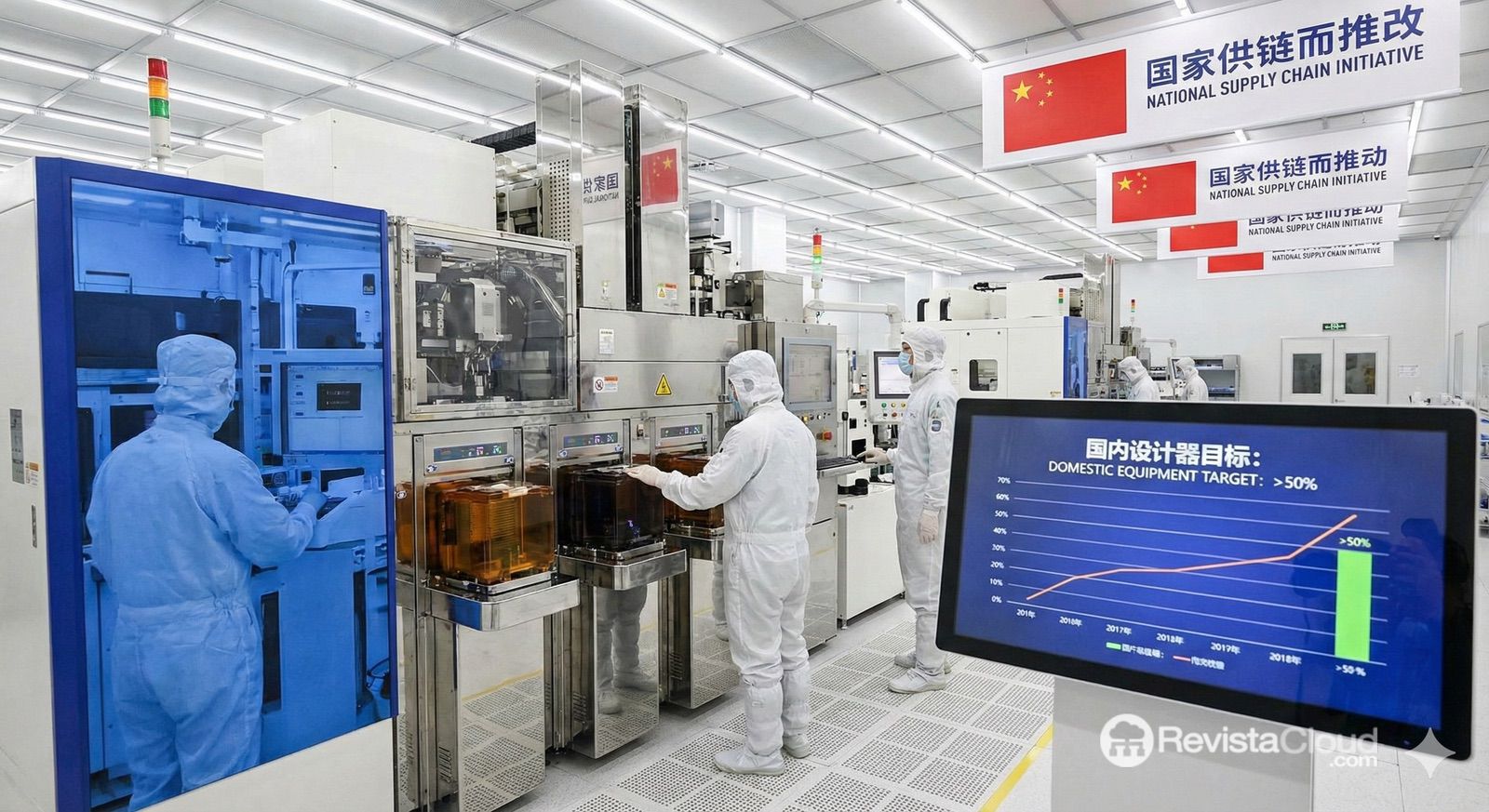
China has started 2026 with a clear signal for its semiconductor industry: those who want to build or expand manufacturing capacity will need to incorporate, as a practical rule, at least 50% of equipment manufactured domestically. This is not a regulation published in an official bulletin, but rather a criterion that — according to sources cited by Reuters — is already being applied in project processing and approval, becoming a de facto requirement to give the green light to expansions.
From “chip shortage” to industrial bottleneck
For years, the global conversation revolved around advanced chips, memories, packaging, and manufacturing capacity. However, the core of the problem has shifted into a less visible area for the general public: the tools (etching, deposition, cleaning, metrology, etc.) that enable a semiconductor plant to operate efficiently and competitively.
Meanwhile, technological restrictions pushed by the United States and its allies have pressured China to accelerate the replacement of foreign suppliers across multiple layers of the value chain. International coordination to limit exports of advanced equipment to China, along with the progressive tightening of controls, has been part of the landscape in recent years.
The result is a strategy that, more than symbolic, aims to drive domestic demand: if factories must purchase locally, Chinese suppliers receive recurring revenue, scale up production, improve reliability, and reinvest in R&D. What was once an industrial aspiration is now an administrative requirement.
How the rule is applied and why it matters that it’s “not a law”
The key nuance is that this directive is described as not officially published, yet it is practically applied “in practice” for project approval. This detail changes the game: it allows flexibility (exemptions, interpretations, case-by-case negotiations) but also introduces uncertainty for multinationals and Chinese manufacturers alike, who must plan investments within a less transparent framework.
According to the approach outlined by Reuters, the 50% threshold is aimed at new plants and expansions, where authorities can condition permits and access to incentives. Additionally, exemptions might be granted for especially advanced lines where the Chinese ecosystem still cannot fully meet all needs with competitive substitutes.
Winners: Naura and AMEC accelerate orders and expand their catalog
Two names consistently emerge when discussing support for domestic equipment: Naura Technology and AMEC. These Chinese companies have a strong presence in critical segments such as etching and related processes, where China has been striving for years to close the gap with Western suppliers. Reuters links these measures to increased commercial traction for local providers, as the purchase becomes less optional.
In practice, this policy tends to create a snowball effect: more orders mean higher volumes, which usually lead to industrial improvements (quality, support, delivery times) and, consequently, further substitution.
Potential losers: the Chinese market was too large to ignore
The uncomfortable side of this story affects major international semiconductor equipment suppliers, especially those heavily exposed to the Chinese market. Reuters suggests that companies like Applied Materials, Lam Research, or KLA could face pressure if part of their factory investment cycle is structurally redirected to domestic suppliers, considering China has been one of the primary engines of global demand for manufacturing equipment.
This doesn’t mean an immediate “turn off”: in industrial technology, changes are gradual due to dependencies on support, spare parts, calibration, know-how, and process compatibility. However, it introduces a direct risk: substitution could shift from a long-term project to an immediate investment condition.
The financial lever: state funds to support the transition
China’s industrial policy isn’t based solely on regulation or administrative requirements. It also relies on capital. In recent years, the country has promoted large investment vehicles for the sector (commonly known as the “Big Fund”), designed specifically to finance critical capabilities and reduce external dependency. In 2024, for example, a new phase of this fund was announced, with substantial size in yuan, aimed at strengthening the domestic ecosystem.
This combination of forced demand + funding makes the shift credible: if domestic purchases are mandated and local industrial capacity is financed, the internal market becomes the testing ground and lifeline for national providers.
Is 50% achievable across the entire supply chain? It depends on the “what” and the “where”
The 50% figure sounds decisive, but its actual impact depends on two questions: which equipment is included and in which nodes/technologies it is applied.
- In equipment where China is already strong or close to the cutting edge, substitution can be quick.
- In areas dominated by foreign providers (due to complexity, patents, ecosystems, or restrictions), exemptions and fine print become crucial.
In other words: 50% doesn’t necessarily mean “half of the most advanced,” but “half of what’s possible without halting the project.” That nuance is precisely what makes this measure a flexible political tool.
A structural change amid a technology war
Beyond who wins orders this quarter, the key message is: China wants its manufacturing industry to no longer be systemically dependent on external tools, and it’s willing to deploy its most powerful mechanism in industrial projects: administrative approval.
If this approach consolidates, it could accelerate the creation of a “dual” semiconductor equipment market: one oriented toward Western ecosystems, and another growing under rules and incentives unique to China. This bifurcation would be more than commercial; it would be geopolitical, technological, and strategic.
Frequently Asked Questions
What exactly does requiring 50% domestic equipment in a chip factory mean?
In new projects or expansions, a substantial part of the machinery and processing tools should be purchased from Chinese suppliers as a practical condition to approve or unlock the project.
Which Chinese companies stand to benefit most from this policy?
Local equipment manufacturers with a presence in critical processes (e.g., etching and others), where China is strengthening its industrial chain through recurring purchases and capacity scaling.
Can China currently produce all the necessary equipment for advanced chips?
Not across all segments or at the same level in each category; hence the talk of exemptions and flexible application depending on line type and technological maturity.
How does this affect suppliers like Applied Materials, Lam Research, or KLA?
If new investments are redirected to domestic providers due to approval requirements, these companies could lose market share in one of the most historically relevant segments of semiconductor equipment.
