
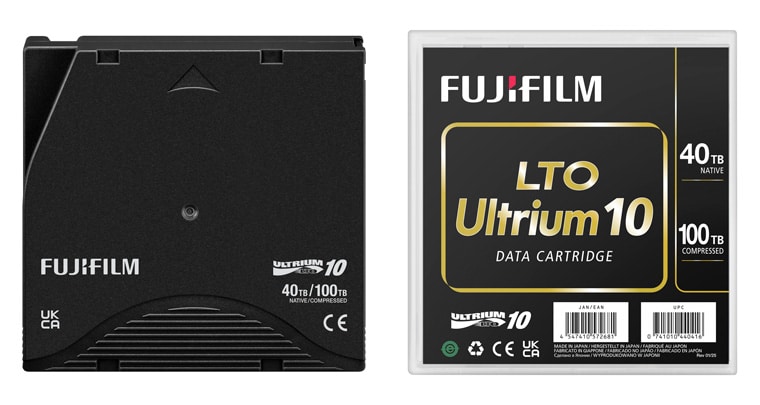
The conversation about infrastructure for Artificial Intelligence usually revolves around GPUs, interconnections, and energy consumption. But there is a less glamorous layer — and increasingly critical — that is regaining prominence in data centers: large-scale storage. In this context, Fujifilm has announced the release of its new cartridge FUJIFILM LTO Ultrium 10 (40TB), a professional magnetic tape that increases capacity to 40 TB without compression and up to 100 TB with compression, with shipments planned to begin in January 2026.
This is no small figure: in a sector where AI projects generate massive volumes of data — datasets, logs, results, versions, and backups — the question is no longer just “how much does a system perform,” but how much does it cost to store and how sustainable it is over time. And here, tape does not aim to compete with NVMe nor replace the high-performance storage needed for training and inference. Its role is another: absorb and organize the growth of “cold data” that accumulates relentlessly.
LTO-10 (40TB): higher density, same family, focus on archiving and protection
According to information published by Fujifilm, the LTO-10 (40TB) cartridge relies on two key changes to increase density:
- The use of “fine hybrid magnetic particles” to improve recording density.
- A thin-film technology that incorporates aramid film, reducing tape thickness and allowing longer support length within the cartridge.
The announcement also emphasizes a practical detail for operations: this new model is compatible with the same LTO-10 hardware units used with the previous 30 TB variant, which Fujifilm launched in 2025. In other words, it’s not a “tech reset,” but an iteration aiming to scale capacity within the same framework.
In specifications, Fujifilm mentions a maximum native transfer rate of up to 400 MB/s and up to 1,000 MB/s with compression (according to the announcement’s own spec sheet). In practice, as with any LTO system, capacity and performance “with compression” depend on data type: compressed video does not compress as much as text or logs.
The advantage that matters again: “air gap” and ransomware resilience
Beyond density and cost per terabyte, Fujifilm focuses on an argument that has gained weight in recent years: security. Tape provides a physical isolation (“air gap”) by remaining offline, reducing exposure to attacks and failures affecting continuously connected systems. The company frames it as a “reliable” medium for backup and archiving amidst growing threats like ransomware.
This point ties into operational reality: as the value of data increases (due to sensitivity, recreating costs, or legal requirements), the strategy shifts from “storing faster” to “storing better and with less risk.” By design, tape fits into the layer where immediate access is not the priority but preservation is.
Greater environmental tolerance: designed for real-world environments, not ideal conditions
Another interesting detail in the announcement is the expanded operating temperature range. Fujifilm indicates that LTO-10 (40TB) extends the recommended temperature range to 15 °C–35 °C (wider than current models) and allows for up to 80% humidity under certain conditions (with nuances noted in the announcement). This points to increased robustness suitable for deployments where conditions are not “laboratory ideal.”
In modern data centers, where energy efficiency and thermal design are under constant review, these tolerances can make the difference between a “centralized archive-only” solution and a more flexible option suitable for various installations.
The tape is not going away: confirming its comeback (and growth)
Although magnetic tape often appears in headlines as if making an unexpected re-emergence, the reality is that it never disappeared from the business world. What’s changing now is context: AI is accelerating the need for large-scale archiving, and data grows alongside models.
In this vein, industry sources report that LTO tape shipments have continued to grow, with recent record-breaking volumes sent. The clear message: data infrastructure is entering a phase where hierarchical storage is no longer just a good practice but an economic necessity.
Implications for AI data centers: data hierarchy and cost control
The key point is not the “big number” of the cartridge, but what it represents within a modern architecture:
- Hot data: fast storage (NVMe/SSD) for training, inference, caches, and active pipelines.
- Warm data: secondary storage for ongoing projects or occasional access.
- Cold data: archives, backups, historical results that must be preserved but do not require minimal latency.
Tape fits into this last tier with a clear advantage: it can store large volumes at a lower operational cost and power consumption compared to systems always powered on. Fujifilm emphasizes the idea of secure, cost-effective storage for massive data volumes.
Additionally, for data centers—especially those focused on AI—that are stressed by power, cooling, and budget limitations, optimization extends beyond computing: it also involves deciding which data stays on expensive storage and which migrates to more rationalized tiers.
Frequently Asked Questions
What is the purpose of LTO tape in an AI data center?
Primarily for backup and archiving of large volumes: historical datasets, logs, results, and copies that need to be preserved but do not require immediate access. Tape enables offline data storage, reducing exposure to incidents.
What does “40 TB without compression” and “up to 100 TB with compression” mean in LTO?
The “without compression” figure is the actual capacity of the cartridge. The “with compression” capacity depends on data type and compressibility; already compressed data (video, many images) tends to approach the native value more closely.
When will the FUJIFILM LTO Ultrium 10 (40TB) be available?
Fujifilm indicates shipments will begin from January 2026.
Why is tape considered a defense against ransomware?
Because it can be kept in a physical air gap, isolated from networks, reducing attack surface and the risk of remote encryption or destruction during incidents.
via: fujifilm
