
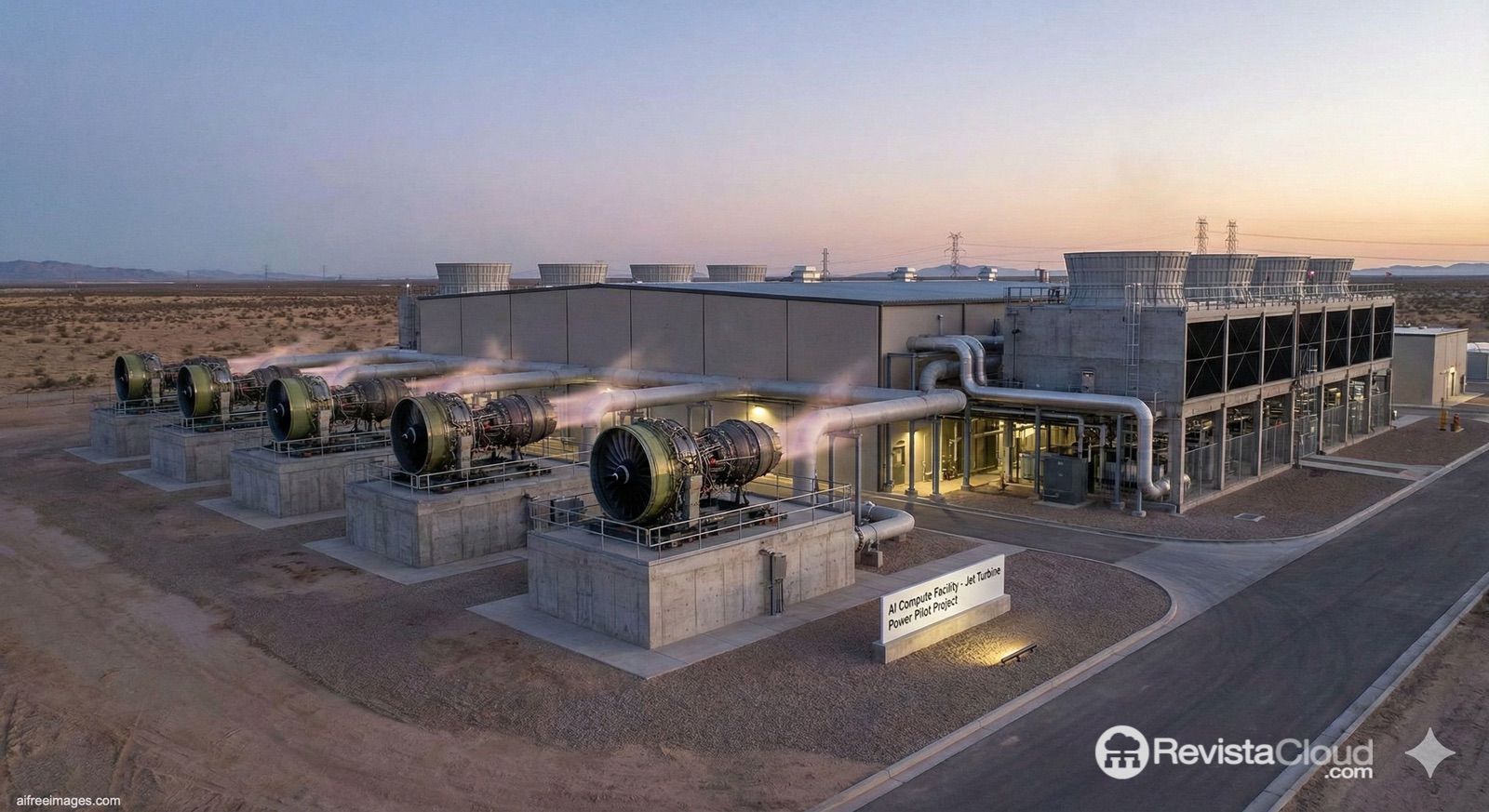
The artificial intelligence industry has become accustomed to talking about chips, memory, capital, and increasingly large models. But in 2025, many operators are discovering that the real bottleneck is more mundane and harder to accelerate: getting electricity on time. And when the grid doesn’t arrive—or arrives too late—the sector is turning to solutions that, until recently, sounded like emergency plans: on-site generation with aeroderivative turbines (technology inherited from aviation) and diesel or gas generators functioning as the main power supply.
The image is powerful because it’s also literal. Temporary energy providers are deploying systems based on aeroderivative turbines—aircraft-derived engines adapted for electricity production—to deliver dozens or hundreds of megawatts alongside facilities that, otherwise, would have to wait years for a robust grid connection. The logic is simple: if a data center project costs billions and timing is critical, the cost of “making” your own electricity can seem less damaging than delaying everything, from the operator’s perspective.
From “backup” to main supply
For decades, the backup generator in a data center was the last resort: tested, maintained, and rarely used. The current tension is changing that role. In North America, industry sources describe a clear shift: equipment designed for backup is gaining prominence as “prime” power (continuous operation) to bypass interconnection delays with the grid, which in many areas have stretched due to waves of new load demands (including data centers).
The challenge is not just the amount of energy, but also the speed: a large data center may require a power level that forces reinforcement of substations, lines, and permits. This, in practice, turns electrical connection into a bureaucratic and civil works race that doesn’t always keep pace with AI infrastructure deployment plans.
Aeroderivative turbines: the “quick fix” that’s not so quick
The most notable alternative is aeroderivative turbines. These machines can start quickly, deliver high power, and deploy with relative agility compared to a traditional combined cycle or complex grid expansion. In the AI ecosystem, they’ve become popular as a bridge: turning on the data center before the grid is ready, or maintaining operation while infrastructure and regulatory processes are completed.
This phenomenon is also stressing supply. The turbine supply chain now references delivery times of several years for certain units, and a market where reserving future capacity has become a strategic industry game. There are even mentions of paying high prices to secure manufacturing slots toward the end of the decade, signaling how much the bottleneck has shifted from silicon to energy and heavy machinery.
Reusing turbine cores: from race track to megawatt
The cultural—and media—shift occurs when the story simplifies to: “aircraft turbines powering data centers.” This doesn’t always mean removing a turbine from a wing and connecting it to a transformer, but it reflects a reality: aeroderivative engineering originates from aerospace, and parts of that technology are now used to generate industrial electricity.
In the U.S. market, cases like ProEnergy have been cited, which has publicly explained its strategy of reusing turbine hardware to adapt it for power delivery in projects where grid access is delayed. Meanwhile, the data sector continues to watch these solutions because, although viable, they raise awkward questions about emissions, noise, fuel logistics, and permitting.
The hidden costs: fuel, emissions, and local conflicts
Here lies the less glamorous part: generating energy “on your site” is expensive and comes with consequences. The operator relies on fuel supply (diesel or gas), exposing themselves to price fluctuations, a higher carbon footprint, and often a more complex relationship with regulators and nearby communities. Still, for certain projects, the calculation is straightforward: the extra energy cost is “tolerated” if it prevents delays that could derail the business plan.
Equipment manufacturers see this trend as an opportunity. For example, Cummins has reported strong demand for power generation products linked to data centers, as these facilities seek solutions to sustain critical loads.
A deeper symptom: AI is outpacing electrical planning
The use of fossil fuel generation as “Plan A” is not just an anecdote, but a symptom: energy planning and grid infrastructure weren’t designed for such rapid growth of new, concentrated loads. While discussions continue around renewables, smarter grids, storage, or small modular reactors, the reality is that many projects need megawatts now, not in 2028 or 2030.
This creates a tension beyond the technical: if the industry becomes accustomed to powering data centers with turbines and fuel, the sustainability debate moves from press releases to operational, regulatory, and reputational issues.
The paradox is clear: the technology that promises to optimize processes, save resources, and “do more with less” is driving part of the ecosystem to burn more just to start working.
FAQs
What is an aeroderivative turbine, and why is it associated with “airplane engines”?
It’s a gas turbine designed from aerospace technology (or inspired by it) that’s adapted to generate electricity in industrial settings. It’s valued for its high power output and relatively quick deployment.
Why would a data center use diesel or gas as its primary energy source instead of just backup?
When high-capacity grid connection delays occur, some operators resort to “prime” generation to start operations or keep them running for months, avoiding project shutdowns due to lack of supply.
Does this mean AI is “unsustainable”?
Not necessarily, but it highlights that the sector’s sustainability depends as much on efficiency and renewables as on less visible factors: the actual capacity of power grids, permits, and infrastructure to absorb new demand without relying on emergency solutions.
What real short-term alternatives exist to reduce this dependence on fuels?
Efficiency improvements (PUE, cooling, consolidation), long-term supply agreements, storage, and hybrid strategies with renewables can help, but in many cases, the immediate bottleneck remains physical power availability and grid works.
