
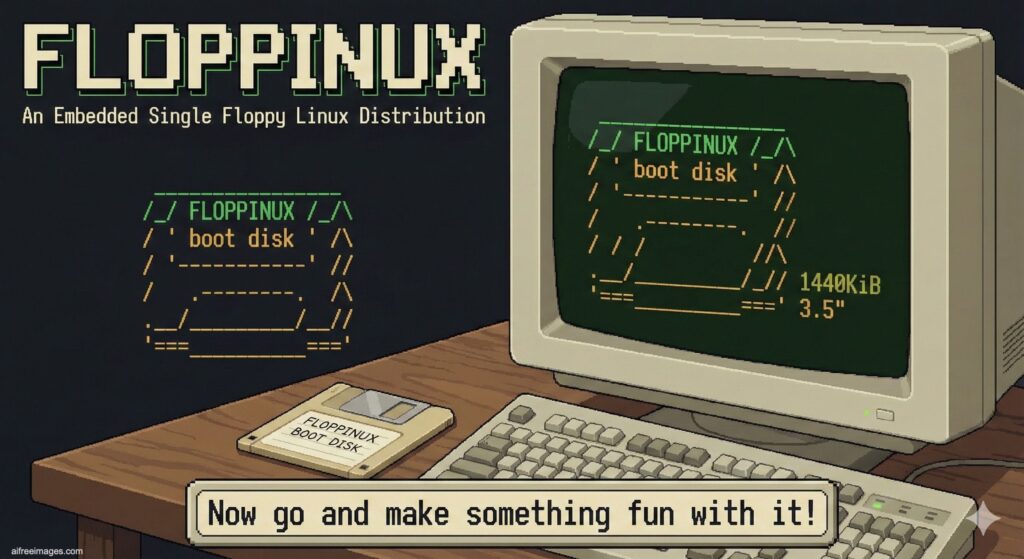
In an era where operating systems are measured in gigabytes and updates come in increasingly large packages, an open-source project is demonstrating—more as a technical challenge than out of practical necessity—that the unthinkable is still possible: booting a full Linux distribution from just a 3.5″ floppy disk, with barely 1.44 MB of space. It’s called FLOPPINUX, and its approach is as straightforward as it is provocative: “Linux From Scratch,” but applied to creating a minimal distro that fits on a device that is now somewhat of a relic.
Far from being merely a curiosity, FLOPPINUX has become a small educational laboratory on what is essential in a Linux system and what is not. Its creator and community have been pushing the boundaries with a clear goal: build a functional, bootable, and useful environment—even in terminal mode—for learning and experimentation. In its latest workshop version, the project explains how to compile a kernel and assemble a minimal set of tools to achieve real booting on old hardware and emulators alike.
A complete Linux… that boots directly to terminal and saves changes
The project’s hook is that it doesn’t just exist as a social media image: FLOPPINUX boots into an operational Linux terminal and also incorporates persistent storage (limited but real) for saving small files. The repository documentation mentions 264 KB reserved for persistence, along with essential utilities and a text editor akin to vi. This setup allows for basic testing, file editing, and task execution without everything being wiped upon reboot.
The minimum requirements are also nostalgic—yet perfectly aligned with the goal: compatibility with x86 32-bit CPUs from Intel 486DX, at least 20 MB of RAM, and, of course, a functioning floppy drive. The project’s workshop describes this as a “complete” distribution that fits on a single floppy, designed to revive old hardware, embedded systems, or serve as an educational tool.
Kernel 6.14.11, i486 support, and the art of minimalism
One of the standout features is that FLOPPINUX boasts a Linux kernel 6.14.11 with i486 support. This alone demands attention: minimal configuration, just enough modules, and removal of all non-essential components. The result isn’t a “pocket Linux” from the 90s, but a modern exercise in extreme reduction, where every driver, compilation option, and utility matters.
The idea of “modern Linux on a floppy” has resurfaced in media precisely because of what it entails: compiling and tuning a current kernel to fit within size constraints that clash with 2025 software realities. A recent Hackaday article summarized it bluntly: it’s achievable, but more as a demonstration of limits than a distro meant for “usual” use. Real issues—dependencies, the fragility of aging physical media (disks and drives)—also come into play.
What’s this good for in 2025? Education, retrocomputing, and system culture
FLOPPINUX doesn’t compete with lightweight distros for Raspberry Pi nor claim to be a modern rescue disk on USB. Its value lies elsewhere: it practically teaches the minimal anatomy of a bootable Linux system.
In a world dominated by containers, orchestrators, and layers of abstraction, a project like this refocuses on very concrete questions:
- What does the kernel truly need to boot and provide a functional console?
- Which tools are essential for file manipulation, diagnostics, and basic operation?
- How is space managed when margins are measured in kilobytes?
For technical profiles—from system administrators curious about the platform’s history to computer science students—FLOPPINUX is a condensed lesson on booting, kernel configuration, toolchains, BusyBox, and the balance between functionality and size. It’s no coincidence that the repository compares it to Linux From Scratch but focused on a single 1.44 MB floppy: it’s not about installing “something,” but about building it with an understanding of each component.
An open project with no strings attached… even in its license
Another key detail for the open-source ecosystem is its licensing: the repository specifies CC0-1.0, a highly permissive license that practically facilitates material reuse, workshop adaptation, and experimentation without legal hurdles. The project also provides documentation in various formats (including workshop material and guides), reinforcing its educational nature and its intent to be replicated by others.
Although FLOPPINUX might sound niche, its metrics show it’s not invisible: the repository has hundreds of stars and ongoing activity, indicating that the challenge appeals to the retrocomputing community and those who enjoy “pushing systems to their limits.”
The core message: when software meets physical constraints again
FLOPPINUX also serves as a cultural commentary on the current state of software: for decades, the trend has been to assume more CPU, more RAM, and more storage. This project reverses that assumption: it forces designing with strict limits and justifying every dependency.
In that sense, its greatest merit isn’t “booting Linux on a floppy,” but what it reveals: with deep knowledge, aggressive trimming, and patience, it’s still possible to bend technical reality towards a goal that once seemed extinct. And at the same time, it demonstrates that computing retains some craftsmanship when played at the margins.
Frequently Asked Questions
What can you actually do with FLOPPINUX once it’s booted?
It boots into a functional Linux terminal with basic utilities (including a vi-like editor), sufficient for manipulating files, running simple tests, and experimenting within a minimal environment.
What is the minimum hardware required for FLOPPINUX to run on real PC hardware?
The project targets x86 32-bit CPUs from Intel 486DX, with at least 20 MB of RAM and a working 3.5″ floppy drive.
Why does FLOPPINUX use a modern kernel if the goal is a floppy-based system?
Because that’s precisely the challenge: demonstrating how far a current kernel can be trimmed and configured to support i486 and boot in an extremely limited space. (GitHub)
Is FLOPPINUX useful as a “rescue disk” today, or just a curiosity?
It can serve for learning and experimentation, but its main motivation is technical and educational: exploring limits, dependencies, and minimal Linux building rather than replacing modern rescue tools.
