
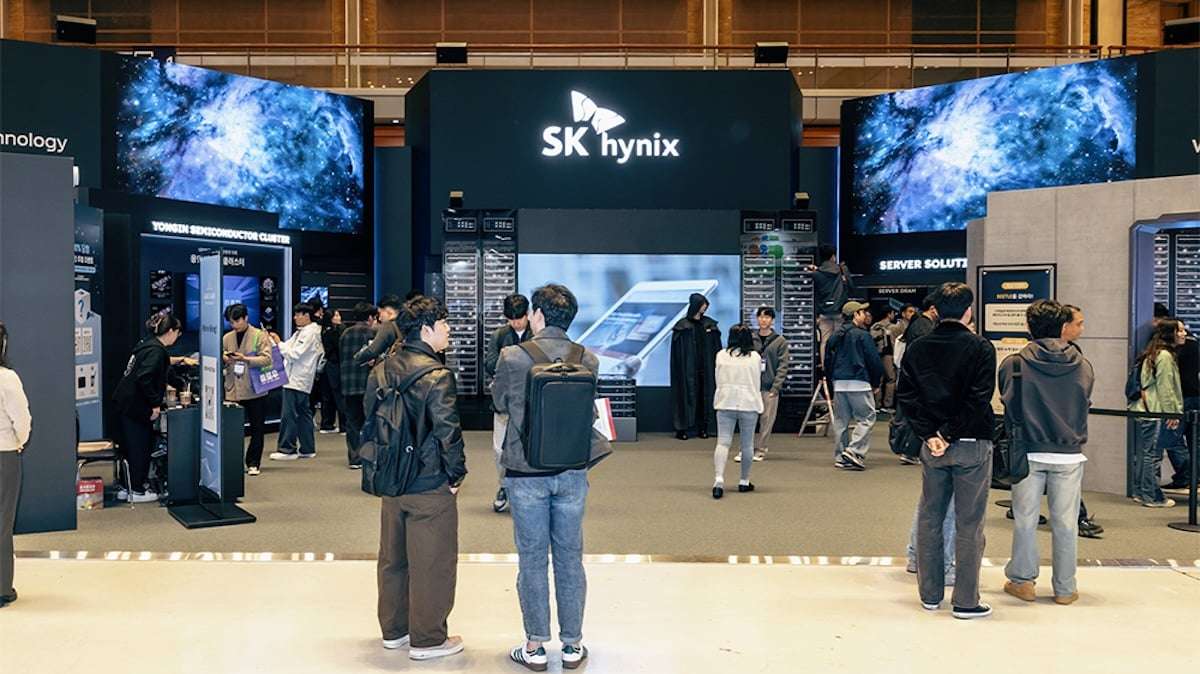
The battle for Artificial Intelligence infrastructure is no longer decided solely in massive data centers or by brute GPU power. Behind this boom is a component that has become an industrial gold: High Bandwidth Memory (HBM), essential for powering accelerators that train and run increasingly demanding models. And here, the South Korean giant SK hynix is making moves in one of the places where — literally — the next leaps in performance are being designed.
According to industry sources cited by DigiTimes, the company has leased an office of approximately 5,500 square feet in City Center Bellevue, east of Seattle. On paper, it’s a modest space, but the message is clear: SK hynix wants to be just minutes away from the teams setting the pace of the market, from Nvidia to the large hyper-scale providers designing their own silicon, such as Amazon and Microsoft.
It’s not “just another office”: it’s about being where designs are validated
In the memory business, opening an office usually signals a commercial move or regional support. In Bellevue’s case, the subtext is different. HBM isn’t a “plug and play” component that’s bought and installed. In cutting-edge accelerators, HBM is integrated into complex architectures and advanced packaging, with real performance depending on ongoing iterations: electrical validation, signal integrity, power consumption, thermal management, packaging tolerances, and, most importantly, fine-tuning with clients.
In other words: being nearby accelerates the correction and improvement cycle. And in the current AI race, winning weeks can mean securing multi-billion dollar contracts.
The choice of Seattle and its surroundings is no coincidence. The area has established itself as one of the most concentrated AI hubs outside Silicon Valley, home to Nvidia engineering teams, as well as AWS and Microsoft teams linked to cloud platforms and proprietary silicon. For an HBM supplier, proximity means sitting at the table where the future generations of accelerators are being decided.
The Context: HBM as a Lever for Leadership… and Revenue
SK hynix has been striving for some time to shed its image as a cyclical DRAM “commodity” supplier and position itself as a key player in the AI era. Its advantage in HBM has been a critical part of this strategy. Recent reports indicate that HBM’s traction has helped the company surpass Samsung in memory business revenue metrics in 2025, a symbolic milestone in a sector historically dominated by its domestic rival.
The financial logic is straightforward: when demand is concentrated on high-value products (HBM3E, HBM4, and future generations), profit margins, revenue visibility, and long-term contract negotiation power change dramatically. For SK hynix, being embedded in the Seattle–Bellevue–Redmond “belt” is a way to protect this position.
Hyper-scale players accelerate their pace
Competitive pressure isn’t just from Nvidia. Hyper-scale companies have been designing their own chips for years to reduce dependency, optimize costs, and tailor performance to their workloads. And in this strategy, HBM memory has become an indispensable element.
A notable example is Trainium3, AWS’s recently announced accelerator, which integrates 144 GB of HBM3E and raises the bar for memory and bandwidth in the race for large-scale training and inference. This leap isn’t possible without a supply chain capable of providing volume, performance, and reliability. That’s why, for SK hynix, the Bellevue move is also an investment in being close to the fastest-growing and highest-volume customer.
The other aspect: manufacturing and packaging in the U.S.
The Washington office aligns with a broader strategy: localizing critical capabilities in the United States. In 2024, SK hynix announced an estimated investment of $3.87 billion to establish an advanced packaging and R&D facility in West Lafayette, Indiana focused on AI products. The project aims to bolster the U.S. supply chain and is projected to start production in 2028.
Furthermore, this initiative has government backing: the U.S. Department of Commerce provided funding under the CHIPS and Science Act to support this effort, as Washington seeks to reduce reliance on foreign technology for strategic sectors.
For the industry, the message is clear: the bottleneck in AI isn’t just wafer manufacturing anymore — advanced packaging and integration have become decisive factors. Controlling this part of the process means controlling timelines, deliveries, and response capabilities.
HBM4: the next frontier is already in play
The move to Seattle also looks ahead to the next tech cycle. SK hynix has announced advances in HBM4 and its readiness for production, as the market anticipates a new wave of demand tied to the next generation of accelerators. Reuters reported that the company is preparing its manufacturing systems after completing internal certifications and has already sent samples to clients, aiming to begin mass production in the second half of 2025.
HBM4 increases complexity: more stacking, tighter thermal budgets, and even more delicate integration. In this context, having teams close to Nvidia engineers and hyper-scale companies can make the difference between “making the list” or missing out on key designs.
A signal for Samsung, Micron… and investors
With this expansion, SK hynix is not only approaching customers but also sending a message to competitors. Samsung maintains enormous industrial capacity and is ramping up investments in the U.S., while Micron seeks opportunities in advanced memory and high-value markets. But in HBM, leadership is measured by a very specific combination: performance, yields, delivery capacity, and co-design speed.
The Bellevue office, though small, functions as a symbol of a strategy: shifting from supplier to technology partner within the design cycle. And in a competitive AI market with tight supplies and multi-year contracts, this has direct implications for market share, margins, and revenue stability.
