
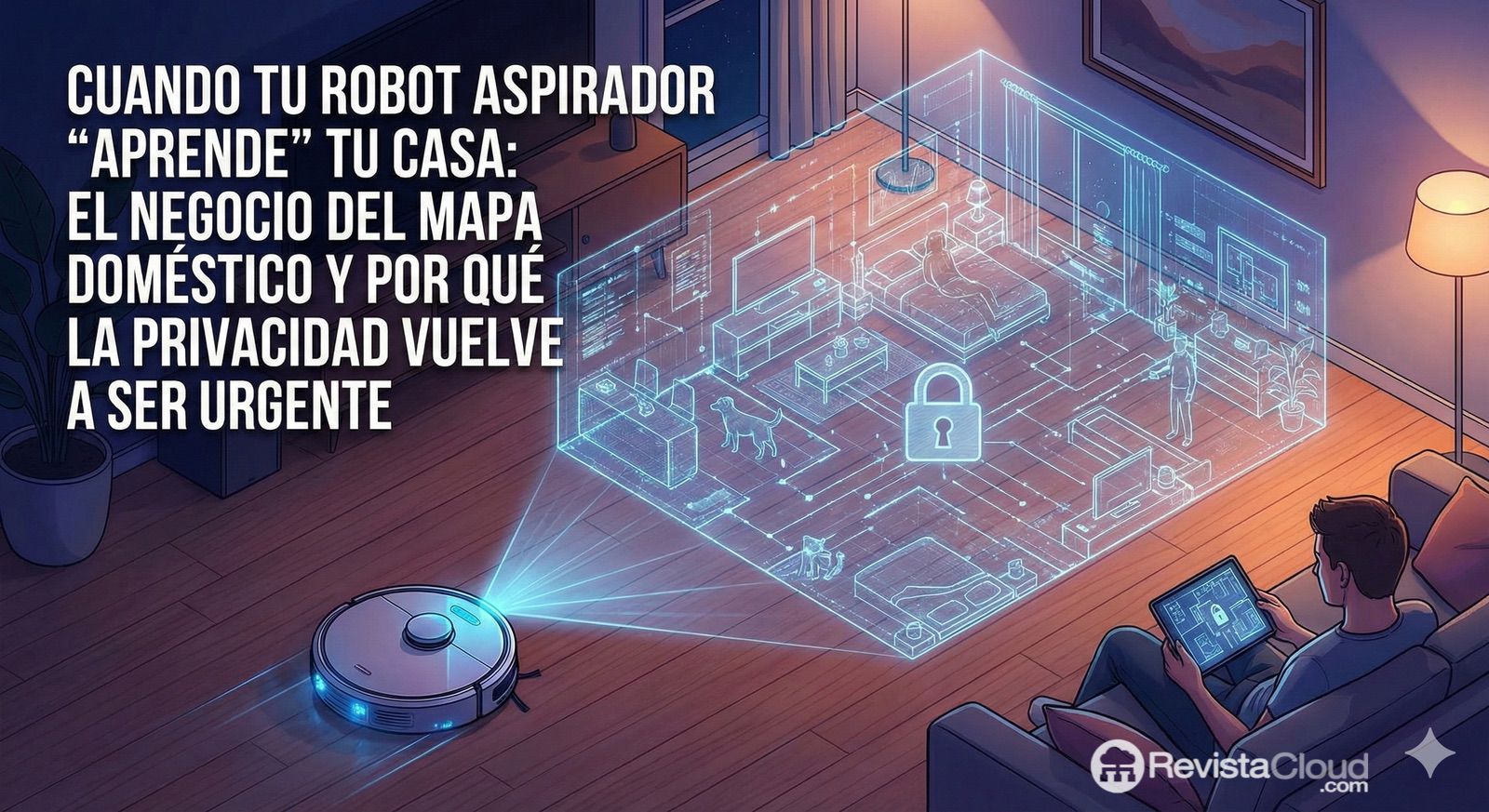
For years, the robot vacuum was the perfect example of useful technology: cleaning effortlessly, dodging obstacles, plotting more efficient routes, and, in the most advanced models, generating a fairly accurate map of the home. However, this “map” is not just a simple drawing: it’s a representation of the most sensitive private space that exists. By 2025, the debate has shifted from whether these devices can collect it to what happens when that information leaves the house, is centralized in the cloud, and becomes part of a business model.
The promise is usually convenient: the robot needs connectivity to update itself, improve navigation, sync maps, allow remote control, and enhance the user experience. The problem arises when connectivity stops being an extra and becomes a requirement: without telemetry, cloud, and service, the device ceases to function. At that point, the user no longer has a “smart” appliance but is left with a black box that decides what it can do… and when.
The case that raised alarms: constant telemetry and a “remote shutdown”
A recent incident illustrates how dependency on the cloud can become asymmetrical. An engineer noticed that his robot vacuum (an iLife A11) was sending telemetry data continuously to manufacturer servers. When he blocked that communication—while maintaining update servers—the device stopped working. After investigation, he concluded that his robot had received a remote “kill” order associated with losing contact with telemetry servers.
The most troubling part of the story isn’t just the functional block but what was uncovered deeper: the robot generated a 3D map of the home, and according to the research, part of the mapping stack was based on Google Cartographer, a common robotics tool used for SLAM (simultaneous localization and mapping). In other words: this isn’t “minor data”—it’s spatial information with enormous value for inferring habits, home layout, and routines.
Cases like this send a clear message: when a device depends on talking to the cloud to stay “alive,” practical control is no longer in the owner’s hands.
Why your home map is worth money (even if they don’t tell you this)
The domestic map is a coveted asset because it’s context. A floor plan approximates size, rooms, layout, permanent obstacles, passage zones, and even patterns (which rooms are cleaned more, at what times, with what frequency). When this information is aggregated at a platform level—across millions of homes—it can become a commercial asset: from product analytics and segmentation to third-party agreements or “smart home” ecosystems aiming to understand the user’s physical environment.
It’s worth clarifying: just because there’s an incentive doesn’t mean all brands “sell the map” outright. But it does mean that the data economy has reached the living room, bedroom, and kitchen. And when hardware margins narrow, the temptation to monetize services, subscriptions, or data increases.
The “smart speaker effect”: when listening becomes part of the product
The debate shouldn’t be limited to robot vacuums. The same pattern can repeat—or intensify—in other connected home devices:
- Smart speakers and voice assistants: by design, they’re prepared to capture audio (at least after the wake word). If processing is in the cloud, there’s a risk that audio fragments, transcriptions, or metadata (when, how much, from where) are used for training, service improvement, or commercial purposes.
- Connected cameras and smart doorbells: they turn the home into a constant video stream. Although most promise encryption and user control, history shows that leaks, misconfigurations, or third-party integrations can happen.
- Photos and videos we share: what’s “private” gets mixed with what’s “publishable” on social media and cloud backups. With generative AI, innocent images can feed into models, profiles, or recognition systems if there are no clear boundaries.
The common denominator is simple: the more sensors we put in the home, the greater the exposure surface. At the same time, it becomes harder to know what’s processed locally, what’s sent out, how long it’s stored, and who it’s shared with.
What consumers can (and should) demand from now on
Privacy in the connected home isn’t fixed with a single setting. It requires informed choices, configuration, and habits. Some realistic measures include:
- Prioritize “local-first” functions
If a robot vacuum can map and clean without relying on the Internet, that’s better. Cloud should be optional, not a requirement. - Separate the home network
Treat IoT devices as “guests”: separate Wi-Fi network, VLAN if possible, and firewall rules to restrict unnecessary outbound traffic. If the manufacturer demands full telemetry for operation, users should be informed before purchasing. - Review permissions and policies with a practical mindset
No need to read twenty legal pages: just look for three key points — what data they collect, for what purpose, and with whom they share it (including “affiliates” and “partners”). - Disable unused features
Remote control, map synchronization, advanced analytics… If it doesn’t offer real value, better to turn it off. Less data, less risk. - Exercise your rights
In Europe, GDPR provides tools (access, rectification, deletion, objection). If a manufacturer turns your home into telemetry, you have the right to ask “exactly what data do you have about me” and “why”.
The bottom line: your home should remain a safe space
Home technology is advancing rapidly, but conversations about privacy lag behind. Meanwhile, it’s becoming normalized for appliances to demand constant connection, apps to ask for excessive permissions, and devices to stop working if they don’t “talk” to remote servers.
If the market wants consumers to embrace “smart homes,” they must accept a fundamental idea: being smart can’t be incompatible with being private. And a home map shouldn’t become a silent bargaining chip.
Frequently Asked Questions
Does a robot vacuum need to send my home map to the cloud to work properly?
Not necessarily. Some models can map and navigate locally. The cloud usually provides synchronization, remote control, and extra features, but isn’t required for cleaning.
What personal data can a home map reveal?
Room layout, approximate size, frequently used zones, cleaning routines, and in some cases, inferences about schedules and habits when combined with telemetry.
How can I reduce the risk without giving up my robot vacuum?
Use a separate network for IoT devices, limit outbound Internet access if the device still functions, disable unnecessary cloud features, and choose models offering local options.
Why are smart speakers and connected cameras included in this discussion?
Because they follow the same pattern: sensors inside the home plus cloud services. The more data exits the house, the greater the potential impact if reused, shared, or leaked.
