
For years, the conversation about Artificial Intelligence in data centers has centered on the obvious: GPUs, accelerators, high-speed networks, and cooling systems capable of supporting racks that no longer work “part-time,” but continuously. However, in the real-world economy of an AI deployment—measured by electricity bills, rack density, downtime, and hardware refresh cycles—there is a component that is starting to take on a leading role: system memory.
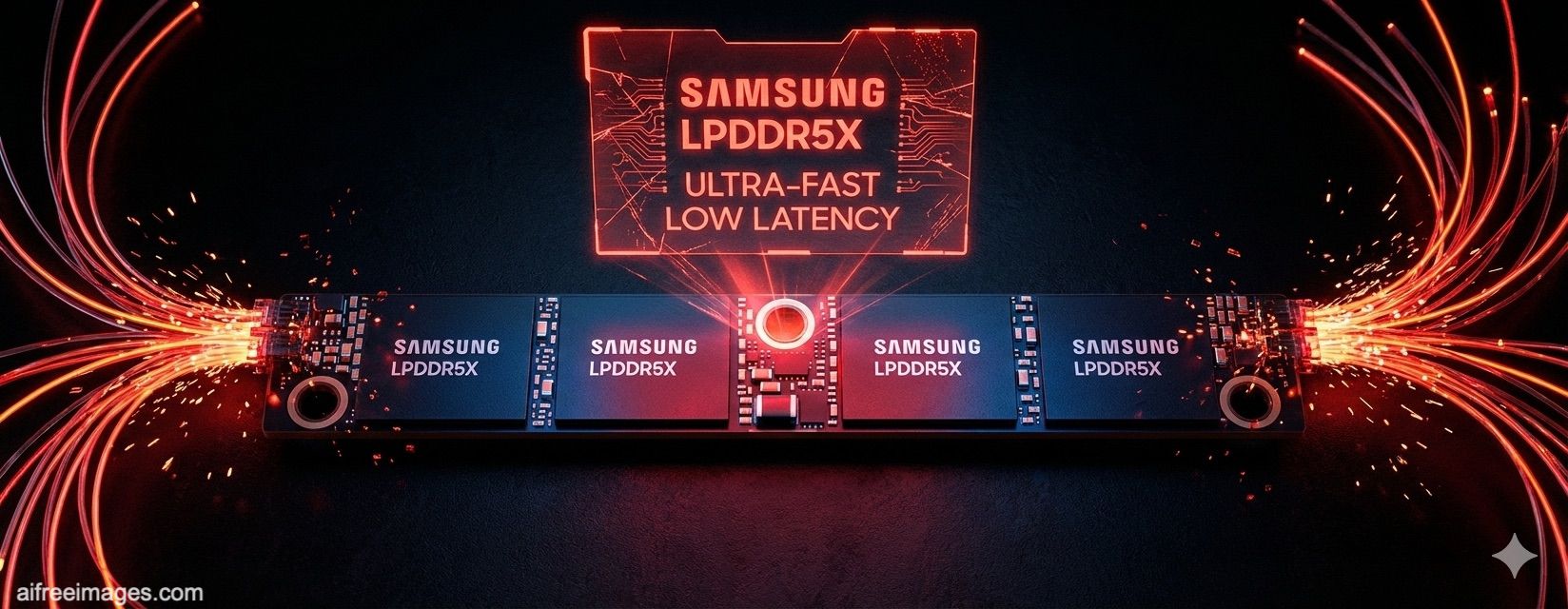
In this context, Samsung has introduced SOCAMM2, an LPDDR5X-based memory module designed specifically for AI-focused data center platforms. The proposal aims to bring some of the classic advantages of LPDDR memory—lower power consumption and high efficiency—to servers, without one of its long-standing drawbacks: the reliance on permanent board soldering, which complicates maintenance and limits large-scale upgrades.
What is SOCAMM2 and why does it matter
SOCAMM2 (Small Outline Compression Attached Memory Module) is essentially a way to package LPDDR5X chips in a modular, removable format designed for servers. The concept is simple to explain but complex to execute: bringing to data centers memory originally meant for mobile and portable devices (LPDDR) because of its energy efficiency, but doing so without turning each motherboard into a “full replacement or nothing” if a component fails or if capacity needs to be expanded in two years.
Samsung claims that this approach allows for higher bandwidth combined with lower power consumption compared to traditional DDR5 RDIMM modules, which continue to be the standard in general-purpose servers. The move is not intended to replace high-bandwidth memory (HBM) integrated with GPUs or accelerators—essential for training and high-performance inference—but to cover a different layer: the “near-CPU” system memory (or superchip CPU-GPU), where energy efficiency per watt begins to matter as much as raw performance.
From the machine room to the bottom line
In data center economics, each watt becomes a recurring cost: direct energy consumption, associated cooling, and rack density limitations. And memory, especially as AI workloads become increasingly “always on,” is no longer a trivial detail. The economic logic behind modules like SOCAMM2 is clear: if more data can be moved per watt consumed, total operating costs improve, thermal stress is reduced, and there is more room to add computing power in the same physical space.
Samsung’s argument focuses precisely on this point: memory can no longer be treated as a secondary optimization when data centers are transitioning toward sustained inference, with services generating tokens, summarizing documents, or supporting real-time assistants throughout the day.
The historical challenge: LPDDR in servers has always been “less friendly”
LPDDR has been notable for operating at lower voltages and incorporating aggressive power-saving mechanisms. The main issue until now was operational: it is often soldered onto the motherboard, as in many mobile devices. In a data center, this is a cultural and logistical barrier. Major operators assume that memory must be replaceable, expandable, or reusable without discarding entire boards or halting systems longer than necessary.
SOCAMM2 aims to resolve this clash between efficiency and serviceability: adopting a modular “compression-attached” (clamp-based) format designed to maintain the signal integrity required by LPDDR5X at high speeds, but allowing replacement and upgrades as part of normal hardware cycles.
A key point: JEDEC standardization
Beyond the specific module, what can truly accelerate—or hinder—its adoption is the ecosystem. The server market tends to distrust overly proprietary formats: reliance on a single supplier often translates into supply risk, less competition, and less favorable long-term purchasing conditions.
That’s why SOCAMM2 aligns with JEDEC’s JESD328 standard under the CAMM2 umbrella. In practice, standardization aims for LPDDR memory in a modular format to be interchangeable and “vendor-agnostic,” resembling the long-standing model represented by RDIMM. If this interoperability becomes solidified, the debate moves away from “a manufacturer’s gimmick” to an industrial category: low-power modular memory for AI servers.
Not just Samsung: Micron is already involved, and the market heats up
The indication that this isn’t just a single player’s game comes from competition. Micron has announced sampling of SOCAMM2 modules up to 192 GB based on LPDDR5X, with a similar message: increased capacity in a compact footprint, efficiency improvements, and direct targeting of inference workloads in AI data centers. This competitive pressure often transforms a technical promise into a real market: with multiple suppliers, enterprise buyers feel more secure planning deployments.
For financial media, this point is especially relevant: if SOCAMM2/CAMM2 becomes established as a standard, it could open a new “product race” in AI-oriented DRAM, with implications for margins, manufacturing mixes, and contracts with major infrastructure clients.
Fine print: latency, thermal considerations, and cost
Not everything is advantages. LPDDR5X tends to have higher latency than DDR5, partly due to design choices that enable speed and pin efficiency. For desktops or interactive workloads, that latency might be noticeable. However, in AI, performance is often more dependent on sustained bandwidth and parallelism, so latency can be amortized across many workflows.
Nonetheless, uncertainties remain: thermal behavior when chips are concentrated in a compact module, signal stability at high speeds, and maturity of support in platforms and firmware. Price is also a factor: LPDDR5X is not necessarily cheaper than DDR5, and SOCAMM2 adds mechanical complexity. Its value proposition rests on total ownership costs: lower power consumption, less cooling, higher effective density, and better hardware reuse.
A “unassuming” change that could redo rack architectures
The evolution of AI data centers is forcing a reassessment of assumptions once considered inviolable. For decades, server memory followed a stable pattern (DIMM after DIMM) with incremental improvements. With AI, the balance among compute, memory, power, and serviceability is breaking down. SOCAMM2 isn’t a splashy gimmick like a new GPU but represents a structural adjustment: if memory metrics shift toward “tokens per watt” and ease of large-scale operation, the dominant standards could begin to move.
Frequently Asked Questions
What differentiates SOCAMM2 from traditional DDR5 RDIMM memory in servers?
SOCAMM2 uses LPDDR5X in a modular, energy-efficient, high-bandwidth format, whereas DDR5 RDIMM is the most widespread general-purpose memory standard in servers. The key is the best performance-to-power ratio and physical footprint, along with serviceability tailored for AI environments.
Does SOCAMM2 replace GPU HBM in AI servers?
No. HBM remains the ultra-high bandwidth memory integrated into accelerators for intensive training and inference. SOCAMM2 targets system memory (CPU-attached or super-chip configurations), complementing HBM within the AI server memory hierarchy.
Why is memory energy efficiency so critical in AI inference?
Because inference workloads tend to be sustained and continuous. When thousands of servers generate responses around the clock, memory power consumption becomes a significant operational and cooling cost. Improving bandwidth per watt can impact rack costs and overall data center capacity.
What does a data center need to adopt SOCAMM2 modules?
Compatible platforms with designs supporting the “compression-attached” format (motherboards and controllers), firmware support, and a mature supply chain. JEDEC’s standardization effort aims to accelerate this ecosystem so it’s not dependent on a single manufacturer.
