
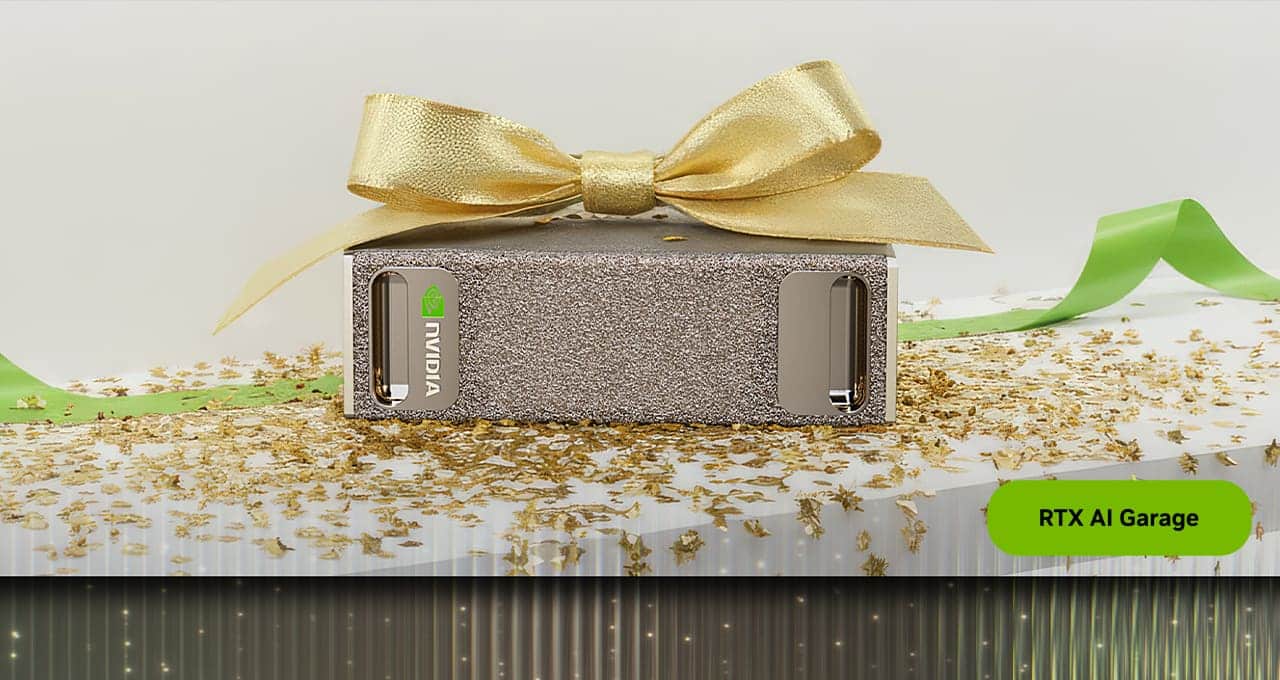
NVIDIA is doubling down on bringing fine-tuning of language models into the “real” developer environment: PCs with GeForce RTX, RTX PRO workstations, and compact setups like “mini supercomputers.” In a recent technical article, the company focuses on Unsloth, an open source framework geared toward efficient training with lower memory consumption, and links it with two tools they aim to make standard in workflows: the new NVIDIA Nemotron 3 family and the DGX Spark system.
The concept is clear: since small and medium models will form the foundation for many assistants and agents (support, automation, analysis, productivity), the challenge isn’t just running them but ensuring they respond consistently and finely tuned to specialized tasks. That’s where fine-tuning becomes a lever to “teach” behavior, domain knowledge, formatting, and operational limits.
Unsloth: the shortcut to fine-tuning models with less VRAM
According to NVIDIA, Unsloth has become one of the most widely used open source frameworks for fine-tuning, notable for its practical approach: specific optimizations that translate heavy operations (matrices, weight updates) into efficient GPU kernels. The company claims it can speed up Hugging Face Transformers by up to 2.5× on NVIDIA GPUs, as well as help reduce VRAM usage, lowering the entry barrier for experimentation on desktops and laptops.
The article reviews three main fine-tuning approaches, which practically determine budget, time, and risk:
- Efficient parameter tuning (LoRA/QLoRA): modifies a small part of the model. NVIDIA presents it as the “jack-of-all-trades” approach for most scenarios (domain, style, accuracy, alignment), with datasets of 100 to 1,000 prompt-response pairs.
- Full fine-tuning: updates all parameters, suited for more demanding cases (agents with strict rules, rigid formats, highly controlled behaviors) and requires more than 1,000 examples.
- Reinforcement learning: aimed at refining behavior with preference signals or rewards; NVIDIA frames this as an advanced technique, combinable with the others, but more complex to set up (model of action, reward, and environment).
The overarching message is that fine-tuning stops being “just for the lab” when there are tools that make it a repeatable process, with guides, notebooks, and quick-start routines.
Nemotron 3: “open” models designed for agents and long-context tasks
The second pillar is NVIDIA Nemotron 3, an open family of models presented as a starting point for building agent-oriented applications and fine-tuning workflows. Notably, Nemotron 3 Nano 30B-A3B is already available, and the company makes two concrete promises for this model:
- Up to 60% fewer reasoning tokens (reducing inference costs).
- Context window of 1,000,000 tokens, designed for lengthy, multi-step tasks.
NVIDIA positions Nano as suitable for debugging, summaries, assistants, and information retrieval, while Nemotron 3 Super and Nemotron 3 Ultra are slated as higher-tier models, with availability expected in the first half of 2026.
Along with the models, the company provides training datasets and reinforcement libraries, emphasizing that Nemotron 3 Nano can be fine-tuned with Unsloth.
DGX Spark: the “mini supercomputer” as a productivity argument
The third pillar is DGX Spark, described by NVIDIA as a desktop system based on the GB10 Grace Blackwell Superchip, with 128 GB of memory and a performance of 1 petaFLOP (theoretically FP4 using dispersity), designed for local prototyping, fine-tuning, and running models.
The message here isn’t just raw power but reduced friction: to run intensive workloads without cloud queues, with more memory than a typical consumer GPU, and capable of handling large models (up to 200 billion parameters in local setups, depending on the configuration).
The article also highlights that beyond LLMs, this kind of “box” aims to support creative and multimodal pipelines, referencing massive image generation and the idea of a comprehensive local workflow.
The key takeaway: the cultural shift in fine-tuning
More than a standalone announcement, this movement points to a trend: fine-tuning is shifting from a “project” into a natural phase in the lifecycle of assistants and agents. With open models (Nemotron 3), optimized training tools (Unsloth), and hardware that reduces dependencies (DGX Spark or RTX PCs), NVIDIA aims to normalize a pattern: download a model, adapt it to your domain, and deploy it locally — all from your desktop.
Frequently Asked Questions
What’s the difference between LoRA/QLoRA and full fine-tuning in real projects?
LoRA/QLoRA are generally quick ways to customize behavior and knowledge with less cost and VRAM; full fine-tuning is reserved for deep format, style, and strict control changes, requiring more data and resources.
What’s the purpose of a 1,000,000-token context window in a model like Nemotron 3 Nano?
It’s for long tasks where the model needs to “remember” large volumes of info: extensive documentation, histories, multiple files, or an agent sequencing many actions over time.
What do I need to fine-tune an LLM locally with Unsloth on an RTX GPU?
Typically, you start with a dataset of examples (e.g., 100–1,000 pairs for LoRA/QLoRA), a compatible NVIDIA GPU, and a transformer-based training stack optimized with Unsloth.
Does DGX Spark replace cloud training for models?
Not necessarily: it’s designed to accelerate local prototyping and fine-tuning with high memory and performance. For massive training or large-scale iteration, cloud or bigger infrastructure still makes sense.
via: blogs.nvidia
