
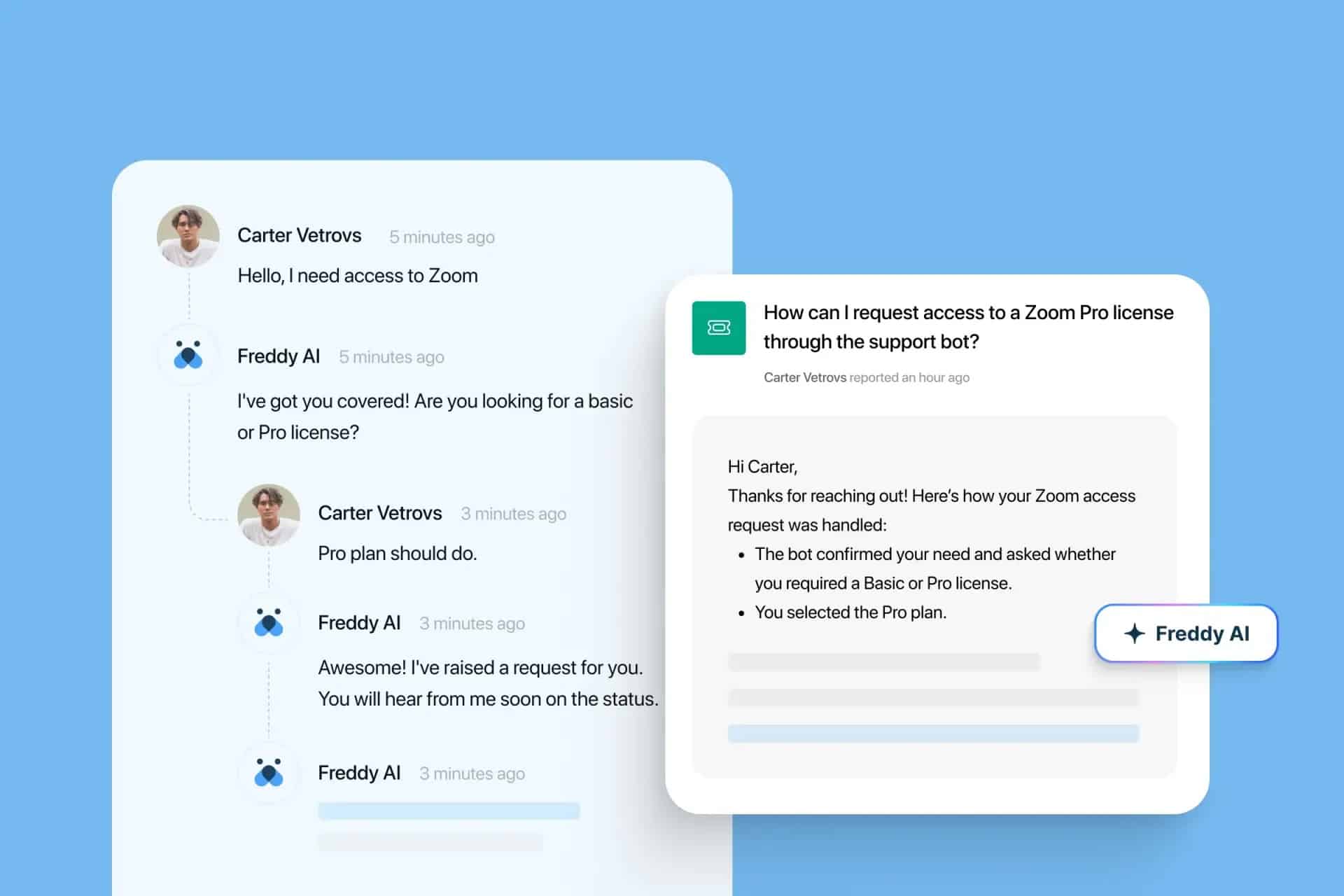
Freshworks has signed a definitive agreement to acquire FireHydrant, a company specializing in incident management software with AI capabilities. The stated goal is clear: to transform Freshservice — their IT Service Management (ITSM) platform — into the core of a broader offering that also covers operations, reliability, and incident response, in an approach the company describes as “AI-native ServiceOps.”
The transaction, whose financial terms have not been disclosed, is expected to close in the first fiscal quarter of 2026, subject to usual closing conditions.
Why is Freshworks moving now: fewer “siloed tools,” more coordinated response
Freshworks’ announcement outlines a problem many organizations are all too familiar with: managing critical incidents is often fragmented across disconnected tools for monitoring, alerts, on-call rotations, team coordination, and post-mortem analysis. This fragmentation tends to lead to delays, manual processes, and unshared learnings, pushing teams into a “firefighting” mode.
This is where Freshworks aims to fit FireHydrant: adding an incident response and reliability component (major incidents, on-call management, retrospectives) that connects with the management of services, assets, and dependencies in Freshservice. The promise is to reduce handoffs between teams, speed up resolution, and most importantly, turn post-incident analysis into operational improvements that prevent recurrence.
What FireHydrant adds to the equation
Founded in 2018 by Robert Ross and Dylan Nielsen, FireHydrant is described by Freshworks as a SaaS platform designed to structure incident response (particularly high-impact ones), with integrated on-call management and retrospectives, supported by AI features to summarize context and guide response flows.
The company cites clients like Palo Alto Networks, BP, and Qlik, indicating that the product has gained traction in environments where incident management is a discipline with real methodology and requirements, not just a feature.
The key word is convergence: ITSM + ITOM + Incident Response
Freshworks presents the acquisition as a step to “unify” historically separate capabilities: service management (ITSM), operations (ITOM), and incident management. The underlying message is that reliability is no longer maintained solely through well-managed tickets: it requires cross-visibleibility, real-time coordination, and the ability to continuously learn after each incident.
Within this framework, the company emphasizes three outcomes:
- Unified visibility: connecting problem detection with its resolution, minimizing handoffs.
- Faster response: leveraging AI to reduce noise, summarize context, and assist in following a structured “playbook.”
- Proactive IT: using post-incident data to identify patterns and prevent repeats.
What changes for customers and the real challenge: true integration
In operational software acquisitions, there’s a huge difference between “integrating” in marketing and achieving seamless integration in the product: identities, permissions, data, workflows, APIs, automation, reports, and ensuring everything works frictionlessly daily. Freshworks assures it will continue supporting, training, and developing FireHydrant customers, aiming to simplify operations through a unified experience.
Still, the success of this move depends on how well this unification translates into practical cases: from activating a war room with automatic context to linking a major incident with assets, recent changes, dependencies, and measurable corrective actions.
A move aligned with the “AI-native” narrative in operations software
Freshworks emphasizes the “AI-native” label, a growing trend in the market, but concretizes it with specific tasks: summarizing context, guiding response steps, reducing alert noise, and deriving learnings from post-mortem analysis.
Additionally, the company highlights its scale: nearly 75,000 companies trust its products. This volume is significant because, if the integration goes smoothly, Freshworks could offer a comprehensive “end-to-end” operations solution for customers seeking reliability without complex, lengthy deployments.
FAQs
What does a company that already uses Freshservice gain from acquiring FireHydrant?
Theoretically, a more comprehensive incident management layer (on-call, major incidents, retrospectives) connected with service and asset management, shifting from isolated tickets to more coordinated response and prevention.
Has it been announced how much Freshworks will pay for FireHydrant?
No. The deal was announced without disclosing the amount or other financial terms.
When will the FireHydrant acquisition close?
Freshworks indicates it expects to close in its first fiscal quarter of 2026, subject to usual conditions.
Does this replace on-call and incident management tools for DevOps/SRE teams?
The intent is for FireHydrant to provide these functions (on-call, structured response, retrospectives) integrated with Freshworks’ ServiceOps. However, the actual impact will depend on how it’s implemented in the product and organizationally.
via: freshworks
