
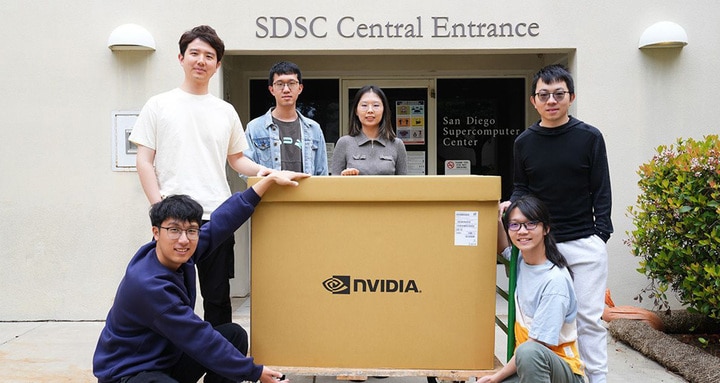
The race to serve low-latency language models is no longer won solely through papers and benchmarks: increasingly, success (or failure) is determined in the system lab, where the bottleneck often lies in how the model is “served” in production. In this context, the Hao AI Lab at the University of California, San Diego (UC San Diego) has incorporated a NVIDIA DGX B200 system to accelerate their large model inference work—a piece of infrastructure also available to the university community through the San Diego Supercomputer Center.
This news is of interest beyond the headline of “new hardware”: several approaches now considered standard—or at least unavoidable—in large-scale inference platforms are based on ideas originating from this group. NVIDIA emphasizes that research concepts developed at the Hao AI Lab have influenced current production inference solutions, including projects like DistServe, focused on improving efficiency without sacrificing user experience.
From “more tokens per second” to “good performance with user-exacted latency”
For years, the dominant metric for comparing inference engines was throughput: how many tokens per second the system can generate. The problem is that this figure alone doesn’t reflect what a person perceives while waiting for the model’s response. In practice, demanding lower latency usually means sacrificing some throughput.
This is where the concept of goodput comes in—a metric that aims to capture “useful” performance: the throughput maintained while meeting latency (SLO) targets. Popularized in this line of research, it becomes especially relevant as LLMs move from demos to products with real service commitments: it’s not enough to generate a lot; you need to generate quickly when it matters, consistently, and at controlled costs.
Separating prefill and decode: an architectural decision with real impact
In a typical inference flow, the system first performs prefill (processing the prompt to generate the first token), then enters decode (generating output tokens sequentially). Historically, both phases ran on the same GPU, creating resource contention: prefill is usually more compute-intensive, while decode tends to be more constrained by memory and efficient cache access.
The strategy of “disaggregation”—separating prefill and decode onto different GPU groups—aims to reduce this interference and improve goodput. NVIDIA frames this as a way to scale without sacrificing low latency and links it to NVIDIA Dynamo, their open-source initiative to bring this kind of disaggregated inference to operation-efficient environments.
Why DGX B200 here, and why now?
For a lab working on real-time model serving, a DGX B200 system isn’t just “more GPUs”: it’s a way to iterate faster, test more hypotheses, and validate with less friction. UC San Diego’s team articulates it as being able to prototype and experiment “much more quickly” than with previous generations.
Technically, the DGX B200 is conceived as a general-purpose system for training and inference, built on eight NVIDIA B200 GPUs and configured to meet high memory and internal communication demands. NVIDIA’s documentation highlights that the system integrates 1,440 GB of total GPU memory and high-speed interconnection via NVLink/NVSwitch—precisely the backbone that supports consistent low latency and sustained high performance under load. In other words: if the goal is to optimize not just the “model” but also the “serving,” the platform matters.
FastVideo and Lmgame-bench: real-time video generation and gaming as testing grounds
The deployment of the DGX B200 also ties into specific projects at the Hao AI Lab. One is FastVideo, which aims to train video generation models capable of producing five-second clips from a prompt in about the same time: five seconds. The goal targets an important psychological threshold for products: moving from “waiting” to “interacting.”

The second is Lmgame-bench, a set of tests that evaluate models using popular video games like Tetris or Super Mario Bros. Beyond the cultural nod, the engineering rationale is clear: games require making sequential decisions, adapting to changing states, and responding rapidly—conditions that closely resemble the demands on production agents operating within a system.
Industry perspective: inference as a discipline
When an academic lab receives a state-of-the-art DGX platform, it’s often seen as a capacity milestone. But the real background is that inference is establishing itself as a distinct discipline, with metrics (like goodput), architectures (such as prefill/decode disaggregation), and tools aiming to industrialize low latency without making costs an existential issue.
For the ecosystem, this is a clear signal: the next competitive advantage won’t come just from “training larger models,” but from serving them better—with more control over experience, efficiency, and scalability.
Source: Noticias inteligencia artificial
