
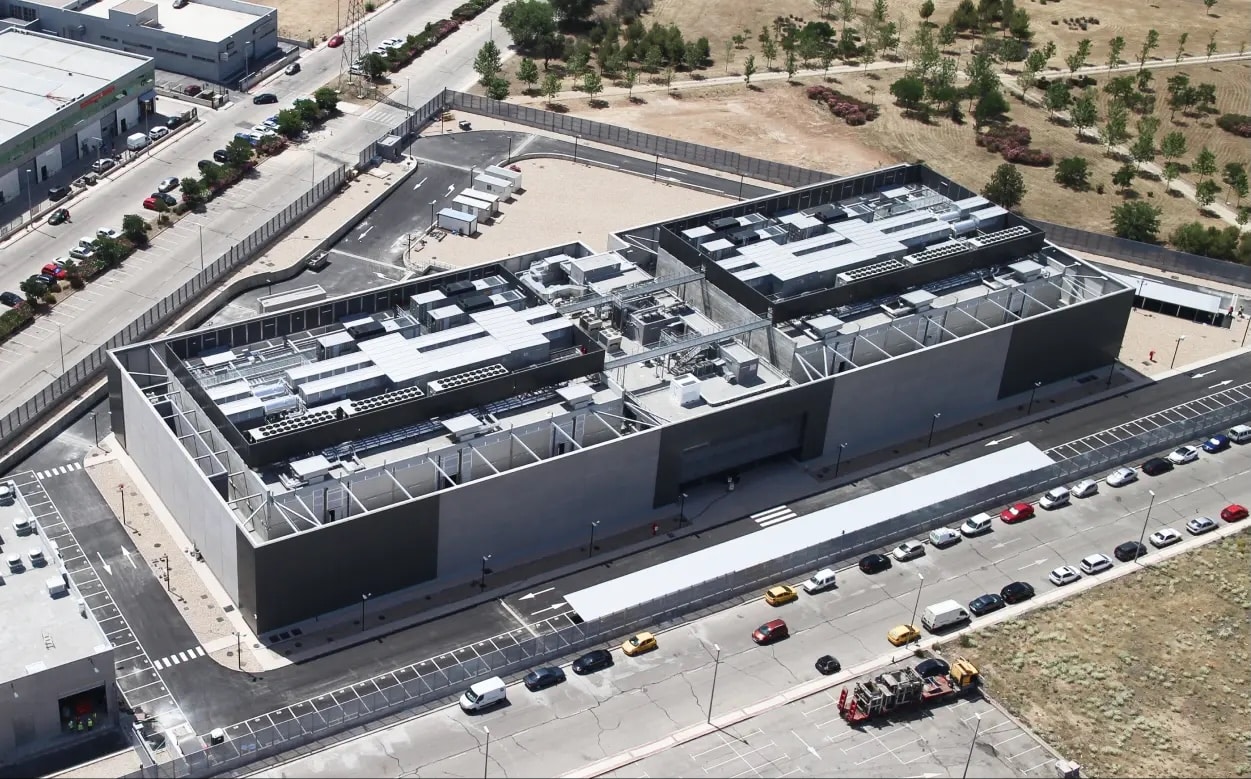
The European colocation industry is experiencing a new corporate shakeup. Templus has announced an agreement to acquire nine data centers from AtlasEdge located across Madrid, Barcelona, Milan, Zurich, Paris, Amsterdam, London, Leeds, and Copenhagen. This move marks the company’s most visible step—so far—toward establishing a pan-European network of “regional hubs” focused on high-growth markets.
The deal was publicly announced by the company itself and reported by financial media, at a time when the data center market is reshaping itself driven by three powerful forces: the expansion of hybrid cloud, the rise of AI demand for infrastructure, and the increasingly political need to keep data and services within local regulatory frameworks.
Nine locations and a clear map reading: being where demand is concentrated
The fact that the list of cities includes Madrid and Barcelona is no coincidence: Spain has been climbing the European digital infrastructure radar for years, especially due to energy availability, connectivity, and business dynamism. But the real message of the announcement is in the overall picture: Templus is not just buying “square meters,” but presence in nodes with existing commercial traction and mature technological ecosystems.
From a product perspective, these assets tend to align with an increasingly common idea in the sector: demand not only seeks hyperscale, but also proximity. Proximity to reduce latency, meet data residency requirements, serve regulated industries, or deploy distributed architectures (including AI inference close to end-users). In this context, a network across European capitals and hubs allows operators to compete not just on price, but on coverage and delivery capacity.
Over 60 MW and 750 clients: size enough to compete in a different league
In its statement, Templus frames the deal as the beginning of its international expansion and states that, with this acquisition, they reinforce strategic positions in the Spanish market and now manage more than 60 MW and 750 clients across high-growth colocation markets.
This figure, beyond the headline, has practical implications: once a certain capacity and customer base threshold is reached, operators can negotiate better with critical suppliers (power, connectivity, equipment), professionalize support even further, and offer more comprehensive catalogs (interconnection, managed services, continuity options, etc.). For clients, the appeal is often straightforward: more locations under a single provider with unified operational policies.
The “how” matters as much as the “what”: integration, customer experience, and transparency
There’s a significant difference between acquiring assets and turning them into a coherent network. From this point, the market typically focuses on three aspects:
- Real operational integration: procedures, monitoring, physical security, maintenance, change management.
- Customer experience: contracts, SLAs, support, portals, the ability to scale between sites.
- Transparency: what changes for existing customers, what remains, what improves, and on what timelines.
In multi-country operations, this point is crucial: each location has its own realities regarding electrical providers, local regulations, maintenance practices, and operational cultures. If the acquisition results in visible improvements (better interconnection, standardized processes, clear growth pathways), the market rewards it. If it’s perceived as a collection of “islands,” the narrative cools down.
AtlasEdge and the context: consolidation to build “regional” networks in Europe
AtlasEdge has grown in Europe with a focus on distributed infrastructure. This positioning makes such assets especially attractive to operators seeking rapid geographic scale without waiting for the full design–permits–construction–commissioning cycle.
Indeed, the underlying trend is clear: European colocation is consolidating at two speeds. On one side, large campuses— increasingly linked to AI and cloud demands. On the other, regional networks serving businesses, administrations, and digital providers that require proximity, compliance, and continuity.
What it means for the market: more competition in “European network,” and a pressure to differentiate
For the sector, Templus’s move points to a scenario with more operators promoting a clear message: “Multiple countries, one partner”. This directly competes with:
- Strong local operators (who succeed through specialization and proximity).
- Pan-European providers (who benefit from scale and catalog offerings).
- Public cloud providers and integrators (who win via deployment speed, though not always control or cost).
At this stage, differentiation shifts from just “we have racks” to “what continuity, security, connectivity, and sustained operation services we can guarantee, and how we do it across jurisdictions.” An additional factor increasingly enters the equation: the conversation about sovereignty and control, not just for compliance but as a resilience strategy.
Frequently Asked Questions
What does it mean for a company that Templus invests in multiple European data centers?
It can simplify the process of consolidating colocation providers and scaling services between sites (e.g., Madrid–Paris or Barcelona–Milan) with more unified management.
Why is the MW capacity figure important for a data center operator?
Because electrical capacity sets the actual growth ceiling (more racks, higher density, more clients) and usually correlates with infrastructure investments and expansion opportunities.
What are the advantages of a “regional” data center network versus a large hyper-centralized campus?
It typically offers better proximity to users and corporate sites, lower latency for distributed services, and more options for meeting data residency or regional continuity requirements.
What should current clients ask after a data center acquisition?
Whether contracts or SLAs will change, what the integration plans are (operations, security, support), if connectivity/interconnection will improve, and the roadmap for expansion by location.
Source: LinkedIn
