
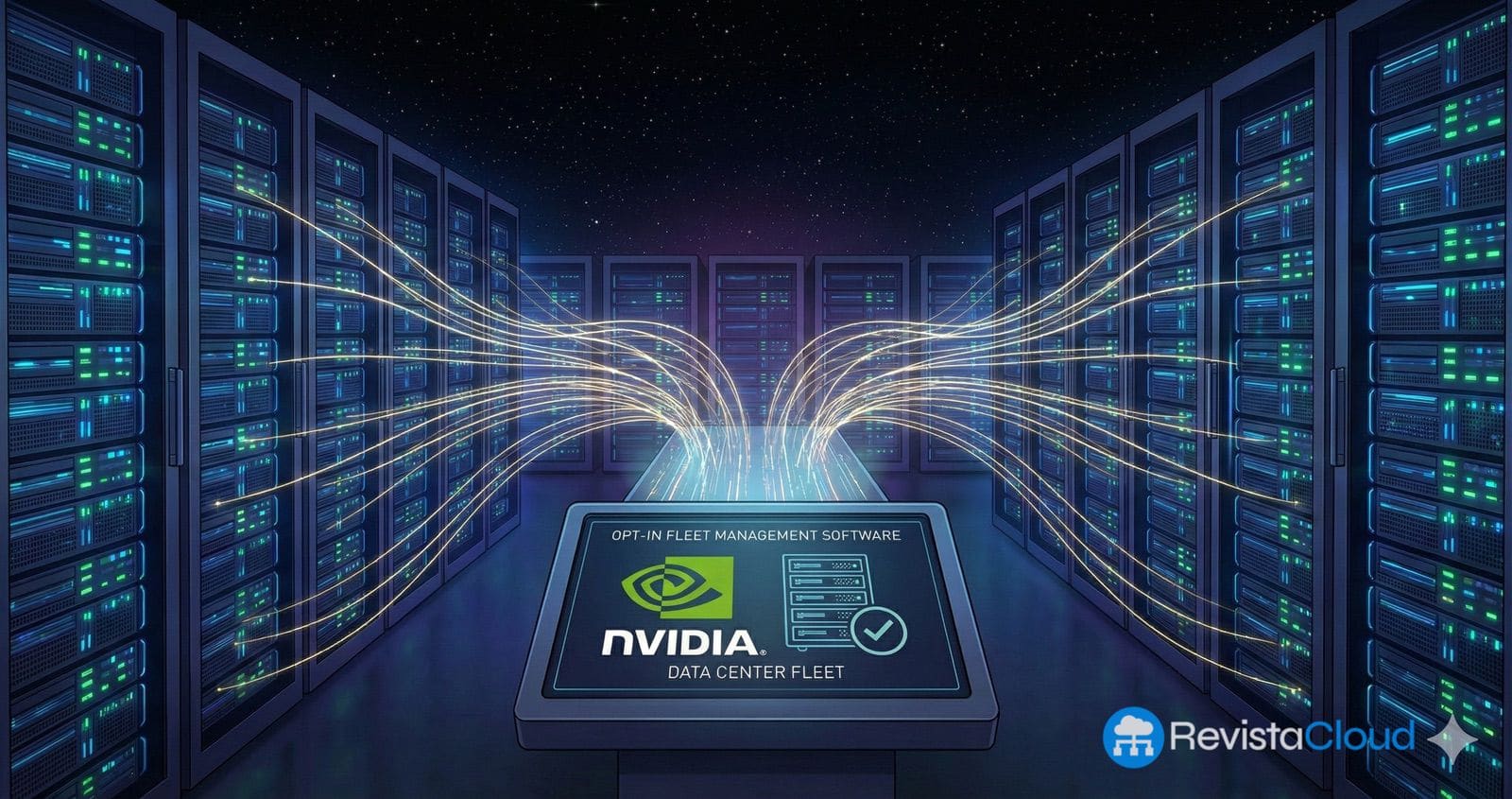
As AI infrastructure grows in size and complexity, data centers are increasingly resembling a living organism rather than a room full of servers: thousands of components operating at their limits, consuming energy at variable rates, and generating heat that, if unchecked, can cost money, reduce performance, and cause failures.
In this context, NVIDIA announced that they are developing an optional (“opt-in”) service to visualize and monitor large-scale GPU fleets, featuring a dashboard aimed at cloud partners and companies running accelerated computing infrastructures. The stated goal is clear: improve availability (uptime) and help these systems operate at their “optimal” efficiency and reliability. The announcement was published on December 10, 2025 and carries a message the company has reiterated in recent months: NVIDIA GPUs do not include hardware tracking technology, “kill switches,” or backdoors.
A “dashboard” to avoid flying blind: energy, temperature, configuration, and failures
The idea is straightforward: if an operator can see what’s happening in their fleet in real-time, they can fix issues earlier. According to NVIDIA, the service will enable:
- Detecting consumption peaks to stay within energy budgets without sacrificing performance per watt.
- Monitoring utilization, memory bandwidth, and interconnection health at the fleet level.
- Identifying hotspots and airflow problems before thermal throttling or premature component wear occur.
- Validating consistent software configurations, which is critical for reproducibility in training or inference.
- Locating errors and anomalies to anticipate parts beginning to fail.
Practically, the focus isn’t just on “measuring” but on enabling operational decisions: detecting bottlenecks, reducing thermal degradation risks, and improving infrastructure productivity to maximize return on investment.
An installable agent, and open source too
The most notable aspect of the design is that it relies on a software agent installed by the client on their nodes. This agent sends telemetry data to a portal hosted on NVIDIA NGC, where operators can view the overall fleet status or by “compute zones” (groups of nodes within a physical location or cloud region).
NVIDIA states that the toolset is intended to be open source, aiming to promote transparency and auditability, and to serve as an example for those integrating these metrics into their own monitoring solutions. The company emphasizes that the system provides read-only telemetry: it displays inventory and metrics but cannot modify GPU configurations or change underlying operations. It also supports generating reports with detailed fleet information.
The elephant in the room: suspicions, tracking, and “is this a backdoor?”
The announcement is not made in a vacuum. Recent weeks have seen media reports connecting these capabilities to debates over high-value chip control and their use in countries under restrictions, amid smuggling and regulatory pressures. Some reports mention software-based verification technologies that might estimate usage locations, but NVIDIA’s corporate messaging remains focused on clarifying limits: no remote hardware control, no mechanism to disable chips remotely, and telemetry managed solely by the customer.
For NVIDIA, the line is about trust: the company argues that implementing hardware-level control would pose security risks and incentivize attackers, and could undermine the credibility of digital infrastructure. This stance is reiterated in previous statements about “kill switches” and backdoors.
In essence, NVIDIA is playing both sides: providing operators with tools to monitor health, energy, and reliability of massive fleets, while simultaneously reducing fears that this monitoring could covertly serve as a control mechanism.
Implications for data center operators
Beyond political debates, the practical issue for infrastructure managers is straightforward: in environments with hundreds or thousands of GPUs, failing to identify problems early can be costly. Recurrent hotspots might mean lost performance; inconsistent configurations could compromise cluster stability; error patterns could predict expensive hardware failures at critical moments.
Furthermore, since the service is external and optional, adoption depends on internal priorities: data sovereignty, telemetry policies, compliance requirements, and willingness to send metrics to an NGC portal. NVIDIA emphasizes that participation is opt-in and that installation is the responsibility of the customer.
More details coming at GTC 2026
NVIDIA invites stakeholders to learn more at GTC 2026, scheduled in San Jose, California, from March 16 to 19, 2026. The official agenda extends the conference from Monday to Thursday, with in-person workshops on March 15.
Frequently Asked Questions
What is GPU fleet monitoring software, and how does it serve data centers?
It’s a system that centralizes metrics (usage, power, temperature, errors, status) from many GPUs and nodes to detect issues, optimize performance, and improve availability in AI infrastructures.
Can NVIDIA’s agent change GPU configurations or act as a “kill switch”?
According to the company, no: telemetry is read-only, and the software cannot modify configurations or underlying operations. NVIDIA also affirms that its GPUs contain no “kill switches” or backdoors.
What types of problems does it help detect in training and inference clusters?
Detection of energy spikes, thermal hotspots, interconnection anomalies, software inconsistencies across nodes, and errors that could foreshadow hardware failures.
Where are fleet data visualized, and how is information organized?
Metrics are sent to a portal hosted on NVIDIA NGC, with dashboards allowing oversight of the entire fleet or by “compute zones” (physical locations or cloud regions).
via: blogs.nvidia
