
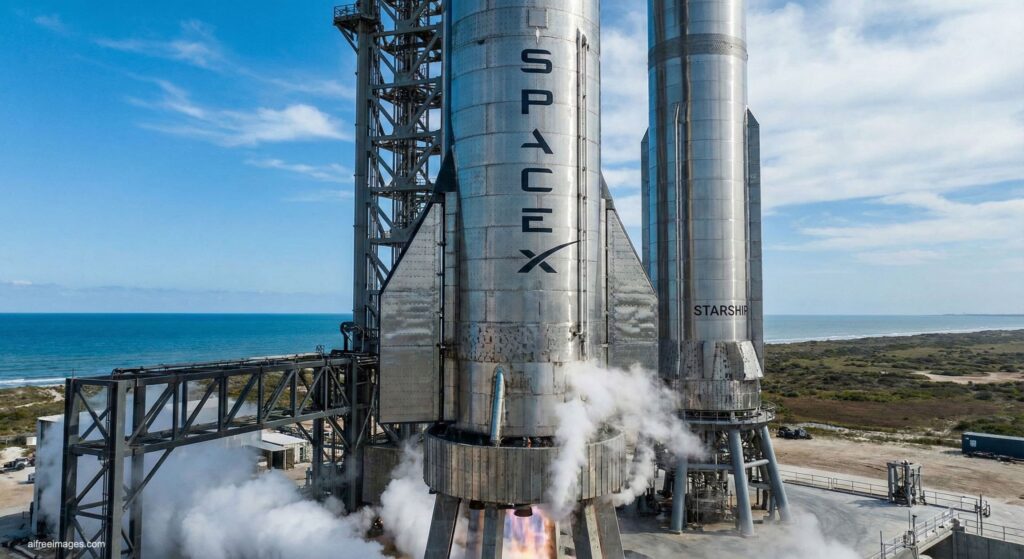
A thread gaining traction on X claims that Elon Musk has “confirmed” that SpaceX will go public in 2026 with a valuation of $1.5 trillion, and that the real goal is to “win the AI race” by deploying orbiting data centers powered by solar energy.
The problem is that, when separating enthusiasm from verifiable data, the story deflates. Not because the energy demands of AI do not exist (they do), but because the narrative mixes real facts, projections, and impossible jumps in engineering and economics.
1) Has Musk “confirmed” that SpaceX will do an IPO in 2026?
There is no formal public confirmation from Musk like “SpaceX will go public in 2026.” What exists is recent journalistic reporting that suggests the company has spoken with investors about a possible timeline, but that does not equate to an official announcement or a prospectus for an IPO.
Specifically, Reuters reported that SpaceX may have indicated a goal to go public in the second half of 2026, according to a report from The Information; it’s also noted that SpaceX did not respond to comment requests and Musk had previously mentioned the possibility of listing Starlink when the business was more predictable.
Plain language summary: today, talking about “confirmation” is an overstatement. The responsible stance is to describe it as a tentative plan/informed rumor, not a formal announcement.
2) Is the “energy crisis” of AI real?
Yes. The escalation of electricity consumption associated with data centers (including AI) is at the heart of industry and regulation debates. Goldman Sachs has popularized a widely cited figure: the electrical demand of data centers could increase by 165% by 2030 (driven by AI, cloud services, and other factors), as part of a widely circulated analysis by the firm itself.
And when considering real-world economics, infrastructure spending also shows impacts: Oracle, for example, reports a significant increase in investment efforts, with $20.5 billion in capex in the first half of its 2026 fiscal year (per its earnings report).
This doesn’t prove “there’s not enough electricity,” but indicates the sector is undergoing aggressive investment.
Important note: many viral threads mix concepts (average power vs. installed capacity, generation vs. peak demand, etc.) to make figures “more frightening.” The underlying issue (energy and grid pressure) is real; the numerical detail in many posts is often exaggerated or inaccurate.
3) “Orbiting data centers” as a solution for energy? The idea exists, but not as presented
This is where the thread often blurs the line between the futuristic and the implausible.
Yes, research and projects around space-based computing and “space data centers” are underway. For example:
- Google has publicly discussed research into running compute loads (TPUs) considering the space environment (radiation, reliability, etc.), as part of the broader debate on off-Earth computing.
- In Europe, the ASCEND study (led by Thales Alenia Space) has explored the viability of space data centers, highlighting potential theoretical advantages (solar power, reduced land/water use), but also significant technical and economic challenges.
However, claiming that SpaceX will “start in 2026” deploying massive AI data centers in orbit as a substitute for terrestrial data centers is a huge leap—unsupported by concrete announcements at the level the thread suggests.
The overlooked bottleneck: heat dissipation in space
On Earth, cooling is costly; in space, it’s physically different: there’s no convection like here. Heat is mainly dissipated through radiation, requiring large and heavy radiators. In other words: you can have “sunshine 24/7” in certain orbits, but computing generates heat that must be removed.
Another challenge: bandwidth and usable latency
Even with laser links between satellites, most useful data (datasets, users, services) remains on Earth. Moving data “up and down” for large-scale training involves huge costs and operational complexity.
4) The most suspect figure in the thread: “300–500 gigawatts per year” in satellites
Here is a quick calculation (no aerospace engineering degree required):
- 300 gigawatts (GW) equal to 300,000 megawatts (MW).
- Assuming (optimistically) a “miraculous” power density of 1 kilowatt per kilogram (1 kW/kg) for the entire system (panels, structure, radiators, electronics):
- 300 GW = 300,000,000 kW
- At 1 kW/kg ⇒ 300 million kg of hardware, i.e., 300,000 tons in orbit every year.
This already sounds unrealistic even before accounting for costs, launch cadence, assembly, maintenance, failures, space debris, and reentries. And that 1 kW/kg is an extremely optimistic assumption for a complete system with thermal management.
In summary: the “gigawatt per year” number is the kind of figure that gains traction online… but falls apart under simple calculations.
5) “Everyone’s after Elon”: the verifiable but nuanced part
The thread also mentions other actors. Some points are accurate; others are exaggerated:
- It’s true that Eric Schmidt has appeared linked to the space sector: reports indicate he took a CEO role and holds ownership shares in Relativity Space.
- Interest in orbital computing/infrastructure does not mean a race is won or that short-term viability as a “solution” to AI energy demands is assured.
6) So, what are the reasonable conclusions?
- SpaceX IPO in 2026: there are signals and reports, but calling it “confirmed” is an overstatement.
- The energy demands of AI are real and they are accelerating investments and concerns in the sector.
- Space-based data centers: research exists, but framing it as an “imminent plan to replace the power grid” today is more viral storytelling than a verifiable roadmap.
Frequently Asked Questions
Can SpaceX go public in 2026?
It’s possible, but currently the most prudent stance is to consider it a tentative goal reported by the media, not an official announcement.
Would an orbiting data center be cheaper than one on Earth?
In the short term, probably not. Launch costs, operation, radiation, and especially thermal dissipation complicate and increase expenses.
Can AI truly spike electricity consumption?
Yes. Analyses project significant increases in data center energy demand by 2030 driven by AI and cloud computing.
What’d be the most plausible use “in space”?
Niche cases: edge processing for communications, observation, defense, or specific services where the value of orbit outweighs the costs. Not “training everything in space.”
Source: X Ric_RTP
