
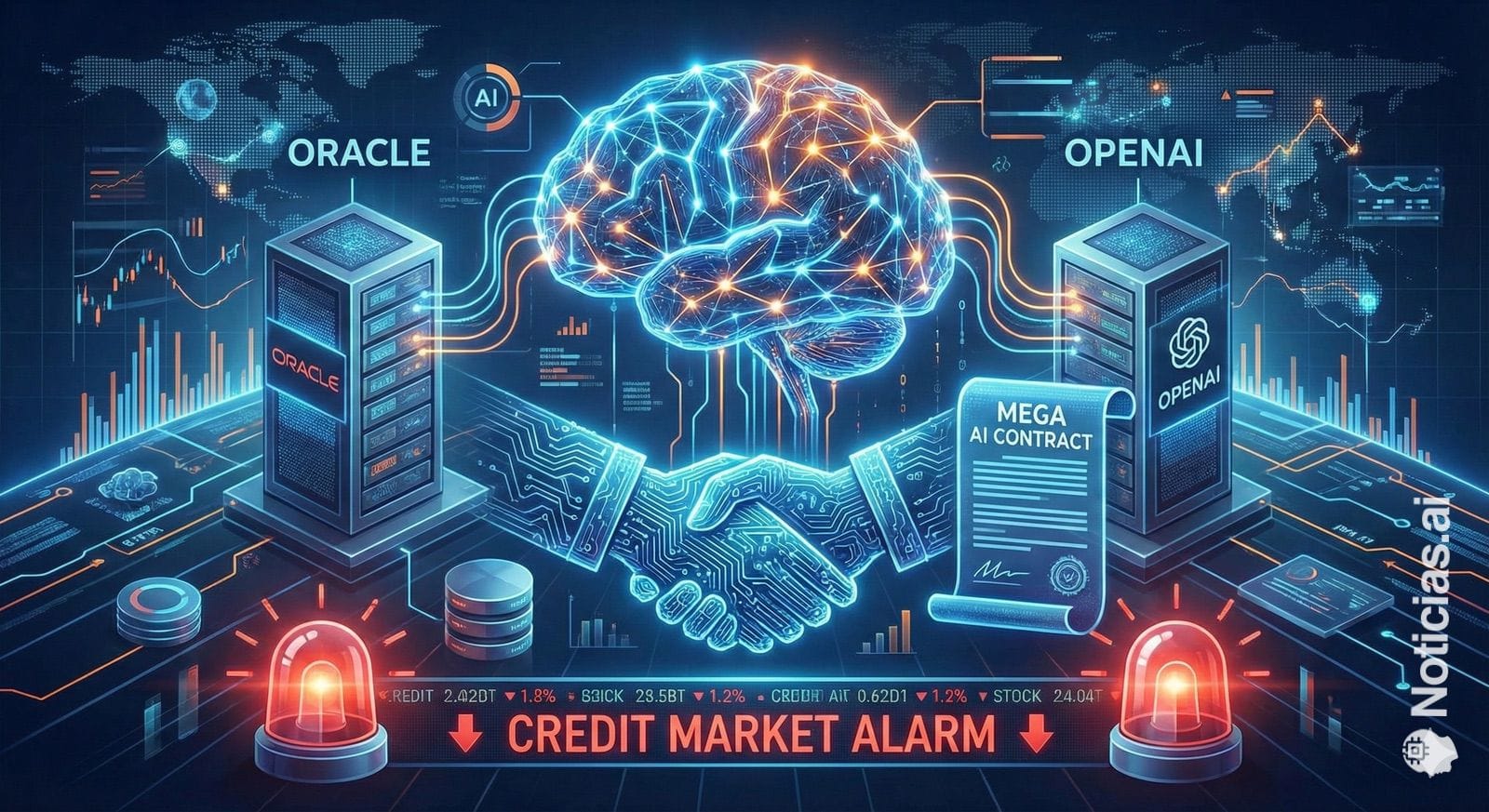
Fear doesn’t always arrive first in the stock market. Sometimes it appears earlier in a market that many retail investors barely watch: the credit default swaps (CDS) market, a sort of “insurance” against default. This week, the price of that insurance for Oracle shot up after earnings were released and its spending on data centers linked to Artificial Intelligence increased — a move that has reignited an uncomfortable question: To what extent is the large-scale infrastructure deployment for the AI era supported by future revenues that don’t yet exist?
The warning signal was clear. Oracle’s five-year CDS moved around 139 basis points (and at times above), levels that various analysts have described as multi-year highs. Meanwhile, the market punished the stock and scrutinized the bill for the plan: Oracle increased its capex (investment) to about $50 billion for the fiscal year, largely driven by AI infrastructure, which has also pressured its free cash flow, with significant negative figures in recent quarters.
A colossal contract that makes everything more sensitive
The story is better understood by focusing on the most talked-about piece: the agreement by OpenAI to purchase massive computing capacity and data centers from Oracle for approximately five years — an agreement some media sources estimate up to $300 billion. If this figure were fully realized, the scale would average around $60 billion per year, explaining why the credit market has become so sensitive to signals of delays, cost overruns, or lower demand.
The same math sets a very high bar for OpenAI: Reuters reported that the company might generate around $13 billion in annualized revenue in 2025. This underscores the rapid growth needed to absorb commitments of this scale without causing ongoing losses on the income statement.
“Stargate” and the race for gigawatts
The context is even more ambitious when looking at the full picture. OpenAI has introduced Stargate as an effort to multiply the computing capacity required for AI, with industrial partners and a narrative of “AI factories” pointing toward massive deployments of energy and cooling. Within this framework, OpenAI has detailed capacity expansions with Oracle (including several additional gigawatts), and SoftBank has announced plans for significant investments in related infrastructure.
In practical terms, this translates AI into more earthly terms: land, permits, substations, grids, water, cooling, and a construction timeline where a delay of months could change everything. For markets, it’s not just about “AI being the future”, but whether data centers are delivered on time and filled with clients paying enough fees to justify investments that, due to their size, resemble national infrastructure projects more than typical tech cycles.
The “snake eating its tail”: when capital recirculates
A metaphor gaining traction in finance networks and analysis is the ouroboros, the snake that eats its own tail. The idea is that part of the money financing the ecosystem’s growth recirculates among the same players: big investors backing AI companies; AI companies buying chips and cloud capacity; suppliers reinvesting to expand infrastructure. Reuters has even described how OpenAI could turn some of its support into buyers in this emerging computing economy.
This doesn’t automatically imply a bubble or fraud, but it increases a risk that credit markets tend to spot before narratives do: correlation. If demand cools, the adjustment could hit investments, capex, margins, and financing simultaneously, because many gears depend on growth happening “now,” not in a decade.
The Achilles’ heel: real adoption and measurable returns
The big question isn’t fundamentally technological — it’s business-related. And here, data often doesn’t match the enthusiasm. A study cited by outlets like Fortune and Axios pointed out that most organizations still see no measurable ROI from generative AI, with very high percentages reporting “zero ROI” in initial deployments; McKinsey has noted that a significant portion of companies still don’t see direct impact on their financials.
This doesn’t mean AI won’t transform entire sectors. It means that the pace of adoption matters. If corporate adoption follows more gradual curves similar to cloud (years of maturity) rather than an immediate “boom,” the disconnect between enormous investments and monetization could strain balance sheets, especially for those relying more heavily on debt or rigid commitments.
Without a public “safety net”: the market’s verdict
An additional element fueling nervousness is the expectation of a government rescue. Some analysts dismiss this outright. In the U.S., figures from the White House have insisted that there will be no “bailout” for private AI bets, a message that, if consistent moving forward, leaves companies and investors facing a classic scenario: if the numbers don’t add up, they’ll have to cut back, refinance, or restructure.
What to watch from now on
At this stage, the debate splits between those who see Oracle as a player capable of crossing the investment valley with its existing core business acting as a cushion, and those who believe that the size of the “jump” in data centers introduces too much financial risk. In the short term, five signals the market will scrutinize closely:
- Evolution of free cash flow and capex quarter over quarter.
- Actual delivery schedule of data centers (and potential delays).
- Contracted capacity vs. built capacity (effective utilization).
- Funding rounds and OpenAI’s revenue (growth rate and quality).
- Credit tensions (CDS spreads, bond spreads, and ratings).
For now, the “canary in the coal mine” doesn’t signal a collapse. But it’s a reminder of something often forgotten during tech booms: when infrastructure costs hundreds of billions, even the magic of technology runs into accounting limits.
Frequently Asked Questions
What does rising Oracle CDS mean, and why does it matter for an AI data center bet?
Higher CDS costs indicate the market perceives increased credit risk. In heavy-capex investments like AI data centers, this can raise financing costs and pressure the company’s balance sheet.
What is the agreement worth — up to $300 billion — between Oracle and OpenAI, and what does it mean annually?
It’s a multi-year commitment to purchase computing capacity and data centers. If fully executed, the average would be around $60 billion per year, but actual cadence depends on delivery milestones.
Why is AI infrastructure measured in gigawatts rather than just “more servers”?
Because the bottleneck isn’t just hardware anymore — it’s available energy, grid connections, cooling, and the logistics of building large-scale facilities.
How can a company measure ROI from generative AI without incurring hard-to-justify expenses?
By defining use cases with clear metrics (time savings, incident reduction, conversion rates), pilots with data and cost controls per user/process, and scaling only what shows real impact.
via: Shanaka Anslem Perera and Twitter X
