
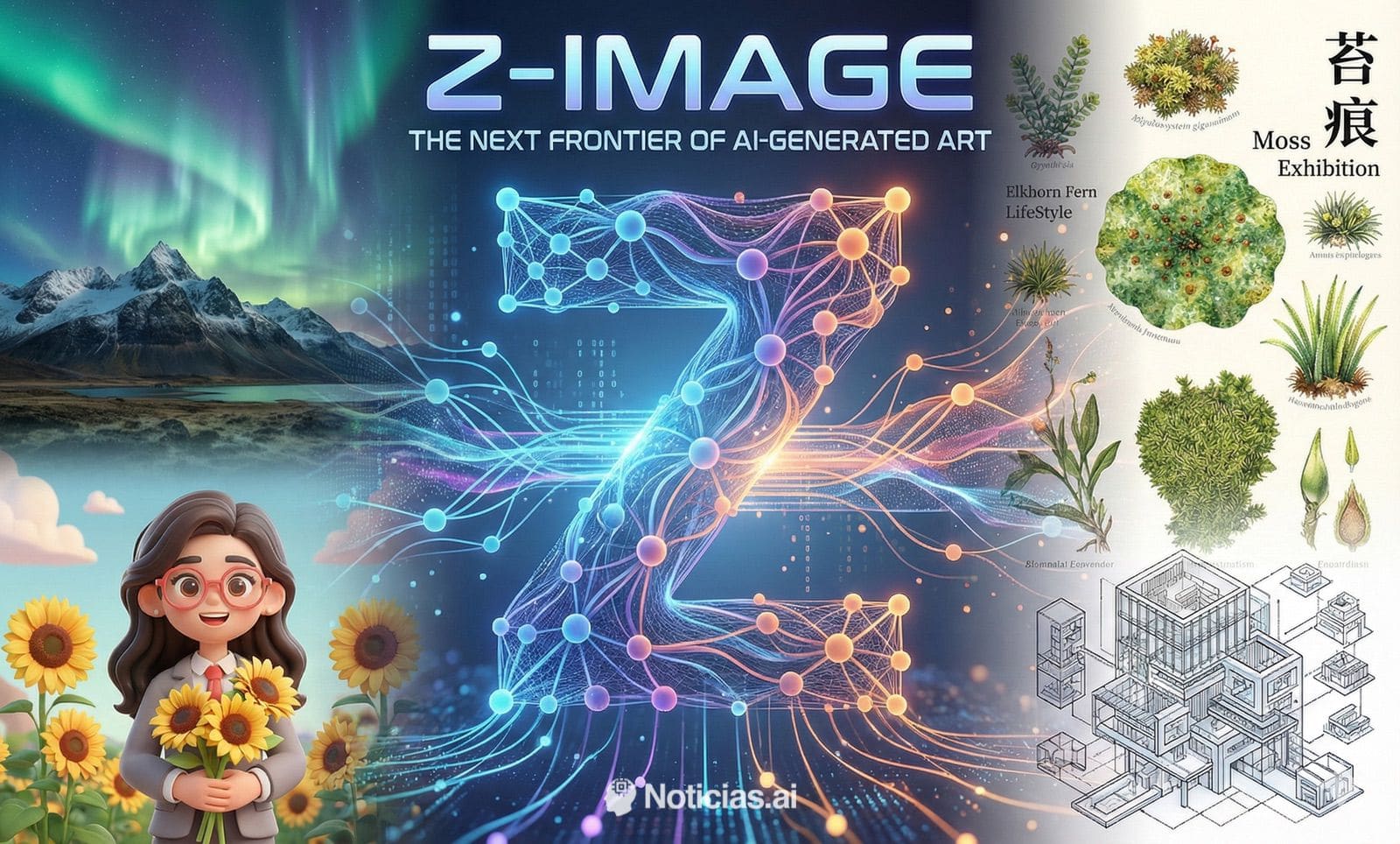
The landscape of AI-generated images is predominantly controlled by large proprietary models with tens of billions of parameters and substantial computational requirements that are tough for anything beyond hyperscale organizations to handle. Against this backdrop, Z-Image emerges as an open model with 6 billion parameters, taking a much more pragmatic approach: delivering top-tier results, but with enough efficiency to run on consumer GPUs and realistic enterprise environments.
Behind the project is the Z-Image team affiliated with Alibaba’s ecosystem, presenting this model as an open alternative to proprietary systems like Nano Banana Pro or Seedream 4.0, and competing with other large open-source models such as Qwen-Image, Hunyuan-Image-3.0, or FLUX.2, which operate in the range of 20 to 80 billion parameters.
Three models to cover the entire cycle: generation, base, and editing
The Z-Image family is centered around three main variants:
- Z-Image-Turbo
This is the distilled and optimized version of the model. Its key advantage is that it requires only 8 inference steps (NFEs) to generate an image, achieving latencies under one second on H800-class GPUs, and comfortably functioning on consumer devices with less than 16 GB of VRAM. It’s designed for production deployments and interactive applications where every millisecond counts. - Z-Image-Base
This is the foundational, undistilled model, aimed at developer communities and research teams interested in performing fine-tuning for specific sectors: fashion, gaming, product design, marketing, illustration, etc. By providing access to the base checkpoint, the project opens the door for ecosystem-derived adaptations and derivatives. - Z-Image-Edit
Built on the base model but fine-tuned specifically for image editing tasks. It allows transforming images via natural language commands—in Chinese or English—with a clear emphasis on maintaining semantic control: changing styles, adding elements, modifying backgrounds, or tweaking visual details without destroying the original content.
In all cases, developers highlight the photo-realistic quality, the ability to accurately render text in English and Chinese, and good compliance with prompt instructions.
A “single-stream” architecture to maximize each parameter
One of Z-Image’s most interesting technical aspects is its architecture, called Scalable Single-Stream Diffusion Transformer (S3-DiT). Instead of separating text and image into two distinct streams, as other dual-branch designs do, Z-Image concatenates text, semantic visual tokens, and VAE image tokens into a single sequence.
This “single-stream” approach aims to maximize parameter efficiency, extracting more value from a 6B model compared to much larger alternatives. According to the research paper, Z-Image was trained using an optimized data pipeline and curriculum, completing the full process in approximately 314,000 GPU hours on H800 GPUs. This equates to a training cost of around $630,000, significantly lower than other reference models.
The guiding philosophy is clear: unlimited scaling isn’t necessary to achieve state-of-the-art results if the architecture and training process are well-designed.
Serious distillation, DMD, and reinforcement: Turbo mode
To enable Z-Image-Turbo to generate high-quality images in very few steps, the team relies on a chain of distillation techniques:
- Decoupled DMD (Decoupled Distribution Matching Distillation)
This technique explicitly separates two mechanisms that are usually combined in other approaches:- The CFG Augmentation (CA), which acts as the main “engine” of distillation, enhancing the model’s ability to follow instructions.
- The Distribution Matching (DM), which functions as a “shield” regularizer, maintaining stability and quality in the samples.
By analyzing these components separately, the authors improve the training process for fewer steps, helping Z-Image-Turbo strike a reasonable balance between speed and fidelity.
- DMDR (Distribution Matching Distillation Meets Reinforcement Learning)
Building upon this, the team introduces a system combining distillation and reinforcement learning (RL) during the post-training phase. The goal is to further refine semantic alignment, aesthetics, and structural coherence without degrading stability. Practically, this means adjusting the model to be more preferred by human judges and preference metrics, without breaking learned behavior.
According to Elo-style human preference evaluations on Alibaba AI Arena, Z-Image-Turbo ranks competitively against other leading models, achieving top-tier results within the open-source ecosystem.
Ecosystem: from Hugging Face to GPUs with 4 GB VRAM
To promote adoption, Z-Image has been integrated into major community tools and platforms:
- Models and demos available on Hugging Face and ModelScope, with Spaces ready for browser-based testing.
- Official pipeline in diffusers, simplifying usage in Python projects with just a few lines of code.
- Support in stable-diffusion.cpp, a C++ inference engine optimized for efficiency that allows generating images with Z-Image on machines with only 4 GB of VRAM, leveraging backends like CUDA or Vulkan.
Additionally, projects like Cache-DiT and LeMiCa provide supplementary acceleration methods without retraining, strengthening Z-Image’s position as a model designed for practical use, not just benchmarks.
From a legal standpoint, the model is released under Apache 2.0 license, one of the most permissive licenses in the open-source ecosystem, permitting commercial use, derivative works, and integration into enterprise solutions, provided attribution and license terms are respected.
What does Z-Image mean for the future of generative AI?
For the tech sector, Z-Image offers several important signals:
- It confirms that it’s possible to compete with large proprietary models using more compact, carefully engineered architectures.
- It reaffirms the importance of efficiency: training for under a million dollars and inference on consumer GPUs open avenues for medium-sized companies and startups to experiment without exorbitant budgets.
- It strengthens the idea that the future of generative AI lies in open, fine-tunable models, tailored for specific use cases (editing, product design, advertising, gaming, etc.) rather than a single “giant AI” for everything.
If the ecosystem responds with fine-tuning, deployment tools, and integrated workflows, Z-Image could become a foundational model for the next generation of open image models.
Frequently Asked Questions about Z-Image
What sets Z-Image-Turbo apart from other open-source image models?
Z-Image-Turbo is optimized to generate images in just 8 inference steps, with sub-second latencies on high-end GPUs and compatibility with consumer GPUs under 16 GB VRAM. This combination of speed and efficiency makes it a compelling alternative to larger models requiring more steps or more expensive hardware.
Can Z-Image run on a home PC or laptop with modest GPU?
Yes. The ecosystem includes support in stable-diffusion.cpp, which allows running Z-Image on devices with just 4 GB VRAM, sacrificing some speed but maintaining core functionality. With 8–12 GB VRAM (common in many gaming cards), higher resolutions and smoother workflows are possible.
Is Z-Image only suitable for photorealistic images or also for illustration and design?
While the main emphasis is on photorealism and bilingual text rendering, the base and edit variants can be adapted to specific styles via fine-tuning or LoRAs. This makes them useful across product imagery, advertising, illustration, concept art, and game materials.
Is it legal to use Z-Image for commercial projects or SaaS?
Distributed under the Apache 2.0 license, it generally permits commercial use, code modification, and integration into proprietary services, as long as copyright notices and license terms are followed. It’s advisable to review the official repository and license details before deploying a product to ensure compliance.
Sources:
arXiv – “Z-Image: An Efficient Image Generation Foundation Model with Single-Stream Diffusion Transformer”
