
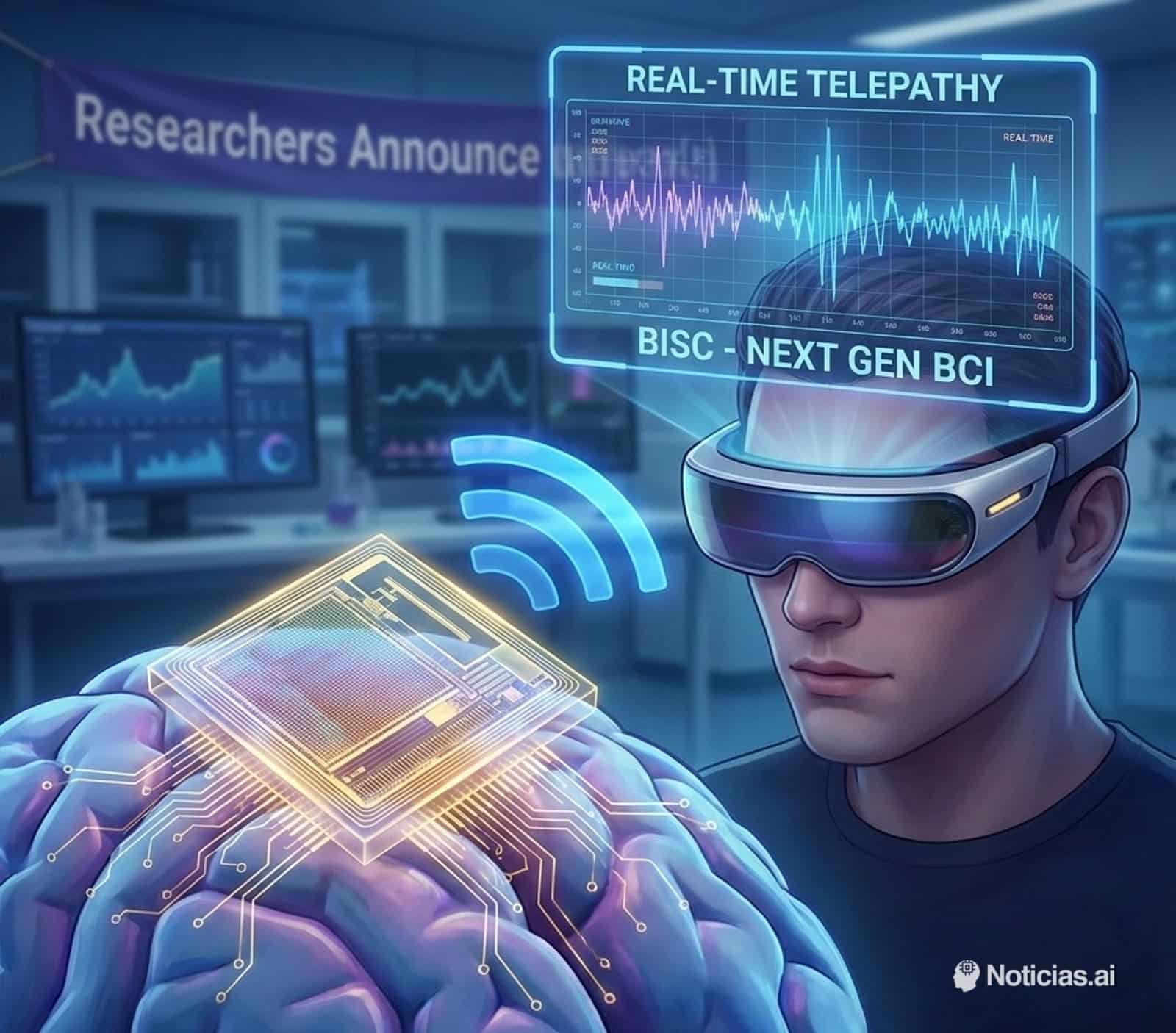
The phrase sounds like cheap sci-fi: “real-time thought streaming”. But this time, it’s not coming from a TikTok guru, but from a peer-reviewed article published in Nature Electronics and a consortium of top-tier universities like Columbia, Stanford, and the University of Pennsylvania.
The system is called BISC (Biological Interface System to Cortex) and represents a new generation of wireless brain–computer interfaces—ultra-thin and with extremely high bandwidth capability—able to record and stimulate brain activity with unprecedented resolution. Its creators describe transforming the surface of the cortex into a high-speed “portal” between the brain and artificial intelligence.
Are we taking the first serious step toward an AI-assisted form of “telepathy”?
A chip as thin as a strand of hair… between the skull and the brain
The key to BISC isn’t just what it does, but how it’s built. Instead of bulky “cans” of electronics embedded in the skull or chest, BISC is a single silicon chip:
- Thickness: about 50 micrometers, similar to a human hair.
- Total volume: around 3 mm³, a thousand times less than many current implants.
- Electrodes: 65,536 arranged in a dense matrix of 256×256.
- Channels for simultaneous recording: 1,024.
- Channels for stimulation: 16,384.
The device slides into the space between the skull and the brain and rests on the cortex like a “wet paper”, without penetrating the tissue. It’s a high-density micro-electrocorticography (µECoG) system: it doesn’t poke individual neurons but creates highly detailed maps of electrical fields on the brain’s surface.

All necessary components—radio, power management, data conversion, analog and digital electronics—are integrated into this single silicon chip, manufactured with industrial technology (TSMC’s 0.13 μm BCD process). This opens the door to producing these implants at an industrial scale, a crucial step for moving from prototype to real-world applications.
“4K video” bandwidth between the brain and AI
The second major breakthrough of BISC is bandwidth. The system consists of:
- A wireless subdural implant (the chip).
- A portable relay station, battery-powered, placed outside the body (for example, integrated into a headband or helmet).
- An ultra-wideband radio link between them, with data rates around 100 Mbps.
- And from the relay station, standard Wi-Fi connection to any computer or AI system.
Practically, this means BISC can transmit raw neural signals at speeds comparable—by orders of magnitude—to the stream of a compressed 4K video. It’s not literally “video” of the brain, but the volume of information is of a similar scale.
This data flow allows feeding deep learning models that decode:
- Visual perceptions (patterns, stimulus location, image features).
- Intention to move and motor actions, such as reaching and grasping objects.
- More complex states and patterns, potentially related to memory, language, or planning.
This is where the popular analogy of “real-time telepathy” comes from: it doesn’t involve reading conscious thoughts or natural language directly, but it opens the possibility of faithfully reconstructing what the brain is processing at each moment.
Preclinical results: pigs and primates, stability and minimal invasiveness
The device has already been tested in animal models:
- Pigs, over two weeks, to assess stability, biocompatibility, and signal quality.
- Non-human primates, with implants over motor and visual cortex, for several months.
Results show stable, high-resolution recordings without the need for crisscrossing wires through the skull or electrodes perforating brain tissue. This combination of high density + full wirelessness + minimal invasiveness sets BISC apart from many current solutions.
Researchers have also collaborated with neurosurgeons to develop minimally invasive implantation techniques: small skull incisions, chip insertion into the subdural space, and closure without bulky devices fixed to the skull.
According to the authors, this approach reduces tissue inflammatory response and long-term signal degradation—two of the classic issues with deep implants and “Utah” arrays.
From science fiction to clinical reality: potential applications
The article and Columbia’s notes list several fields where BISC could have a transformative impact if human trials confirm its potential:
: early detection of epileptic foci and precise stimulation to abort seizures before generalization. - Paralysis due to spinal injury, ALS, or stroke: decoding motor intentions to control exoskeletons, wheelchairs, cursors, or even re-activate neural circuits.
- Vision loss: using decoded visual signals (or direct stimulation) as a basis for richer, adaptive visual prostheses.
- Speech disorders: combining high-resolution recordings with AI models to translate cortical activity into words, as in recent neural voice prostheses.
To accelerate the transition to clinical use, part of the team founded Kampto Neurotech, a spin-off developing commercial versions of the system for preclinical research and, later, clinical applications. The project is funded by DARPA, NSF, NIH, and US Department of Defense programs—clear signs of strategic interest in these technologies.
AI, neuro-rights, and the risk of easy headlines
Talking about “telepathy” is an irresistible hook, but also a double-edged sword. BISC doesn’t “read your mind” in the everyday sense of reconstructing complex thoughts, beliefs, or memories at will. Instead, it captures electrical patterns at very high resolution and leaves the analysis to AI models capable of extracting increasingly sophisticated correlations.
This raises uncomfortable questions:
- Who controls these neural data, and with what guarantees?
- What limits should exist for using this technology beyond medical purposes?
- To what extent will private information (intentions, preferences) be extractable in the future without full consent?
Countries like Chile have already opened debates on “neuro-rights”. Advances like BISC will accelerate this conversation globally. Moving from controlling a cursor with your mind to streaming perceptions and complex states radically changes the landscape—just as early smartphones connected permanently to the cloud transformed communication.
And now what?
For now, BISC remains in preclinical phase. The first human studies will be intraoperative and short-term, involving patients already undergoing brain surgery for medical reasons. There’s a long regulatory and ethical road ahead before such implants become standard options.
But the direction is clear: finer, more discreet, more powerful brain–computer interfaces closely integrated with advanced AI models. If silicon chips enabled pocket-sized computers, BISC aims for a future where part of that computing support literally rests on the brain’s surface.
It’s not magic, nor an inevitable dystopia. This is extreme engineering applied to the most complex tissue we know: the human brain. What society does with this power—regarding health, cognitive enhancement, or data exploitation—might well be the true plot twist of the coming decades.
References: Javi López on X, Nature, and Engineering Columbia
