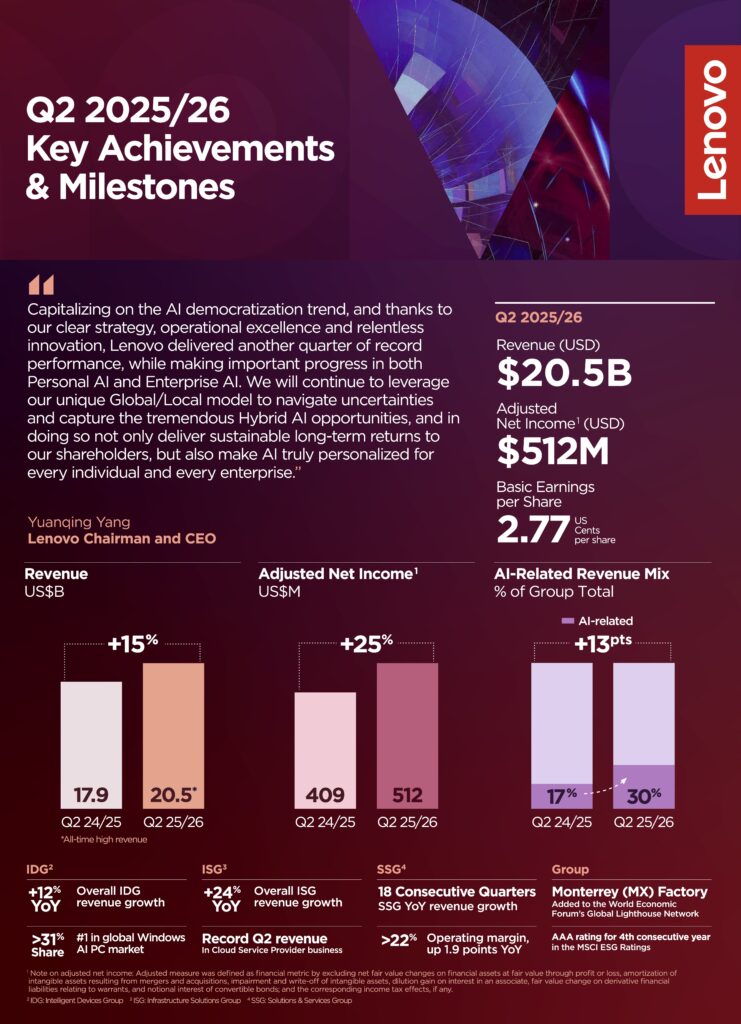
Lenovo has confirmed that the wave of artificial intelligence is not just a marketing slogan but a very real business. The company announced its second quarter results for fiscal year 2025/26 with record figures: $20.5 billion in revenue, a 15% increase from the previous year, and an adjusted net profit of $512 million, which grew by 25% and raised the margin to 2.5%.
Behind these numbers lies a clear strategy: betting on hybrid AI, combining personal devices with AI capabilities, data center infrastructures, and a layer of services and solutions that integrates everything.
AI now nearly one-third of the business
One of the most revealing data points this quarter is that AI-related revenue now accounts for 30% of the group’s total revenue, 13 percentage points higher than a year ago.
Growth is coming through multiple channels:
- AI servers, with high double-digit increases.
- AI PCs, AI smartphones, and AI services, with three-digit growth.
- Complete solutions combining hardware, software, and services for businesses looking to bring language models and advanced analytics to their own data.
In a context where large AI models are beginning to “commoditize” and conversations shift toward personalization and data control, Lenovo is aiming to position itself at that very point: close to the user, the device, and the corporate data.
Personal AI: the “digital twin” moving between devices
The Intelligent Devices Group (IDG) remains the company’s financial core and drives its focus on Personal AI. In the quarter, this division generated $15.1 billion in revenue, up 12% year-over-year.
Lenovo continues to lead globally in PCs with a record market share of 25.6%, extending its lead over the second manufacturer. Within that volume, AI-enabled PCs already represent 33% of shipments, and the company claims to be the number one in the Windows AI PC segment, with a 31.1% share.
The momentum of AI devices is evident: their contribution to revenue within IDG has increased 17 points to reach 36%. This is complemented by the strong performance of Motorola, which has achieved record smartphone volumes.
All of this sets the stage for the next step: the global launch on January 6, 2026, of the “super agent” of Personal AI introduced at Lenovo Tech World. The idea is for each user to have a “AI twin” that can learn from habits and continuously accompany them across their PC, mobile, wearables, or home and office ambient devices.
Enterprise AI: fluid infrastructures and edge data
On the enterprise side, the focus is on what Lenovo calls Enterprise AI, which is the ability to transform corporate data into decisions and business value using hybrid AI.
The Infrastructure Solutions Group (ISG), responsible for servers, storage, and edge solutions, posted $4.1 billion in revenue, a 24% increase from the same quarter last year. The company highlights:
- A record quarter in cloud service provider (CSP) business, key for large AI platforms.
- Strong double-digit growth in AI infrastructure, with an increasing project pipeline.
- A remarkable +154% in revenue from liquid cooling solutions, increasingly demanded for cooling dense racks of high-performance GPUs and CPUs.
Lenovo emphasizes that the trend is shifting from large public clouds and massive training to scenarios of local inference and edge computing, where companies want to run models close to where data is generated, whether in factories, stores, or hospitals. This transition opens the door to more sales of servers, storage, and connected AI devices.
Services and solutions: 18 consecutive quarters of growth
If devices generate volume and infrastructure provides raw power, the third pillar of hybrid AI strategy is the layer of services and solutions.
The Solutions and Services Group (SSG) recorded revenues of $2.6 billion, up 18%, marking 18 consecutive quarters of year-over-year growth. Its operating margin exceeded 22%, nearly 2 points higher than a year ago.
Within this division:
- Support services are growing at double digits.
- Managed services and projects/solutions now account for nearly 60% of SSG’s revenue.
- Lenovo is building what it calls the “Hybrid AI Advantage”: a combination of “AI factory” (infrastructure and software), AI services, and a library of repeatable solutions for sectors like industry, retail, education, and healthcare.
The aim is for companies not to start from scratch with each AI project but to leverage already tested use cases and adapt them to their data.
Sustainability, supply chain, and diversity: the other side of business
Beyond financial results and AI strategy, Lenovo also highlighted its advances in sustainability and responsible management:
- Their Monterrey factory (Mexico) has been included in the Global Lighthouse Network of the World Economic Forum, which groups the most advanced manufacturing plants worldwide.
- The company has improved its scores on CDP and S&P Global and maintains a AAA rating in MSCI ESG ratings for the fourth consecutive year.
- It received a AA+ rating in the Hang Seng Corporate Sustainability Index 2025.
- Recognized as “Best Place to Work for Disability Inclusion” in the U.S., U.K., and Brazil, and as an “Ambassador” on the global Workplace Pride benchmark for LGBTQI+ inclusion.
- Additionally, it joined the Sustainable AI Coalition, led by the French government and the United Nations Environment Program, committing to develop AI responsibly.
Record quarter with an eye on the next AI phase
With annual revenues around $69 billion and presence in 180 markets, Lenovo positions itself as one of the main winners of this first stage of the AI revolution.
The company advocates that the next chapter will not only revolve around large data centers but also near-user AI, tailored to each business and individual. Its blend of AI-enabled PCs, smartphones, servers, edge solutions, services, and software allows it to operate across all these layers.
The big question remains: how will competitors and the market respond? From other AI PC manufacturers to hyperscale cloud providers and emerging hardware players. For now, the quarterly results indicate that Lenovo has gained a strategic position to compete effectively in this race.
Frequently Asked Questions (FAQ)
1. What exactly is Lenovo’s “hybrid AI” strategy?
Lenovo’s hybrid AI combines personal devices with AI (PCs, mobiles, wearables), data center and edge infrastructures, and a layer of services and solutions. The goal is to split processing between the cloud and local environments, near the user or data, depending on the use case and privacy or latency requirements.
2. How does a Lenovo “AI PC” differ from a traditional PC?
An AI PC includes specialized hardware (such as NPUs or AI accelerators) and optimized software to run AI models locally, without always relying on the cloud. This enables advanced functions for productivity, creativity, or security, while keeping data within the device and reducing cloud computing costs.
3. Why is liquid cooling important in AI data centers?
Training and running large AI models requires many high-performance GPUs and CPUs per rack, generating significant heat. Liquid cooling more efficiently removes this heat compared to air, reducing total power consumption and increasing power density per rack.
4. What role does sustainability play in Lenovo’s AI strategy?
Lenovo aims to link its AI growth with sustainability goals: improving ESG ratings, earning recognition for factory efficiency, participating in international initiatives like the Sustainable AI Coalition, and promoting circular economy projects. The company wants to position itself as a provider of powerful yet environmentally friendly AI infrastructure.