
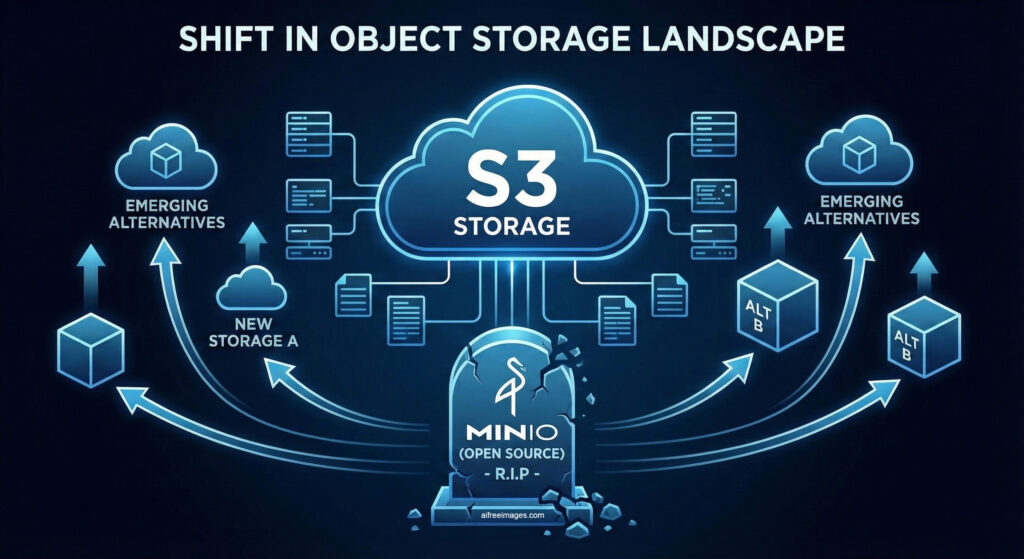
The S3-compatible storage ecosystem has just received a blow. Without a press release or major announcement, the official MinIO repository’s README changed a few days ago to a brief message: the open-source project has entered maintenance mode. No new features, no accepted pull requests, and only security fixes “case by case.” For thousands of companies that rely on it as a core component of their infrastructure, the message is clear: the open-source version of MinIO, as it was known, has come to an end.
Meanwhile, the company directs users to MinIO AIStor, its enterprise-supported commercial solution, as the preferred path for those who want to continue running the product in production with guarantees.
To understand why this is so significant, it’s helpful to review what S3 means today and why MinIO had almost become synonymous with “local S3.”
From Amazon S3 to De Facto Standard: Why This Change Matters So Much
Amazon Simple Storage Service (S3) was launched in 2006 as an object storage service accessible via HTTP, designed to be simple, massively scalable, and with an advertised durability of 11 nines. Its model of “buckets” and “objects” and its REST API eventually became the de facto standard for cloud object storage.
Although there isn’t an open formal specification for S3, hundreds of products —both commercial and open source— have implemented its API or parts of it. Why?
- Easy integration with native cloud applications.
- Huge ecosystem of backup, archiving, and analytics tools that “speak S3”.
- The ability to build private clouds and hybrid solutions without rewriting applications.
In this context, MinIO became a prominent player: a relatively simple binary to deploy, with good performance, an open license, and S3 compatibility “good enough” for most cases. It became the default backend for many Kubernetes clusters, on-premise platforms, and hosting services that needed their own S3.
The move to maintenance mode directly contradicts that expectation: the idea of having an open-source, active, and continuously evolving S3 implementation.
What Does MinIO’s “Maintenance Mode” Really Mean?
The message in the open-source repository leaves little room for interpretation:
- The code moves to maintenance only.
- No new features or pull requests will be accepted.
- Security fixes will be evaluated case by case.
- Existing issues and PRs will no longer be actively reviewed.
- For “actively maintained” versions, users are directed to MinIO AIStor, the enterprise product.
Translated into system operation terms:
- The pace of feature development halts.
- There’s no guarantee critical vulnerabilities will be fixed promptly… or at all.
- From a compliance perspective, any minimally demanding auditor might consider this component as software without active maintenance.
In environments where object storage is part of security perimeter — backups, customer data, sensitive information — this situation is hard to defend in the medium term without some form of commercial contract.
MinIO, Business Model, and the End of “Free S3 for Everyone”
Over recent years, a clear trend had emerged: the project was tightening its stance against certain commercial uses, especially by large cloud providers. The current shift consolidates that trend: anyone wanting MinIO as a strategic component of their platform will need to consider the paid version seriously.
This is not new in the open source world: MySQL, Elastic, Redis, or HashiCorp have all followed similar paths, balancing community and business models to some extent. The difference here is that MinIO was very present in mid-sized stacks, tech SMEs, hosting providers, and DevOps teams, chosen precisely because it was:
- S3-compatible,
- easy to deploy,
- with an open license.
This triangle no longer exists under the same terms. The practical result: it’s time to review the object storage roadmap.
S3-Compatible Alternatives: SeaweedFS, Garage, Ceph, and Others
The good news is that the S3-compatible ecosystem doesn’t end with MinIO. The bad news is that no alternative offers a perfect “drop-in replacement”; all will require evaluation, testing, and probably migration efforts.
SeaweedFS: Performance and Simplicity at Scale
SeaweedFS is a distributed filesystem and object store designed to handle large volumes of data and many small files. It offers:
- S3 support as well as file-based access.
- Distributed architecture with master nodes and volume servers.
- Replication and erasure coding.
It’s a good choice for:
- Hosting providers and cloud users needing a highly scalable object + file backend.
- Environments where performance with small files matters as much as raw bandwidth.
However, it requires understanding its architecture and deploying with care; it’s not simply “download a binary and go.”
Garage: Distributed S3 for Small to Medium Clusters
Garage is a distributed object store written in Rust, with an S3 interface, designed for:
- Small or medium clusters.
- Self-service environments, advanced homelabs, small businesses, and projects wanting full control over their data.
- Node-to-node replication and, in some deployments, between sites.
The main strength is its simple design and focus on self-hosting. On the downside, it doesn’t yet have the history or ecosystem of Ceph.
Ceph: The Veteran Multi-Purpose Solution
Ceph is likely the most mature and widely used open-source alternative at scale:
- It provides RADOS as a distributed object layer, CephFS as a distributed filesystem, and RADOS Gateway (RGW) for S3 and Swift interfaces.
- It’s present in many private clouds, OpenStack deployments, and large hosting platforms.
- It has a large community, extensive documentation… and a steep learning curve.
It’s the natural choice when dealing with:
- Multi-petabyte deployments, high availability, and advanced replication.
- Integration with existing Ceph or OpenStack ecosystems.
However, deploying and operating Ceph requires more team effort, process, and expertise than MinIO or lightweight solutions.
Beyond Software: Risks of Doing Nothing
The initial instinct for many teams might be “leave everything as is”: if it’s working today, why move? But the real risk isn’t technical immediately — it’s strategic and regulatory.
Some pressing questions to consider:
- What happens if a critical vulnerability appears in MinIO and isn’t promptly fixed?
- How do you justify to an auditor that your backup or customer data store relies on unsupported software?
- What would be the cost and impact of a forced, urgent migration versus a planned approach?
In regulated sectors (finance, healthcare, government, etc.), the answer tends to be clear: relying on unsupported components is not acceptable, unless you have an internal strategy to maintain custom patches, which few organizations can sustain.
What Systems and Hosting Teams Can Do Now
Beyond the philosophical debate about open source and monetization, technical teams need to be pragmatic. Some reasonable steps include:
- Inventory MinIO usage
Where it’s deployed, what data it stores, which applications depend on it, which Kubernetes clusters use it as backend, etc. - Assess criticality and compliance requirements
It’s not the same if it’s a testing environment versus a backup backend or a production data lake. - Consider future scenarios
- Pay for MinIO AIStor and continue with the same stack but with support.
- Gradually migrate to another S3-compatible solution (SeaweedFS, Garage, Ceph, public clouds, etc.).
- Use mixed approaches depending on criticality (e.g., support contracts in core environments while legacy MinIO remains in non-critical environments during migration).
- Test alternatives in parallel
Set up proof of concepts: measure performance, API compatibility, failure behavior, available observability tools, etc. - Plan data migrations
Transferring objects between S3 backends isn’t trivial when dealing with hundreds of terabytes. Consider:- Maintenance windows or online migration strategies.
- Bandwidth costs.
- Data integrity and post-migration verification.
- Update documentation and contracts
Hosting providers and cloud services that offered “S3 over MinIO” will need to revise marketing materials, SLAs, and contracts to reflect the new reality.
A Turning Point in the Open Source S3 Ecosystem
MinIO’s decision effectively marks the end of an era where many companies could rely on a high-level, free, actively evolving S3-compatible solution, only paying for infrastructure.
From now on, the landscape is reshaping:
- MinIO remains a powerful option but with a clear path toward its enterprise version.
- Projects like SeaweedFS, Garage, and Ceph are gaining visibility as active open source alternatives.
- System teams and hosting providers will need to further professionalize their object storage strategies, just as they did with databases, hypervisors, or container platforms in the past.
It’s clear that “Free, maintained, and production-ready S3” can no longer be taken for granted. Recognizing this early will lead to a smoother transition.
Frequently Asked Questions
Is it necessary to migrate immediately if I use MinIO open source?
No immediate technical obligation if everything works today, but the risk is increasing: being in maintenance mode and lacking a clear patch roadmap, time is working against you. The prudent move is to start evaluating options and planning migration or support contracting now.
Does switching to MinIO AIStor solve the problem?
For many organizations, purchasing the enterprise version can be the fastest way to reduce risk: it maintains compatibility and avoids complex migration. Still, it’s important to review costs, support terms, and compare with alternatives.
Are all S3-compatible alternatives equal?
No. While they expose similar APIs, they differ in architecture, performance, consistency models, management tools, and maturity. Ceph, SeaweedFS, and Garage suit different use cases and require serious testing before large-scale adoption.
Can I rely solely on the S3 service from a public cloud provider?
That’s a valid option and often very robust: you delegate storage management to the provider. However, it introduces dependency on a third party, exit costs, and potential data sovereignty issues. Many favor hybrid models: public S3 + on-premise S3 solutions with custom or managed software.
