
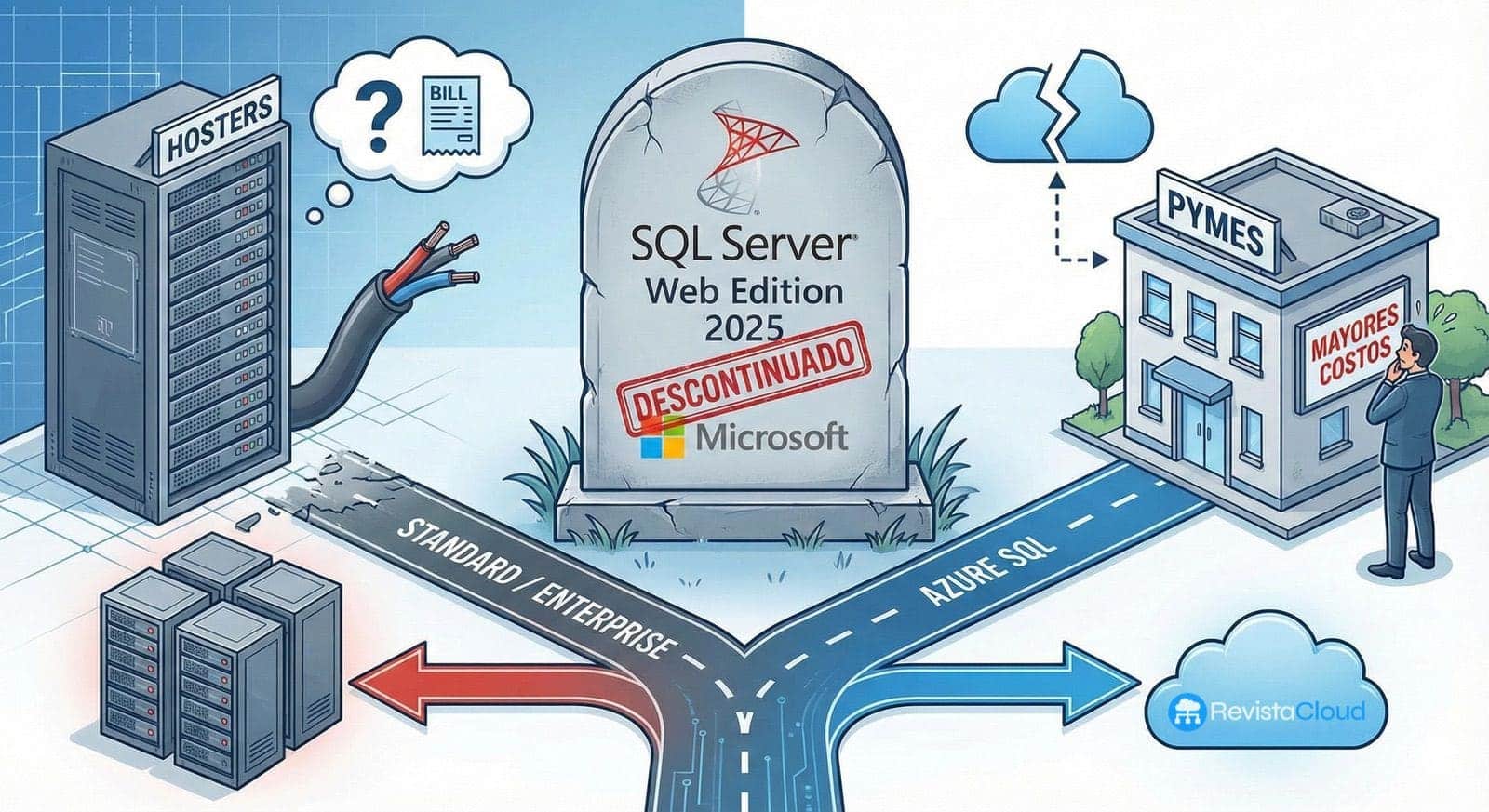
Microsoft has officially confirmed that SQL Server 2025 will not have a Web edition. The company will continue offering the Enterprise, Standard, Express, and Developer editions, but SQL Server 2022 will be the last version with a Web edition, which will be supported until January 2033 according to Microsoft’s fixed lifecycle policy.
Behind this move is a clear strategic shift: a greater focus on security and AI capabilities within SQL Server, and increased prominence for Azure SQL as the natural choice for modern web applications and multi-tenant environments.
SQL Server 2022 Web, the last stop until 2033
The Web edition of SQL Server was introduced in 2008 to fill a very specific niche:
Small and medium-sized web applications, with an absolute focus on cost and typically deployed through hosting providers and SPLA-licensed vendors.
With SQL Server 2025, that option disappears:
- There will be no SQL Server 2025 Web edition.
- SQL Server 2022 Web will be the last available version, with security support and updates until January 2033, in accordance with Microsoft’s fixed lifecycle.
- Microsoft encourages customers to explore alternatives like SQL Server 2025 Standard or Azure SQL Database.
In practice, the upcoming years will be a transition period: projects currently relying on the Web edition will have some leeway, but there will also be a clear deadline after which migration will be necessary.
A database built for AI requires “out-of-the-box” security
Microsoft frames this change within a very specific context: SQL Server 2025 arrives with a strong emphasis on AI-driven capabilities. With increasingly integrated models and assistants within the platform, the company emphasizes that security is no longer an optional extra but a critical requirement.
Some features that Microsoft considers essential for securing sensitive data in AI scenarios include:
- Transparent Data Encryption (TDE) to encrypt data at rest.
- Extensible Key Management (EKM) to manage encryption keys in a more advanced and integrated way.
These functionalities are not available in the Web edition, but are included in Standard and higher editions, along with scalability and performance improvements designed for modern workloads and AI scenarios. In other words: if the database is going to run AI features within the engine itself, Microsoft wants that to be done with at least enterprise-level security guarantees.
From Web edition to Azure SQL: the new path for web applications
Historically, SQL Server Web edition has been the “logical” choice for many small and medium-sized web applications, especially in shared hosting environments or low-cost dedicated servers.
Today, Microsoft considers Azure SQL Database to occupy that role, offering:
- Elastic scalability adapted to traffic peaks and multi-tenant environments.
- Pay-as-you-go models and elastic pools to host multiple customer databases.
- Direct integration with other Azure services, including AI tools, analytics, and observability.
The message is clear:
for new web applications or projects that can migrate to the cloud, Microsoft wants the natural alternative to Web edition not to be another SQL edition “installed on a server,” but Azure SQL as a managed service.
Fewer editions, simplified licensing
Beyond the technical aspects, this decision also involves business simplification. With the removal of the Web edition in SQL Server 2025, the product portfolio shrinks, and along with it:
- The licensing complexity and SKUs for customers and partners.
- The confusion when choosing editions or planning upgrade paths.
- The effort needed for license compliance and audits in hybrid environments.
Microsoft emphasizes that in the long run, fewer editions will lead to clearer upgrade paths, easier management, and more predictable cost planning, both on-premises and in the cloud.
Implications for SPLA partners and hosting providers
The discontinuation of Web edition in SQL Server 2025 directly affects SPLA partners and service providers who have built part of their offering around this edition, especially in shared hosting and low-cost dedicated servers.
Microsoft outlines several key points for them:
- They will be able to continue offering SQL Server 2022 Web edition to their clients, with support lasting until January 2033.
- An opportunity for modernization arises to upgrade the installed base from Web to either SQL Server 2025 Standard or Azure SQL.
- From January 1, 2026, Microsoft will introduce flexible billing and Azure services for SQL Server Web (2016–2022) via Azure Arc, even for databases running on-premises or in other clouds.
- These capabilities will be available through the Cloud Solution Provider (CSP) program, enabling partners to bundle SQL licensing, Azure Arc management, and managed services.
Practically, providers will be able to continue supporting the current Web edition, but with a clear timeline and new tools to help clients transition.
Next steps for organizations and database administrators
For organizations currently relying on SQL Server Web edition, the announcement brings several tasks:
- Review your inventory of Web edition instances (version and criticality).
- Define a migration strategy:
- To SQL Server 2025 Standard for workloads that need to stay on-premises or on IaaS.
- To Azure SQL Database for web applications that can benefit from PaaS.
- Utilize the support period until 2033 to plan and test migrations without rush, but don’t delay addressing the issue.
- For SPLA partners, update product roadmaps and commercial offerings to reflect the end-of-life of Web edition and the options for Azure Arc and CSP.
The message from Microsoft is that the future of SQL Server involves more AI, more security, and deeper Azure integration, and that Web edition, as conceived in 2008, no longer fits into this scenario.
Frequently Asked Questions about the end of SQL Server Web edition
How long will SQL Server 2022 Web edition be supported?
SQL Server 2022 Web edition will continue to receive support under Microsoft’s fixed lifecycle policy, with a planned end date in January 2033. After that, no patches or security updates will be provided.
What options does Microsoft recommend as alternatives to SQL Server Web edition?
Microsoft encourages customers to evaluate SQL Server 2025 Standard edition for on-premises or virtual machine environments, and Azure SQL Database for modern web applications, especially in multi-tenant scenarios or with variable load peaks.
Does this change affect current SPLA licenses based on SQL Server Web 2022?
SPLA partners can continue offering SQL Server 2022 Web edition while it remains supported, but it is advisable to update product roadmaps and plan transitions before the end-of-support date in 2033.
What role does Azure Arc play in modernizing environments with SQL Server Web?
Microsoft will incorporate flexible billing and Azure services for SQL Server Web (2016-2022) via Azure Arc starting January 1, 2026. This will be accessible through the CSP program and will allow advanced management and monetization capabilities even when SQL Server runs outside Azure.
Sources:
Microsoft—announcement regarding SQL Server 2025 and the discontinuation of Web edition; official lifecycle documentation and SQL Server on Azure Arc.
