
China is preparing to make a significant change regarding the safety standards for external batteries used on flights. The country’s authorities believe that the 3C certification — the mandatory conformity mark for electronic products — is no longer sufficient to ensure that a power bank is safe onboard an aircraft. The goal: to minimize the risk of fires, explosions, cracks, and leaks during flight, even if it means increasing the product’s cost and pressing the industry.
The initiative comes amid growing global concern over incidents related to lithium batteries. In recent years, several flights have had to make emergency landings due to fires in overhead compartments linked to portable batteries, prompting regulators and airlines to tighten their internal standards.
From the 3C certification to the “zero fires” era
China had already taken a first step in 2025 by banning on domestic flights external batteries without visible 3C markings, those with defective labels, or belonging to batches withdrawn from the market due to safety issues. This measure addresses an uncomfortable reality: the proliferation of low-quality products and the increase in incidents involving overheating and smoke in cabins.
Now, the country is going further. The Chinese Institute of Electronics Standardization has proposed a new framework of requirements for power banks, set to take effect from June 2026. The guiding principle is clear and unambiguous: “No fires, no ignition, no cracks, and no leaks.” In other words, external batteries must pass more demanding tests of thermal resistance, chemical stability, and mechanical robustness before they can be sold and carried on flights departing from China.
The proposal is currently in consultation until December 11, 2025, but the message to the sector is clear: the minimum standards are going to rise—and quickly.
Why do power banks worry airlines so much?
External batteries have become a common accessory. They are used to keep smartphones, laptops, tablets, or headphones charged during long trips, power outages, or emergencies. But in the confined, pressurized environment of an aircraft, they also pose a risk.
The problem lies in the very nature of lithium batteries: if there is a manufacturing defect, physical damage, or a short circuit, the cell can enter a “thermal runaway,” a chain reaction producing extreme heat, smoke, and even flames. That’s why the International Air Transport Association (IATA) and European regulations (AESA and EASA) limit the capacity of power banks allowed in cabin:
- Up to 100 Wh, usually permitted without prior approval.
- Between 100 Wh and 160 Wh, typically require airline approval.
- Above 160 Wh, are outright prohibited.
Additionally, these batteries must always be carried in hand luggage, never in checked baggage, so that crew can detect incidents in time.
However, China considers that capacity control alone is not enough. The country wants to ensure that design, materials, and manufacturing processes meet stricter safety standards than those currently covered solely by the 3C certification.
Impact on manufacturers: more R&D, new materials, and price increases
If the new regulations are implemented, the external battery industry will need to adapt on several fronts.
First, manufacturers will be required to strengthen their designs to minimize the risk of internal short circuits, electrolyte leaks, or casing deformations. This may include improvements in electronic protection systems, more robust separators, better heat dissipation solutions, and more durable casing materials.
Second, the proposal indirectly points to changes in battery chemistry. The goal is to move away from products that are easily combustible, opening the door to safer — though potentially more costly — technologies compared to current lithium variants.
All of this comes at a cost. The new testing, certification, and material requirements are likely to increase the final price of power banks manufactured for the Chinese market or travelers who need to carry them on flights originating in China. For consumers, the outcome will probably be a safer product range… but also less affordable.
Implications for travelers and the global market
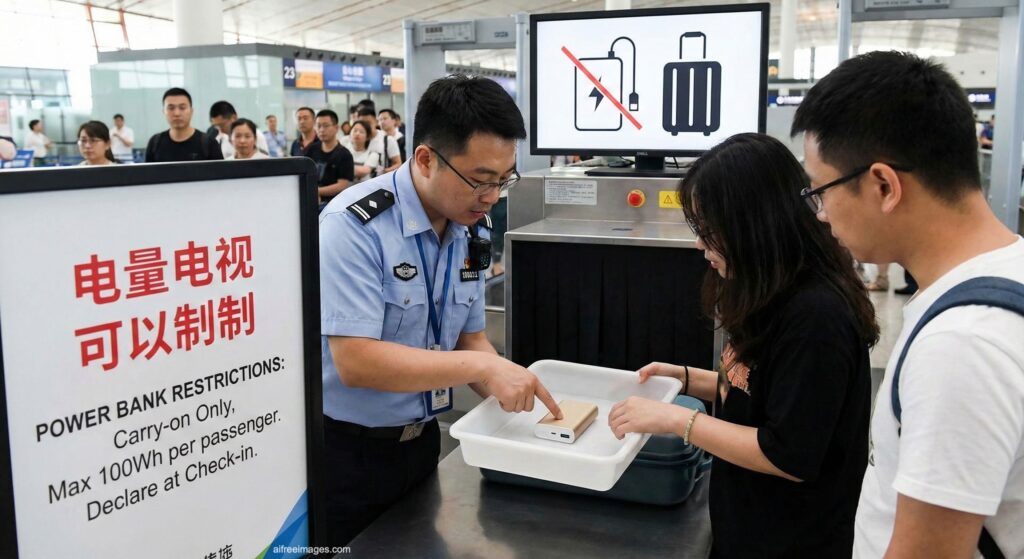
In the short term, while the new rules are debated, the most visible changes are in Chinese airport security controls: power banks are inspected more thoroughly, with careful checks that they bear the clearly visible 3C mark and are not models recalled from the market.
If the “zero fires, zero leaks” standard is approved, the impact will be much greater:
- International manufacturers wanting to sell in China or serving customers who fly from China will need to adapt their products.
- A new generation of “flight-safe” batteries, specifically certified to meet Chinese standards, is likely to emerge, which could influence global trends.
- Frequent travelers may be required to replace their external batteries before flying from a Chinese airport if they do not meet the new specifications.
Meanwhile, in Spain and the rest of the European Union, existing norms remain in place: capacity restrictions (Wh), the requirement to carry batteries in hand luggage, and bans on exceeding limits set by IATA, without an equivalent Chinese 3C mark.
A reminder that safety outweighs convenience
China’s move fits into a broader global trend: scrutinizing any device containing lithium batteries, especially in critical settings like aviation. Regulators, airlines, and manufacturers recognize that passenger comfort — charging devices anywhere at any time — can never take precedence over flight safety.
For end users, the message is clear: it’s time to stop viewing power banks as simple “cheap accessories” and start treating them as what they are — small energy storage systems that must comply with serious standards. Buying reputable brands, respecting capacity and transportation rules, and replacing any damaged or swollen batteries are basic steps that, with or without new Chinese regulations, will remain essential.
Frequently Asked Questions about China’s New External Battery Regulations
What requirements will an external battery need to meet to fly from China starting in 2026?
If the proposal is approved, besides the visible and valid 3C certification and adherence to usual Wh capacity limits, power banks will have to conform to a strengthened safety standard aimed at preventing fires, ignition, cracks, and leaks during use and transport. This will involve models designed and tested under stricter criteria than current standards.
How do China’s regulations differ from those in Spain and the European Union?
In Spain and the EU, regulations focus on energy capacity (notably 100 Wh and 160 Wh), the requirement to carry batteries in hand luggage, and the device’s condition, under the oversight of AESA, EASA, and IATA. In China, in addition to capacity limits, a specific certification mark (3C) is required, and additional safety requirements for power banks are being prepared.
How can a user determine if their power bank is airline-eligible?
First, check the capacity in Wh, which should be marked on the device or in the manufacturer’s specifications. If only the capacity in mAh is listed, it can be estimated with the approximate formula: Wh = (mAh ÷ 1,000) × nominal voltage. It’s also important to ensure the battery is undamaged, not swollen or overheated, and, for flights from China, bears a clear 3C mark and isn’t a model recalled from the market.
Will power bank prices increase due to China’s new requirements?
All signs point to yes. If manufacturers need to adopt safer materials, redesign products, and pass additional tests to meet Chinese standards, production costs will rise. This could lead to slightly more expensive power banks, though also more reliable and less prone to serious incidents during flights.
