
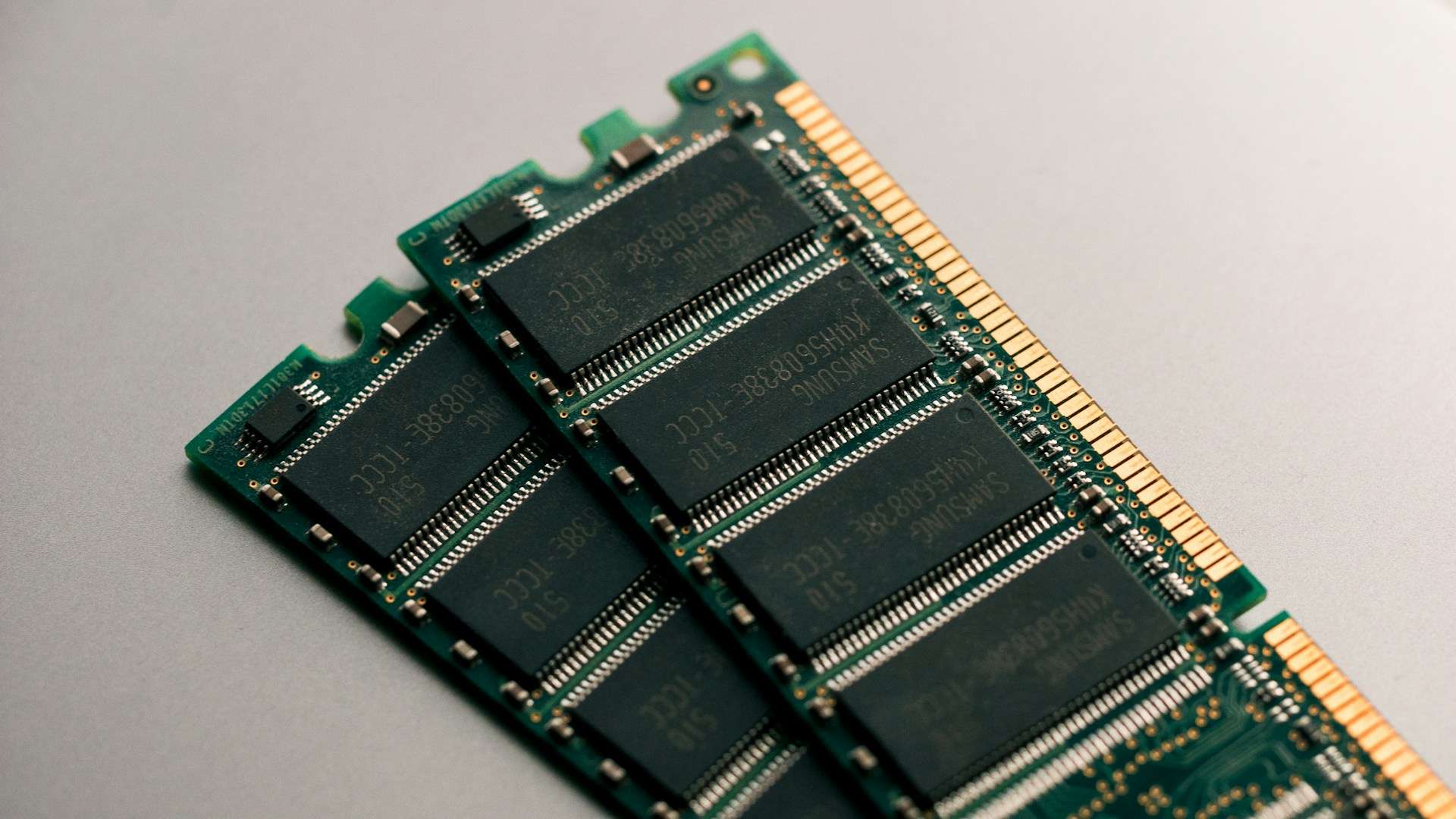
By the end of 2025, the memory chip war is also taking place in Hefei. There, China’s ChangXin Memory Technologies (CXMT), which until a few years ago was virtually unknown outside the country, has established itself as China’s leading DRAM manufacturer and one of the fastest-growing players closing the gap with the sector’s dominant trio: Samsung, SK Hynix, and Micron.
Their latest technological leap has resulted in 16 Gb DDR5 chips manufactured with an effective 16 nm cell, a level that U.S. authorities attempted to set as a red line through sanctions and export controls.
From local player to uncomfortable global competitor
CXMT began volume production of DRAM in 2020. In just five years, it has shifted from a niche supplier for the Chinese market to controlling around 5% of the global DRAM market in 2024 and approximately 6% of worldwide capacity by early 2025, thanks to rapid factory expansion and strong state backing.
Its installed capacity is already estimated to be around 10-13% of global DRAM production, making it an influential player capable of impacting prices, especially in entry-level and “legacy” memory segments, despite still lagging behind its rivals in cutting-edge technology.
Samsung, SK Hynix, and Micron continue to dominate the vast majority of the market, especially in high-value products like server memory and High Bandwidth Memory (HBM), critical for AI. But CXMT has stopped being a distant contender and is now a competitor worrying Seoul and Boise.
The leap to 16 nm DDR5: crossing Washington’s red line
A key milestone of 2025 has been the independent analysis of CXMT’s new DDR5 chips. A teardown by TechInsights detected a memory cell with an effective size of 16 nm, a density of 0.239 Gb/mm² on 16 Gb chips, and a 4F² cell design comparable, though still somewhat inferior, to industry leaders.
Why is that number so relevant? Because U.S. export controls defined DRAM processes below 18 nm as “advanced,” attempting to lock Chinese industry at that threshold. Restrictions on lithography equipment and processes for smaller nodes aimed to prevent companies like CXMT from making the jump to competitive DDR5 and HBM generations.
That Hefei-based company producing DDR5 chips with an effective 16 nm cell indicates that, despite sanctions, China has found ways to progress: clever reuse of equipment, multi-patterning processes, and intensive domestic R&D efforts. While not yet at the level of Samsung or SK Hynix’s most aggressive nodes, the technological lag has shrunk to about 3 years from previously 5-7 years just a few years ago.
Performance, DDR5-8000, LPDDR5X: from theory to actual modules
The big question was whether CXMT could turn that progress into real, mass-produced chips. By mid-2025, industry sources reported yields of only about 50% in DDR5, delaying mass production until late that year.
This slowdown appears to have been temporary. By late October, reports from TechPowerUp and other tech outlets indicated CXMT’s DDR5 yields exceeding 80%, approaching commercially viable figures and allowing for volume scaling.
Meanwhile, the company has showcased at industry events DDR5 modules reaching speeds up to 8,000 MT/s, with 16 and 24 Gb chips supporting both “binary” modules (16, 32, 64 GB, etc.) and non-binary configurations of 24 or 48 GB, now common in recent platforms.
In mobile, CXMT also demonstrated LPDDR5X chips reaching up to 10,667 MT/s, positioning itself as a local alternative for Chinese smartphone manufacturers seeking to reduce dependence on foreign suppliers, especially amid sanctions and geopolitical tensions.
It’s still unclear what volumes they can produce at these high speeds, but the fact that prototypes and initial commercial batches have been shown indicates the company can keep pace with DDR5 evolution, albeit one or two steps behind the industry leaders.
HBM and the AI race
The other crucial front is HBM, the high-bandwidth memory that powers GPUs for AI and supercomputing. CXMT has started producing HBM2 and is working on HBM3, with a volume rollout planned for 2026, supported by a new advanced packaging plant near Shanghai, designed to handle around 30,000 wafers per month initially.
Recent reports suggest the company has already sent key HBM3 samples to Huawei for AI accelerator testing, giving a sense of their strategic goal: sustain the Chinese AI ecosystem with domestically-produced memory and reduce reliance on imported HBM, which has been heavily impacted by sanctions.
Industry analysts estimate that CXMT still trails Samsung and SK Hynix by 3-4 years in HBM, which are already working on HBM3E and planning the transition to HBM4. Yet, the gap is closing: China is no longer outside the AI memory conversation but is now a “fast follower.”
Sanctions, blacklists, and the boomerang effect
CXMT’s progress occurs despite a cascade of restrictive measures. The U.S. Department of Commerce has tightened controls on semiconductor manufacturing equipment exports since 2022, and in May 2025, officially added CXMT to the Entity List, requiring licenses for any U.S technology exports relevant to the company.
Additionally, the Department of Defense has included CXMT in its list of “Chinese military companies,” reinforcing political messages and discouraging Western partners.
Paradoxically, these measures have accelerated China’s push for self-sufficiency: increased public investment, greater pressure to develop domestic equipment, and a strategy focused first on meeting internal demand, now valued at over $22 billion annually in memory chips.
The result is a more fragmented market: the West shields itself from Chinese hardware in sensitive applications, while China builds its own memory ecosystem with CXMT as a key player.
A giant preparing for an IPO
The next major step for CXMT is planned for 2026, assuming current plans are fulfilled. Reuters reports that the company is preparing to go public in Shanghai with a target valuation of up to $42 billion, aiming to raise between 20 and 40 billion yuan to fund new factories and advanced HBM and DDR5 lines.
This move would establish CXMT as one of the heavyweight players in China’s semiconductor sector and enable further capacity expansion. However, it also increases pressure: investors will want to see sustainable margins and returns in a sector characterized by cycles of oversupply and price crashes.
How much has the gap with Samsung, SK Hynix, and Micron really narrowed?
As 2025 closes, the picture is nuanced. CXMT has demonstrated:
- DDR5 with an effective 16 nm cell and competitive densities.
- DDR5-8000 and LPDDR5X-10667 modules shown in demos and initial shipments.
- DDR5 yields jumping from around 50% to over 80% in months.
- Initial serious steps in HBM2/HBM3 and a domestic ecosystem ready to test these products.
Nevertheless, it still trails in several areas: it does not utilize EUV lithography, depends on more complex and costly processes to achieve similar densities, and lacks the maturity in premium offerings for data centers and large AI cloud deployments. Meanwhile, Samsung, SK Hynix, and Micron are already eyeing HBM4 and DDR5-8800 as their next benchmarks.
According to various technical analyses, the gap in technology nodes and density has shrunk to about 3 years, down from previously much larger disparities. If CXMT sustains its pace and avoids bottlenecks due to sanctions, it could attain double-digit market shares in DRAM during the second half of the decade, impacting global prices and the balance of technological power in the AI era.
FAQs about CXMT and its role in the memory market
What does it mean that CXMT manufactures DDR5 memory with 16 nm technology?
Practically, it means CXMT’s DRAM memory cell has an effective size around 16 nm, with a bit density per square millimeter close to that of leading manufacturers. This allows for 16 Gb DDR5 chips with a competitive die size and thus higher-capacity modules in the same physical footprint. Although the company’s official node may be declared as 18.5 nm to comply with sanctions, independent analysis shows these chips have functionally crossed the 18 nm threshold Washington aimed to restrict.
How does CXMT’s DDR5 memory differ from that of Samsung, SK Hynix, or Micron?
CXMT’s DDR5 modules now reach speeds up to 8,000 MT/s and capacities of 16 and 24 Gb per chip, similar to competitors. However, industry leaders have had more time to optimize power consumption, latency, and reliability at high volumes, and are ahead in the most extreme speed bins (like DDR5-8800) and used in servers and data centers. CXMT mainly aims to meet internal Chinese demand and serve mid-range and consumer markets, gradually gaining experience in premium segments.
How do U.S. sanctions impact CXMT and the global memory market?
Sanctions restrict CXMT’s access to cutting-edge manufacturing equipment and software, especially for nodes below 18 nm and advanced HBM technologies. This hampers their roadmap, making processes more expensive and challenging. Simultaneously, restrictions are prompting China to invest more in domestic capacity and local equipment, which could, in the medium term, lead to a Chinese-origin memory oversupply, putting downward pressure on global prices and increasing supply chain fragmentation.
What impact might CXMT have on the AI ecosystem and data centers?
If CXMT manages to produce HBM3 at volume from 2026 and offers competitive DDR5, China’s AI ecosystem will benefit from a domestic source of critical memory for GPUs and accelerators. This supports Beijing’s tech self-sufficiency strategy. For Europe and other regions respecting sanctions, CXMT won’t be a direct supplier soon, but it could influence the market indirectly: increased global DRAM supply often results in lower prices but also heightens volatility and sector uncertainty.
Sources:
SCMP / Yahoo Finance; TechInsights; Reuters; Tom’s Hardware; Silicon.co.uk; TechPowerUp; Wccftech; Digitimes; aggregated analyses of ChangXin Memory Technologies (grokipedia) and public documentation from BIS and U.S. DOD.
