
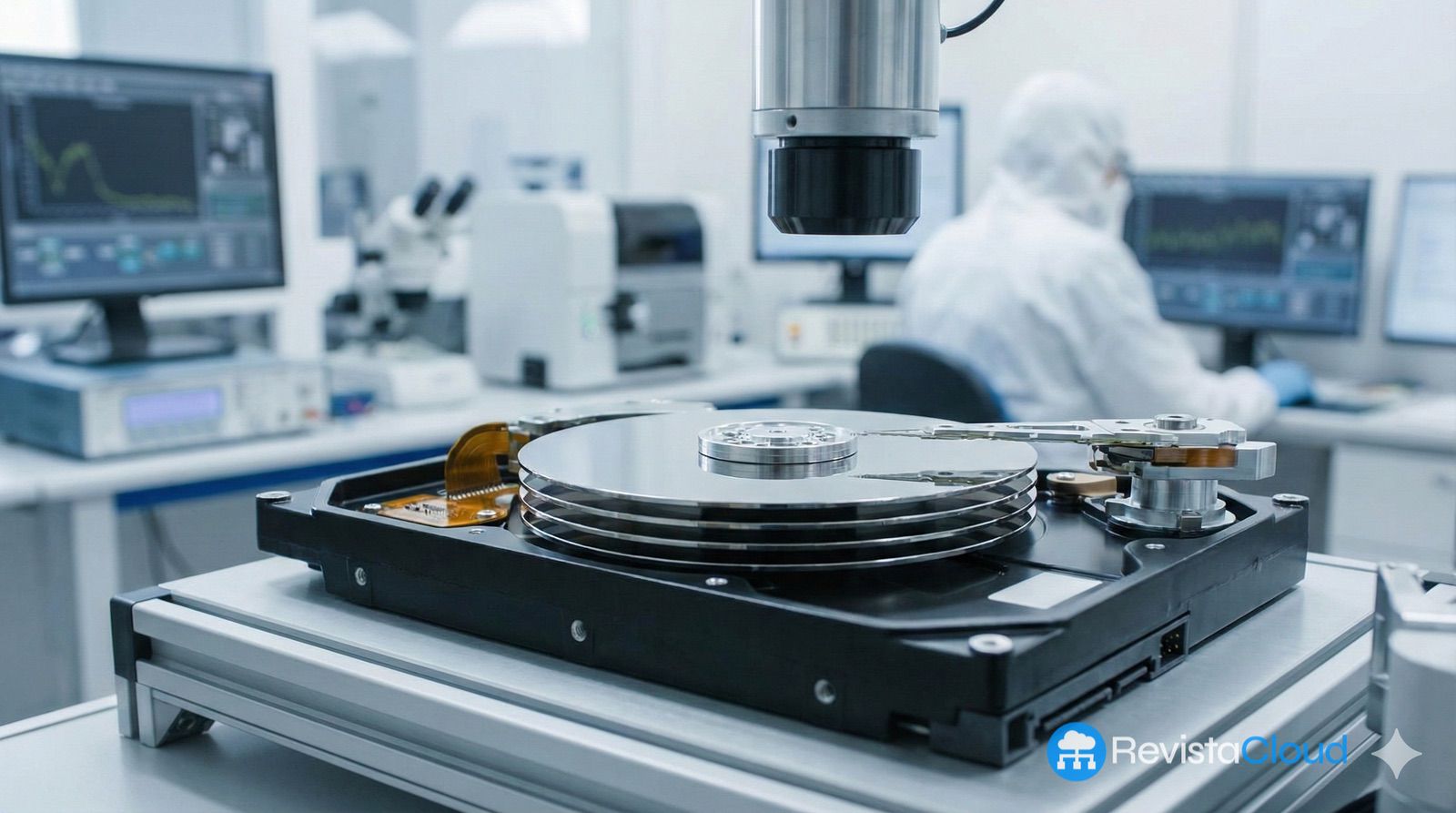
Seagate once again proves that mechanical hard drives are far from dead. The company has achieved a density in the laboratory of 6.9 TB per platter thanks to its HAMR (Heat-Assisted Magnetic Recording) technology, making it physically possible to manufacture units ranging from 55 TB to 69 TB in a standard 3.5-inch format.
To put it into perspective, their most advanced commercial models today hover around 30 TB, using platters of about 3 TB each. In other words, Seagate has managed to more than double the capacity per platter in its laboratory prototypes.
What exactly has Seagate achieved?
The milestone lies in the platter itself—the circular disk where data is magnetically stored. According to information leaked by industry media, Seagate has tested platters of 6.9 TB, double the capacity of their current 30 TB drives.
With this level of density, the math is clear:
- A 8-platter disk could reach roughly 55 TB.
- A 10-platter disk could go up to about 69 TB.
All of this without changing the physical disk format (3.5″), which is crucial for data centers to leverage new capacities in existing racks and chassis.
HAMR and Mozaic 3+: the secret is in heating (a lot) and writing (very finely)
The key to this leap isn’t just adding more platters but how the data is written:
- HAMR uses a tiny laser to locally heat the platter surface while recording data. This heating temporarily reduces the coercivity of the magnetic material, allowing bits to be written much smaller without losing stability.
- Building on this, Seagate’s Mozaic 3+ platform further reduces the size of the magnetic grains in the medium, squeezing even more bits per square inch.
In other words: the head writes on smaller areas without data “mixing” or degrading, enabling higher density without compromising reliability.
Not tomorrow: Seagate’s realistic roadmap
The bad news for those already crunching numbers is that these 6.9 TB platters will still take time to hit the market. According to Seagate’s own roadmap, the company plans a gradual rollout:
- 2027: platters of 4 TB
- 2028: platters of 5 TB
- 2029: platters of 6 TB
- 2030: production of 6.9 TB platters begins
- From 2031 onward: target platters between 7 TB and 15 TB
If these timelines hold, the industry could see disks with tens of TB per unit over the next decade, and near-petabyte drives before 2040 in multi-platter configurations.
Why hard drives remain key amid the AI boom
Alongside the rise of SSDs, mechanical hard drives continue to be the backbone of mass storage for several reasons:
- Cost per terabyte: still significantly cheaper for large volumes of cold or archival data.
- Capacity per unit: despite SSD advances, the maximum gross capacity per device favors HDDs.
- AI demand: training and operating AI models generate vast amounts of data that must be archived for years. HDD providers report order backlogs of up to 2 years in data center segments.
In this context, Seagate’s efforts to increase disk density are not just engineering exercises—they’re a strategy to contain long-term storage costs in a world of exponentially growing data volumes.
Fierce competition: Toshiba, Western Digital, and others
Seagate isn’t alone in this race:
- Toshiba has announced plans for 40 TB drives in 2027 using 12 platters and technologies like MAMR, with potential hybrids incorporating HAMR.
- Western Digital is also working on high-density roadmap combining SMR, ePMR, and future energy-assisted variants.
However, having commercial 30 TB HAMR HDDs and a clear path toward 50 TB and beyond gives Seagate an advantage in technological maturity over some competitors.
Implications for businesses and users
In the short term, nothing will change immediately on your home PC: these advances are primarily aimed at data centers, public clouds, and large service providers.
But in the medium term, clear implications arise:
- Storage providers will be able to fit more petabytes into the same rack space, critical in data centers where every square meter counts.
- As these technologies mature and costs decrease, we’ll see larger capacities in professional NAS and eventually in the consumer market.
- The combination of very high-capacity drives + fast SSDs will continue to dominate: SSDs for performance, HAMR HDDs for massive archiving.
FAQs on Seagate’s new HAMR drive advancements
When will I be able to buy a 60 or 70 TB hard drive?
According to Seagate’s roadmap, 6.9 TB platters won’t be available commercially until around 2030. Therefore, 55–69 TB drives are expected after that time, initially in data center environments.
Are HAMR drives reliable compared to traditional HDDs?
The first commercial 30 TB HAMR models are designed for intensive use in data centers and professional NAS, with reliability profiles comparable to current enterprise HDDs. The main challenge isn’t basic reliability but demonstrating long-term durability at scale, in millions of units.
Does this mean the end of SSDs for mass storage?
No. SSDs will continue to increase in capacity and decrease in price, but HDDs will remain more cost-effective per terabyte for large-scale cold or archival data. Both technologies are likely to coexist, each optimized for different workloads.
Will we see 1 PB drives in a single unit?
If current projections of 7 to 15 TB platters after 2031 hold, combining multiple platters and new recording techniques could reach near-petabyte capacities before 2040, at least in data centers.
via: tomshardware
