
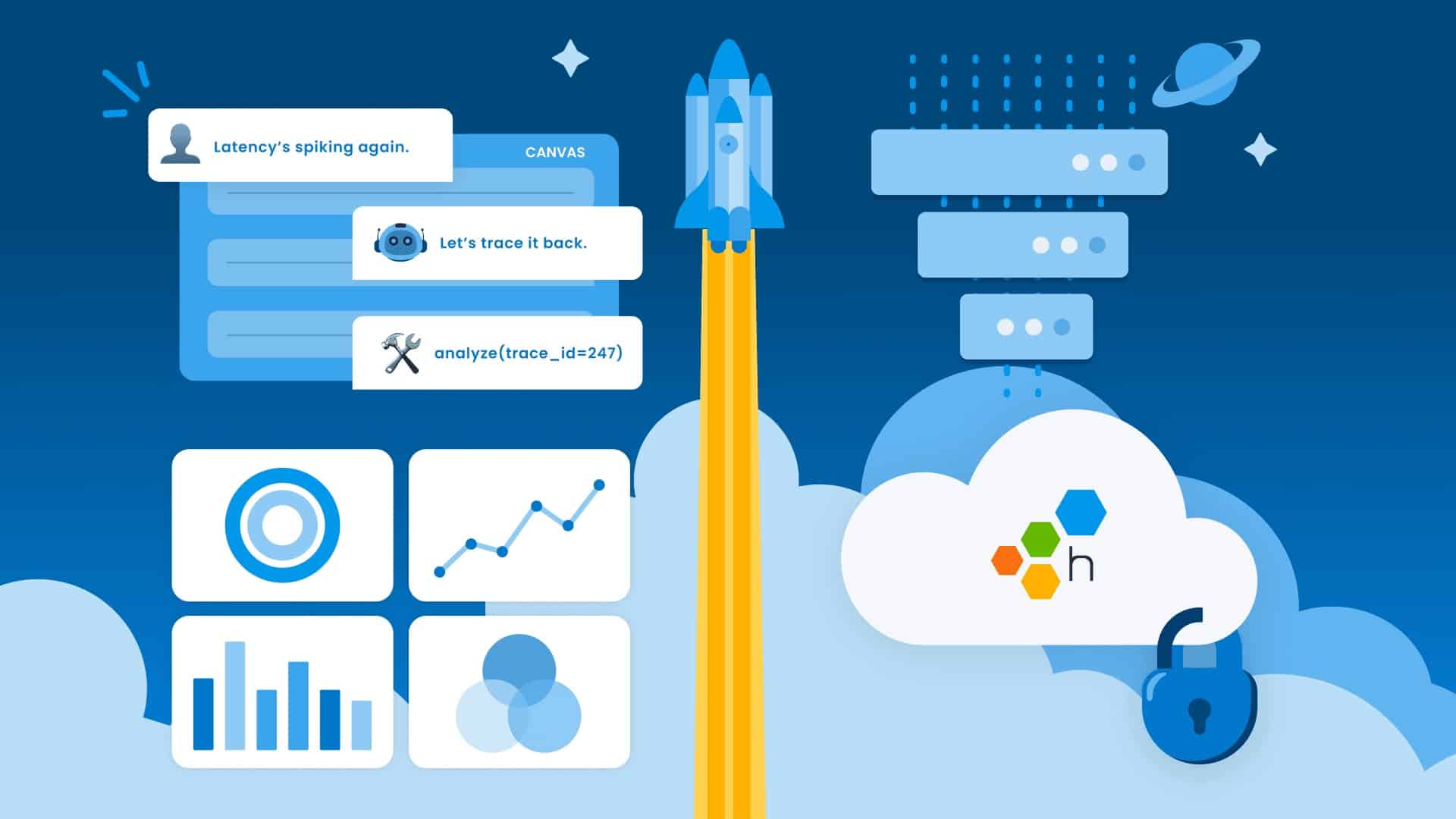
Honeycomb, one of the leading references in observability for native cloud architectures, has announced a significant upgrade to its enterprise portfolio: a new Honeycomb Private Cloud offering, enhanced support for native metrics, and general availability of Canvas, its AI-driven investigation panel. The goal is clear: to meet the increasing demands for security, regulatory compliance, and cost management in a world where distributed applications and AI no longer tolerate errors.
Observability for organizations that cannot afford to go down
More and more organizations are migrating toward private and hybrid cloud environments to gain better control over their data, comply with residency regulations, and strengthen security. In this context, observability ceases to be “something desirable” and becomes a critical function: without deep visibility into what’s happening across hundreds of microservices, queues, databases, and APIs, it’s impossible to guarantee user experience and business continuity.
Honeycomb Private Cloud is specifically designed to fill this gap. Instead of a traditional multi-tenant model, the company offers a dedicated infrastructure on AWS, with data and environment isolation, aimed at highly regulated sectors like finance or healthcare. The idea is that engineering teams can continue to use the familiar Honeycomb experience — fast queries, high event detail, and intuitive workflows — without compromising on strict compliance requirements.
BYOC: observability in your own cloud and leveraging your discounts
One of the most notable aspects of this announcement is the Bring Your Own Cloud (BYOC) approach. Instead of sending all telemetry data to a fully managed environment, companies can choose to keep telemetry within their own AWS accounts, taking advantage of existing cost agreements and discounts.
This model offers several advantages:
- Full control over data residency, which is critical for regulations like GDPR or industry-specific laws.
- Long-term cost optimization, by utilizing negotiated consumption discounts with their cloud provider.
- Enhanced technological sovereignty, by not relying entirely on an external environment for monitoring critical systems.
The offering is completed with two options: self-managed environments by the customer or Honeycomb-managed ones, for those preferring to outsource daily platform maintenance.
Native metrics with OpenTelemetry: more context, fewer silos
The second key update introduces Honeycomb Metrics, a major evolution of the platform that provides native support for standard metrics based on OpenTelemetry. Until now, Honeycomb’s strength had been its event and trace-oriented observability model, featuring high cardinality and very fast queries over large data volumes.
With these new capabilities, teams can:
- Ingest and work with classic metrics (counters, gauges, histograms).
- Visualize trends, system health, and performance changes over time.
- Explore metrics and events within the same environment, without switching between disparate tools.
The key is in the platform’s unified model: instead of separating “infrastructure” metrics from “application” data, observability becomes a single narrative where a spike in a metric can be quickly traced back to specific events or detailed traces. This makes it easier to answer complex questions like “Why did latency spike just for this user segment in this region?” without switching dashboards or tools.
Canvas: AI-guided investigation to resolve incidents faster
The third major announcement is the general availability of Canvas, an AI-powered investigation panel that is part of Honeycomb Intelligence, the native AI-driven observability suite introduced months ago.
Canvas combines three concepts into a unified experience:
- Natural Language: engineers can ask questions in text (“What changed in production in the last hour for European users?”) and let the platform run the necessary queries.
- Interactive Notebooks: results are displayed in a notebook-like interface with charts, tables, explanations, and traces that update as the investigation progresses.
- Real-time Collaboration: multiple team members can work on the same Canvas, sharing insights and annotations during incident resolution.
In practice, this means AI transitions from being a “helper chatbot” to an integrated layer within the observability workflow: it proposes queries, highlights anomalies, correlates signals, and aids navigation through large telemetry volumes—all without requiring team members to be expert query language users.
Furthermore, Canvas integrates with other Honeycomb Intelligence features, such as anomaly detection systems or MCP Server, enabling AI agents to interact with observability in a controlled and secure manner.
Observability for the era of AI and distributed systems
Beyond the feature set, Honeycomb’s announcement reflects a clear industry trend: observability is becoming a fundamental component of any distributed architecture and AI workloads.
With applications spread across multiple clouds, microservices, messaging queues, specialized databases, and AI models running across different layers, engineering teams face three major challenges:
- Technical complexity: increasing components, each with their own telemetry.
- Business demands: systems must be “always-on” with very low response times.
- Regulatory and cost pressures: growing regulations, increased scrutiny of data, and cloud budgets under pressure.
Honeycomb aims to position itself as a solution to these challenges:
- Private Cloud and BYOC offer control, data residency, and more predictable costs.
- The new native metrics with OpenTelemetry help unify signals and reduce tool fragmentation.
- Canvas and other Honeycomb Intelligence features support a shift toward a model in which AI actively participates in problem-solving and decision-making.
What does this mean for companies already using monitoring tools?
For many organizations, these advancements do not necessarily mean replacing all their existing monitoring tools overnight. However, they do indicate a direction: simply tracking CPU, memory, and availability is no longer sufficient to ensure high-quality digital experiences.
Modern observability—combining traces, metrics, logs, and events with business context—is fast becoming the industry standard. In this environment, solutions like Honeycomb Private Cloud, the new native metrics layer, and Canvas can be particularly appealing to:
- Teams with cloud-native applications already using OpenTelemetry or planning to adopt it.
- Regulated sectors requiring deep observability without moving data outside their cloud environment.
- Organizations exploring the integration of AI agents into their development, deployment, and operational processes, while maintaining strong security and compliance controls.
Frequently Asked Questions about Honeycomb Private Cloud and new observability features
What sets Honeycomb Private Cloud apart from traditional SaaS observability solutions?
Honeycomb Private Cloud provides a dedicated infrastructure on AWS, with data isolation and the ability to deploy within the customer’s own cloud account (BYOC). This enables strict security and residency compliance without sacrificing platform performance or user experience.
Why is native support for metrics with OpenTelemetry important?
OpenTelemetry has become the open standard for instrumenting applications and systems. By natively supporting OTel metrics, Honeycomb simplifies ingesting signals from multiple services and technologies, and allows correlation of metrics with events and traces within a unified observability environment.
How does Canvas practically assist engineering teams?
Canvas enables investigation using natural language queries, with the platform automatically generating dashboards, comparisons, and visualizations. This accelerates incident resolution, lowers the barrier for new team members, and facilitates collaboration during complex analysis.
Is Honeycomb useful in hybrid or multi-cloud environments?
Absolutely. Honeycomb’s approach is tailored for distributed architectures involving multiple clouds, Kubernetes, diverse databases, and third-party services. Its event-based model, native metrics, and Private Cloud/BYOC capabilities provide unified visibility in complex, highly regulated environments.
via: honeycomb.io
