
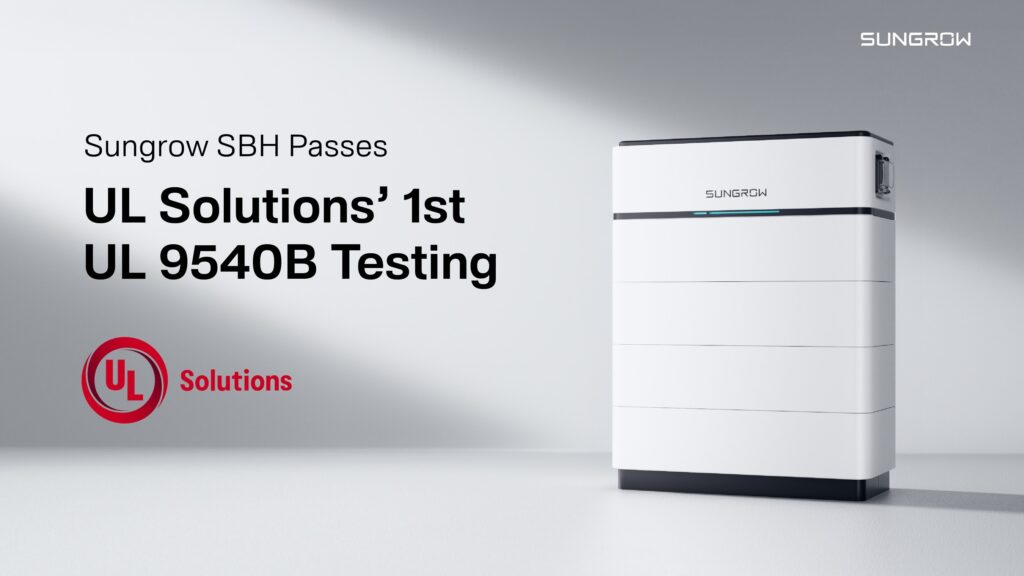
Safety has become the major pending issue for home batteries. Increasing numbers of residential storage systems are being installed in garages, closets, and facades, and any incident could have serious consequences. In this context, Sungrow has just taken a step forward: its SBH Residential ESS series has passed the first real-world UL 9540B test for residential systems, a milestone that raises the bar for the entire industry.
But what does this certification really mean, and how does it compare to solutions from brands like Tesla, Enphase, or EcoFlow?
What is UL 9540B and why does it matter so much
Until now, the safety benchmark for storage systems was the combo of UL 9540 (complete system) and UL 9540A (thermal runaway propagation), focusing on how battery modules behave when a cell enters thermal runaway. UL 9540B takes this a step further:
- It is specifically designed for residential systems up to 20 kWh.
- It forces the battery into an extreme thermal runaway scenario completely unassisted, with the system charged, flammable gases accumulated, external ignition, and no intervention from fire suppression systems or firefighters.
- The goal: verify that fire does not propagate, that there are no explosions or dangerous fragment projections, and that the temperature in the environment remains within safe limits.
Practically, this is a full-scale realistic fire test designed to answer a very simple question: if something goes wrong inside the battery, does it stay contained or does it become a hazard for the whole house?
What Sungrow has achieved with the SBH series
In the test conducted by UL Solutions, the Sungrow SBH Residential ESS system was subjected to 24 hours of maximum stress conditions:
- Battery modules positioned very close together.
- Internal fire suppression disabled.
- Repeated external ignition attempts.
- No manual intervention or additional aids.
According to the company, the results were:
- The fire was confined to the affected module’s pressure relief zone.
- Adjacent modules remained well below critical ventilation thresholds (a few tens of degrees Celsius compared to >150 ºC that trigger gas release).
- The flames self-extinguished in less than an hour, with no re-ignition over the following 24 hours.
- No explosions or fragment projections were recorded, and the enclosure maintained its structural integrity.
This test builds upon the earlier UL 9540A certification of the SBH series, reinforcing that the system is engineered to manage thermal escape from the cell to the entire cabinet, minimizing the risk of internal incidents becoming house fires.
Additionally, the SBH range is based on a high-voltage modular architecture, with typical blocks of 5 kWh that can be grouped into residential configurations of 10 to 20 kWh, and even larger in bigger installations, maintaining a compact design intended for wall or tower mounting.
How it compares to other home batteries
Sungrow is not competing in isolation. The residential battery market is dominated by a few highly recognized names and an increasing number of specialized players. Notables include:
- Tesla Powerwall 3, which integrates a hybrid inverter and offers about 13.5 kWh of usable capacity in a single unit, with lithium iron phosphate (LiFePO₄) chemistry and UL 9540 certification, aimed at high-power residential solar setups.
- Enphase IQ Battery 5P, a modular 5 kWh system also based on LFP, certified with UL 9540 and UL 9540A, and natively integrated with Enphase microinverters and ecosystem for PV self-consumption.
- BYD Battery-Box Premium (HVS/HVM), a family of high-voltage modular batteries that, combined with certified inverters, meet UL 9540 for the North American market and have become a reference in residential and light commercial installations.
- EcoFlow Ocean Pro, a new-generation home system with about 10 kWh per unit and up to 24 kW of output power, based on LFP and designed to power entire homes. It is promoted as the first residential system to achieve UL 9540B certification after intensive testing, emphasizing multi-layered safety and a 15-year warranty.
Quick comparison of residential ESS solutions
| Residential ESS system | Typical capacity per unit | Battery chemistry | Key safety certifications | Main focus |
|---|---|---|---|---|
| Sungrow SBH Residential ESS | ~10–20 kWh (modular 5 kWh) | High-voltage lithium | UL 9540A, UL 9540B (full-scale fire) | Structural safety & modularity |
| EcoFlow Ocean Pro | 10 kWh (up to 24 kW output) | LFP (LiFePO₄) | UL 9540, UL 9540A, UL 9540B | Whole-home supply & advanced backup |
| Tesla Powerwall 3 | 13.5 kWh | LFP | UL 9540 | Solar+battery all-in-one integration |
| Enphase IQ Battery 5P | 5 kWh (stackable) | LFP | UL 9540, UL 9540A | Integration with microinverters & granular control |
| BYD Battery-Box Premium (HVS/HVM) | 8–22 kWh (depending on tower) | LFP | UL 9540 (with inverter) | Design flexibility & scalability |
Note: Typical capacities and certifications are based on manufacturer datasheets and publicly available documentation; final configurations depend on the market and the inverter compatibility.
What truly sets Sungrow apart?
Beyond the table, three key points highlight the prominence of the SBH series:
- First residential UL 9540B certified through large-scale testing
While other manufacturers are progressing similarly, having formally passed a UL 9540B full-system test provides Sungrow with a significant reputational advantage among installers, insurers, and regulators—especially in fire-sensitive markets. - Design aimed at containing the worst-case scenario
The test was performed with fire suppression disabled, inducing thermal runaway and ignition attempts. The observed behavior—confined flames, self-extinguishing without re-ignition, and no explosions—indicates that pressure management, thermal insulation, and mechanical design are optimized to prevent a cell failure from escalating into a structural house fire. - Continuity with utility-scale experience
Sungrow has previously conducted real combustion tests on large-scale solutions, and now applies that philosophy to residential products. For end-users, this means a coherent safety design approach where the same engineering standards used in utility-sized energy storage are adapted for home use.
Compared to this, Tesla and Enphase focus more on integration within their own solar ecosystems (inverters, microinverters, monitoring) and simplify installation, while BYD emphasizes configuration flexibility with multiple inverter brands. EcoFlow positions itself as an “all-in-one” solution with high instant power and a strongly safety-oriented message, including UL 9540B certification.
What does this mean for owners and installers?
For the residential user, the core message is clear:
- Safety is no longer an “extra” but a central selling point.
- Advanced certifications like UL 9540B can become as important as capacity or price, especially in semi-detached homes, garages, or indoor installations.
- Regulatory pressure and insurance requirements will likely increase, pushing the market toward systems with proven real-scale fire testing.
For installers and energy companies, having solutions like Sungrow SBH, Ocean Pro, or the latest Tesla, Enphase, and BYD products expands the options but also raises the bar for project specification and design: it’s not just about asking “how many kWh?” but also “where will you install the battery, what certifications does your regulation require, and what level of risk are you willing to accept?”
Ultimately, Sungrow’s successful UL 9540B certification of the SBH Residential ESS series is not just good news for the brand; it signals that the home storage industry is entering a new phase, where performance in extreme safety tests will be just as vital as storing cheap energy or optimizing photovoltaic use.
Sources:
Sungrow – Press release on the SBH Residential ESS series and UL 9540B
EcoFlow – Communications on Ocean Pro and UL 9540B certification
Tesla – Public info on Powerwall 3
Enphase – Technical documentation for IQ Battery 5P
BYD – Commercial info on Battery-Box Premium (HVS/HVM)
