During the height of the Cold War, when the world was starting to organize around zeros and ones, a small group of Soviet scientists chose a different path: building a computer that thought in three values instead of binary. This experiment was called Setun, and it became the first universal ternary computer in history. According to those who knew it, it was reliable, efficient, and surprisingly elegant in its logical design.
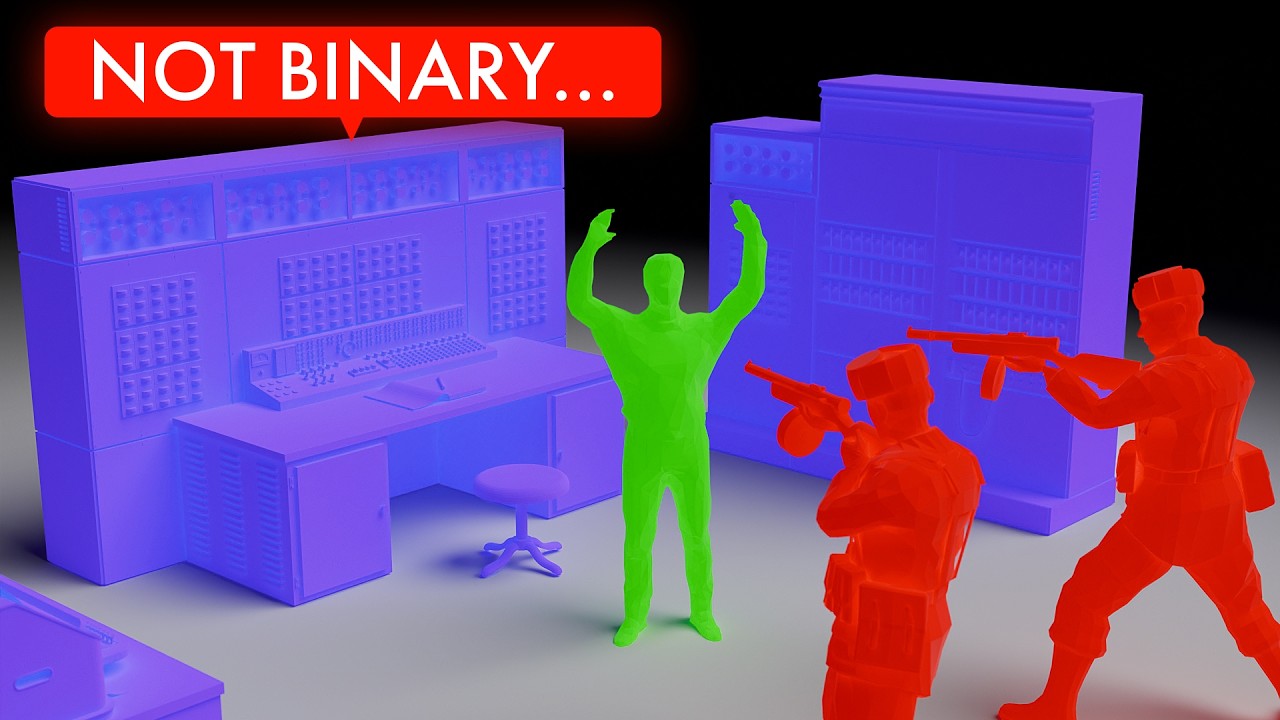
However, it was ultimately banned by official agencies, production was halted, and it was dismantled to erase nearly all physical traces. The story of Setun is that of a fantastic technical idea that clashed head-on with politics, bureaucracy, and internal power struggles within the Soviet Union itself.
From the unsuccessful M-2 to the ternary discovery
The main figure in this story is Nikolai Brusentsov, a young engineer who graduated in 1952 from the Moscow Power Engineering Institute. His career took a turn in 1954 when a colleague showed him a prototype of the M-2 computer, intended for Moscow State University (MSU) at the request of Serguei Sobolev, one of the country’s most influential mathematicians and a key figure in the Soviet atomic program.
The M-2 was to be installed in the imposing Lomonosov Tower, in room 1.313, meticulously prepared for the machine. Brusentsov and two other engineers moved to the university’s new computing center to work with it. But in 1955, everything fell apart: a personal and academic dispute between Sobolev and the laboratory manager overseeing the M-2 prevented the transfer. The computer was never delivered.
Instead of giving up, Sobolev challenged the team: “If we can’t have the M-2, we’ll build our own computer.” He wanted a cheap, robust, and easy-to-use machine designed for universities and research institutes nationwide. Brusentsov was tasked with defining the technical foundations of the project.
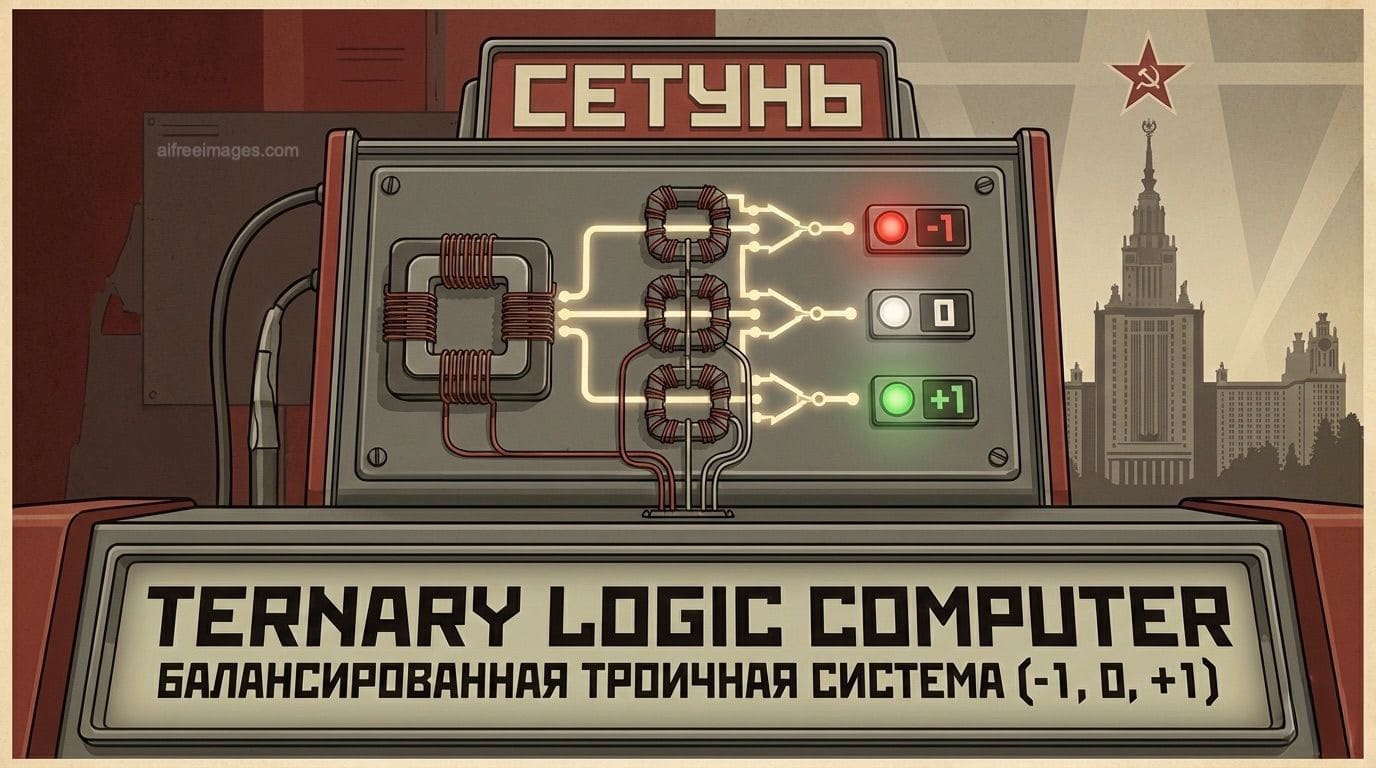
A key limitation was that vacuum tubes were off-limits, and semiconductors were still scarce. In this context, ferrite elements—magnetic cores used in logic and memory—appeared as a realistic alternative. Experimenting with these, Brusentsov made a discovery that would change his life: with proper wiring, these cores could produce stable impulses with three distinct states, not just two.
In other words, instead of mimicking the classic “0 or 1” of binary logic, they could handle “−1, 0, and +1”. This marked the physical basis of a ternary computer.
Balanced ternary logic: three values instead of two
Building on this physical foundation, the team relied on an elegant mathematical idea: the so-called balanced ternary logic. Instead of representing numbers only with positive digits, three symbols (−, 0, +) are used, corresponding to −1, 0, and +1, combined in powers of 3.
For example, the number 7 can be written as “+−+” in balanced ternary, which equals:
- (1 × 3^0 – 1 × 3^1 + 1 × 3^2 = 1 – 3 + 9 = 7)
The advantages went beyond aesthetics. In balanced ternary:
- Numbers are inherently signed, since the most significant trit already indicates positivity or negativity.
- No need to distinguish between signed and unsigned integers, as in binary.
- Rounding becomes simpler because the representation is symmetric around zero.
Brusentsov and his team quickly realized that, although a trit (ternary unit) might be more complex than a bit, many arithmetic and logical operations could be simplified. The designer himself later wrote that the apparent complexity of each element was offset by “the naturalness and harmony” of the overall ternary architecture.
On January 7, 1956, the team formally presented the concept of a balanced ternary machine to the group. After dozens of seminars, debates, and comparisons with binary designs, most became convinced: the Moscow University computer would be ternary. It was named after a small river near the campus: Setun.
How Setun worked: architecture and features
Setun was completed in December 1958. It was not just a theoretical experiment, but an operational computer with six well-defined functional blocks:
- Arithmetic Logic Unit (ALU).
- Control Unit.
- Working Memory.
- Input Unit.
- Output Unit.
- Magnetic Drum Memory.
Input was via punched paper tape with five positions, capable of reading about 800 characters per second. Data entered serially into a 9-trit shift register, then converted to parallel format for storage in memory.
The RAM was divided into two levels:
- A fast ferrite core memory with 162 words of 9 trits.
- A magnetic drum with 1,944 words—slower but with greater capacity.
The ferrite memory effectively functioned as a cache, foreshadowing concepts that would later be common in computer architecture. The ALU could add and subtract in around 180 microseconds and multiply in about 320 microseconds, in addition to performing shifts, normalization, and floating-point operations within the ternary system.
Setun supported 24 instructions (21 for common use), including conditional and unconditional jumps. It fully supported three-valued logic, in line with the work of Polish logician Jan Łukasiewicz on “true, false, and unknown” states mapped to −1, 0, and +1.
There was, however, a controversial point: in the magnetic drum, ternary states were stored by combining two bits—a hybrid solution that some criticized for “diluting” the system’s ternary purity. Yet recent research has shown that this encoding could even offer performance advantages for certain arithmetic operations.
The key factor for that era was reliability. And on that front, Setun excelled. During official testing, it operated for three weeks without failures—a remarkable feat for a late 1950s machine.
Technical success, political veto
After its deployment, Setun was showcased in 1959 at the Soviet Union’s Economic Achievements Exhibition. Even Nikita Khrushchev may have seen it working. But the major backing came on April 29, 1960, when an interdepartmental commission officially certified that Setun met specifications and recognized it as the first universal ternary computer model.
It seemed the project had a clear path forward. But that was not the case.
That same year, the State Committee for Radioelectronics—the agency responsible for approving mass production—placed Setun on its blacklist, excluding it from industrial manufacturing. The official reason was that producing it would be a “waste of funds,” despite the committee never having financed its development.
Sobolev, incensed, confronted officials: “Have you even seen the machine?” The answer was devastating: they didn’t need to see it; all that mattered were the paperwork with official seals and signatures.
The setback was not only from Moscow. From Czechoslovakia, an offer was made to mass-produce Setun in Brno, capable of producing hundreds of units per year. But Soviet authorities blocked this, claiming production should be domestic… even though they did not intend to produce it themselves.
Nevertheless, the team managed to initiate limited production. Between 1959 and 1965, about 50 units were built, distributed across military academies, meteorological centers, and universities. Setun was used in aircraft engine testing, short-term weather forecasts, and scientific calculations.
Brusentsov emphasized that the machine operated flawlessly in diverse climates—from the desert of Ashgabat to the severe winters of Yakutsk—almost without technical support or spare parts. Just as it was beginning to demonstrate its true utility, production was abruptly halted in 1965. The clients only found out when their orders were canceled.
The designer later summarized: this ending was not due to technical, economic, or scientific failures. Simply, the machine did not fit within the political decisions already made in favor of binary architectures “cloned” from Western designs.
Setun-70, a second attempt that also clashed with the system
Despite these setbacks, Brusentsov didn’t give up. In 1967, he secured approval from the Moscow University Calculation Center to develop a new ternary machine: Setun-70.
The goal was ambitious: to have the computer ready before 1970. He succeeded. Setun-70 improved upon the original with more RAM, user-programmable ROM pages, a larger magnetic drum, lower power consumption, and a transistor-based power supply. It was also physically smaller.
But history repeated itself. The software developer never delivered the planned system, distracted by other projects, and the center’s leadership changed. The new leaders were far less interested in experimental architectures.
The situation culminated in the forced relocation of Brusentsov’s lab to an unlit attic in a student residence. Despite the poor conditions, the team took the Setun-70 with them and developed an educational system called Nastavnik (“Tutor”), used for decades to assign students to language groups based on their level.
The fate of the original Setun was more tragic: it was still operational but was turned off and dismantled in the summer of 1973. Only the logbook remains, documenting its use until the last day. The official order for dismantling has not survived, and no one convincingly explains why an operational, unique computer was destroyed.
An uncomfortable legacy and an open question
Until his death in 2014, Nikolai Brusentsov remained a defender of ternary computing, leading a dedicated laboratory and unsuccessfully seeking funding for new 3-based processors.
For him, Setun was never a failure. It proved that a non-binary computer could be built, programmed, taught, and used for years in real environments. Its problems were not technical but rooted in political and institutional contexts: the Soviet system favored replicating Western binary designs and marginalized any promising alternatives.
The big question remains: why was the project so thoroughly suppressed? Series production bans, proposals blocked from other Socialist bloc countries, and even physical destruction of the prototype—official documents and later testimonies have yet to fully clarify this mystery.
Today, as new architectures for accelerating AI, optimizing energy use, or exploring multi-value logics are reexamined, Setun’s story no longer seems as exotic as it once did. It serves as a reminder that sometimes, the best technical idea does not prevail… if it doesn’t fit the plans of those who decide which technologies get manufactured and which are buried.
Frequently Asked Questions about the ternary computer Setun
What exactly was the Soviet computer Setun?
Setun was the first universal computer based on balanced ternary logic, developed at Moscow State University and operational since 1958. Instead of using bits with two states (0 and 1), it employed trits with three states (−1, 0, +1). Designed as a general-purpose machine for universities and research centers, it featured a full architecture (ALU, ferrite core memory, magnetic drum, punched tape input) and a set of 24 instructions.
Why is Setun considered a “forbidden” or vetoed computer?
Setun passed official tests and was recognized as the first universal ternary machine, but the State Committee for Radioelectronics excluded it from mass production, citing “waste of funds”—despite never having funded its development. Later, attempts to produce it in Czechoslovakia were blocked, and in 1965, its limited production was halted altogether. The original prototype was dismantled in the early 1970s even while still functioning. This combination of bureaucratic bans, industrial obstruction, and physical destruction leads many historians to refer to it as a de facto “forbidden” computer.
How many Setun units were made, and what were their uses?
Approximately 50 units were built between 1959 and 1965. They were deployed across various institutions: military aviation academies for engine testing, meteorological centers for short-term forecasts, and university departments for scientific calculations. Reports agree that the machines were highly reliable, operating for years in extreme climates with minimal maintenance or spare parts.
Is ternary computing still relevant today compared to traditional binary architectures?
Balanced ternary offers theoretical advantages: natural signed number representation, symmetric rounding, and high efficiency in the “numerical economy.” However, binary standards became universal, making it difficult for alternative architectures to thrive. Today, as interest grows in new architectures for AI, neuromorphic computing, and multi-value logics, Setun reemerges as a significant precedent—demonstrating that practical ternary computers are not only possible but have already operated successfully in real-world conditions.
Sources:
– Testimonies and notes from Nikolai P. Brusentsov on the development of Setun and Setun-70.
– Technical reports and historical reconstructions on Setun and balanced ternary computing.