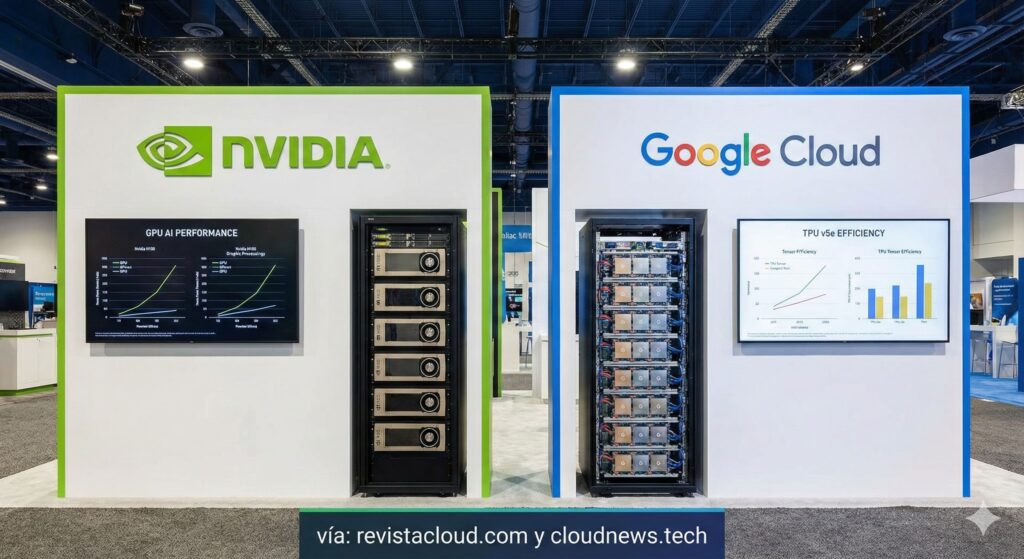
The artificial intelligence market was, until recent weeks, living in a nearly unquestioned story: NVIDIA dominates, the rest chase. However, a series of discreet but highly significant moves is beginning to challenge that narrative. Google has decided to manufacture its next TPU v9 with Intel instead of TSMC; Meta is apparently following the same path for its own AI chips; meanwhile, NVIDIA’s stock has been falling over 7% in a month.
In this context, many are turning their attention to Michael Burry, the investor famous for predicting the 2008 subprime crisis and who recently placed bets against NVIDIA. Exaggeration or the first visible crack in the “green” dominance?
From Stock Market Hero to Target of Bearish Bets
Burry became part of popular culture thanks to the movie The Big Short, which tells how he made billions betting against the US housing market when everyone thought it was indestructible. Years later, his positions are scrutinized: when he decides to take short positions against a company, debate is guaranteed.
Among his recent bets is NVIDIA, along with other names linked to the AI boom like Palantir. Back then, many considered betting against the world’s most valuable company by market cap and undisputed GPU leader in AI to be tantamount to madness. Today, with the stock retracing and new competitors moving into the scene, the question returns: what if Burry was not so mistaken?
NVIDIA Hits Records… but the Stock Is Fizzling
On paper, NVIDIA’s situation remains enviable:
It dominates the AI GPU market with an overwhelming share.
It posts record results, quarter after quarter.
It has evolved from a gaming-focused company to the backbone of AI infrastructure in data centers worldwide.
Yet, the share price has recently fallen more than 7% in a month, while Alphabet (Google) has gained around 20% amid news about its own AI chips. The market, always ahead, seems to be starting to price in that the future might not belong solely to NVIDIA.
Key Development: Google Will Manufacture Its TPU v9 with Intel EMIB
One of the most impactful moves has been Google’s decision to trust Intel to manufacture its upcoming TPU v9, bypassing TSMC, the Taiwanese giant with whom NVIDIA maintains a very close relationship.
This involves several technical concepts:
TPU (Tensor Processing Unit): chips designed by Google specifically to accelerate AI workloads, especially tensor and matrix operations typical of neural networks. They are not standard GPUs: they are ASICs highly specialized for AI.
Intel IFS and EMIB: IFS is Intel’s third-party manufacturing business, and EMIB (Embedded Multi-die Interconnect Bridge) is an advanced interconnection technology for packaging multiple chips (chiplets) in a single module, offering high performance at lower costs and complexity than other advanced packaging solutions.
In practice, Google’s choice to go with Intel for these TPUs means:
Reduced dependence on TSMC, which is saturated with orders from NVIDIA and other major clients.
A boost for Intel’s strategy to become a major third-party manufacturer again.
A clear message to the market: Google does not intend to rely solely on NVIDIA’s GPUs for its AI future.
Meta Looks to Intel, and Concerns Grow for NVIDIA
Google’s move is not isolated. Reports suggest Meta is also approaching Intel to produce its own AI SoCs. This pattern is worrying for NVIDIA:
Major “hyperscalers” are seeking own chips (TPUs, ASICs, AI SoCs) to reduce reliance on a single supplier’s GPUs.
Intel, which until recently played a secondary role in AI discussions, is positioning itself as an alternative manufacturer to TSMC, with available capacity and an aggressive roadmap.
Combine this with AMD’s growing presence in data centers with its Instinct accelerators, and the perception is clear: NVIDIA’s dominance is no longer as secure as it was a year ago.
Why Are Google’s TPU So Scary for NVIDIA?
Unlike a GPU, originally designed for graphics but very effective in parallel computing, a TPU is built from scratch for a single goal: making AI as fast and efficient as possible.
This entails:
Higher performance per watt for specific workloads.
Better alignment with the AI models that Google and other major platforms run at scale.
Full control over hardware development, without dependence on third parties.
Google already extensively uses its TPUs in its services and offers them via its cloud. Now, with TPU v9, there’s an upgrade in power and efficiency. For NVIDIA, the issue isn’t just losing direct business—every large-scale TPU deployment becomes a missed opportunity to sell GPUs.
Industry sources report that interest in these new TPUs among major tech companies has surged, including some that previously relied almost exclusively on NVIDIA GPUs.
NVIDIA’s Public Response: Praise… With a Subtle Message
In response, NVIDIA issued a public statement with a conciliatory tone towards Google. In a social media message, the company states:
“We’re delighted with Google’s success: they’ve made great advances in AI and we continue to supply to Google. NVIDIA is a generation ahead of the industry—it’s the only platform capable of running all AI models anywhere in the world.”
We’re delighted by Google’s success — they’ve made great advances in AI and we continue to supply to Google.
NVIDIA is a generation ahead of the industry — it’s the only platform that runs every AI model and does it everywhere computing occurs.
They acknowledge Google’s success, attempting to ease concerns of a rupture.
They emphasize that their GPUs remain the “universal platform” capable of running any model, unlike ASICs (like TPUs), which are more specialized.
Subtextually, NVIDIA aims to remind investors and customers that, although giants like Google may opt for tailored chips for their data centers, the global AI landscape—startups, companies, institutions—still relies on a flexible platform where GPUs continue to be the most versatile option.
TSMC, Intel, and the Battle over Advanced Packaging
Alongside the GPU vs. TPU struggles, another quiet battle is unfolding: manufacturing and advanced packaging.
TSMC is nearing capacity limits for its leading-edge nodes, with NVIDIA reserving much of its production for AI GPUs.
Intel, with its IFS initiative, is positioning itself as an alternative, with expanding factories and technologies like EMIB and Foveros for large-scale chiplet packaging.
Google and potentially Meta choosing Intel is a sign of the shifting landscape: if major clients diversify, the advantage of controlling capacity could turn into a double-edged sword for both TSMC and NVIDIA.
Is This the End of the GPU Reign in AI?
The big question is whether we are at the beginning of the end of GPU dominance in AI computing, or entering a phase of greater diversity among accelerators.
Arguments exist for both sides:
GPUs will remain essential because of their flexibility: allowing training and inference of any model, even those not yet conceived.
TPUs and other ASICs excel when the model is well-defined and runs at scale for years, where every bit of energy efficiency counts.
Probably, the future won’t be “GPU or TPU,” but a hybrid:
Large platforms with dedicated chips for very specific workloads.
A vast ecosystem of mid-sized and small companies relying on NVIDIA, AMD, or others’ GPUs.
What’s clear is that NVIDIA’s near-absolute dominance over recent years will be much harder to maintain. With Google approaching Intel, Meta exploring the same path, and AMD gaining ground, the landscape is becoming more complex.
Whether this is the start of the correction Michael Burry anticipated or just a bump in NVIDIA’s rise will be revealed in upcoming quarters. For now, the market has sent a warning: in the AI race, it’s no longer enough to run fast—you also have to watch who’s switching lanes.
Passionate about technology, cloud infrastructure, and language models and artificial intelligence. Always up to date in a world that never stops for a second.