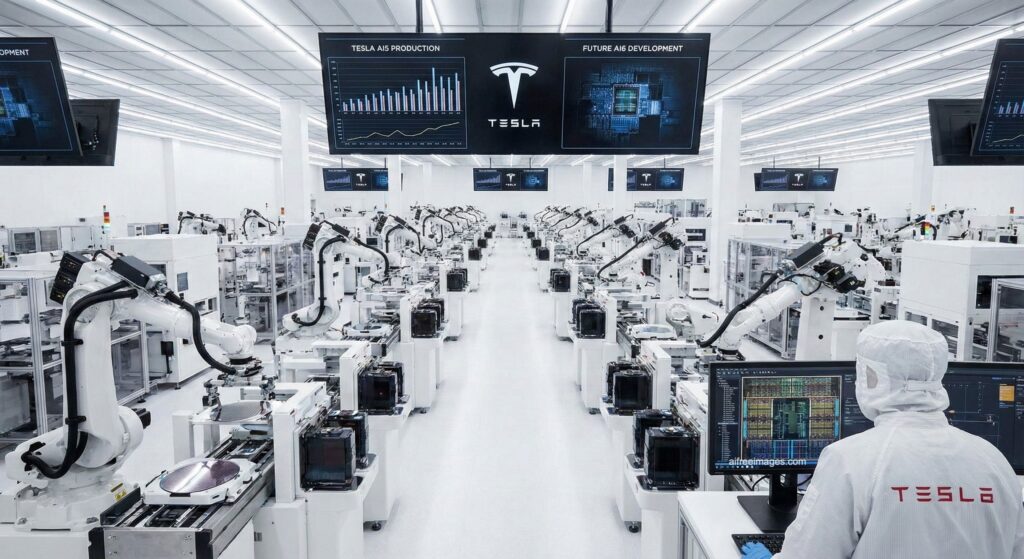
Elon Musk has once again shaken up the AI landscape with a claim that certainly grabs attention. According to the executive himself, Tesla not only has a solid track record of designing its own AI chips but aims to “manufacture more volume than all other AI chips combined.”
A goal as ambitious as it is controversial, especially considering the current dominance of companies like NVIDIA in the data center accelerators and generative AI model markets.
Tesla boasts its own AI chip team and roadmap
In a post on X, Musk recalled that Tesla has “had an advanced AI chip and board engineering team for years.” This team has already designed and deployed “several million AI chips” in both vehicles and data centers.
For Tesla vehicles, these chips are at the core of the assisted driving system and the controversial Full Self-Driving (FSD). Musk states that the current generation installed in Tesla cars is the AI4 chip, and the company is “close to tape-out” of the AI5, meaning finalizing the design for wafer fabrication. At the same time, he confirms they have already begun working on AI6.
Tesla’s clear ambition is to release a new generation of AI chips every 12 months, an extremely aggressive schedule compared to the typical multi-year development cycles in the semiconductor industry, where major leaps often take several years.
“More chips than all others combined”: a tough promise to match reality
The most striking phrase in Musk’s message is undeniably:
“We expect to manufacture in greater volume, ultimately, than all other AI chips combined. Read that again, I’m not joking.”
Most people don’t know that Tesla has had an advanced AI chip and board engineering team for many years.
That team has already designed and deployed several million AI chips in our cars and data centers. These chips are what enable Tesla to be the leader in real-world AI.
That “all others” includes giants like NVIDIA, AMD, Intel, Qualcomm and many other chip manufacturers and designers for both data centers and personal devices.
The assertion relies on an idea: if Tesla produces and sells tens of millions of cars equipped with its own AI chips (plus units dedicated to data centers for training models), the volume of silicon specific to AI could be enormous. Each vehicle already integrates hardware for neural network processing to analyze surroundings and run autonomous driving algorithms in real-time.
However, in today’s context, this promise sounds challenging. NVIDIA, for example, ships millions of general-purpose GPUs for AI annually, powering massive server farms that support language models, agents, and generative systems worldwide. Moreover, Tesla still relies on NVIDIA GPUs to train its vision and driving models, despite its Dojo project and internal chips.
From FSD promises to leadership in “real-world AI”
Musk has long argued that Tesla is not just an automaker but a company of artificial intelligence and robotics. In his post, he reiterates that these chips will enable Tesla to be “the leader in real-world AI,” meaning systems that interact directly with physical environments:
Autonomous driving in their vehicles.
Humanoid robots, Optimus, which Tesla presents as a future platform for industrial tasks and, in the long term, service or medical applications.
According to Musk, these chips “will profoundly and positively change the world,” saving millions of lives through safer driving and providing “advanced healthcare” via Optimus.
Nonetheless, the tech community has seen overly optimistic promises before. The timelines for achieving full autonomous driving have repeatedly been delayed year after year, and current technology still requires constant driver supervision while being under regulatory scrutiny in multiple countries.
A message that also sounds like a mass recruitment effort
Beyond the media attention, Musk’s message clearly aims to:
“Send an email with three pieces of evidence about your exceptional capability to [email protected].
We’re especially interested in applying cutting-edge AI to chip design.”
This underscores Tesla’s intention to compete on the same level as major semiconductor companies: not just using chips but designing and optimizing them for their workloads, increasingly relying on generative AI and specialized models to create new architectures.
The context: an increasingly fierce AI silicon race
Musk’s statement comes at a time when the AI chip market is exploding:
NVIDIA dominates the data center segment with its Blackwell GPUs and NVL72 platforms, which combine dozens of accelerators into a “superchip” for large-scale training and deployment of AI models.
Google, Amazon, Microsoft, Meta, and other hyperscalers are designing their own AI ASICs (TPUs, Trainium, Maia, etc.) to reduce dependency on NVIDIA and better tune cost, power, and performance.
In devices, companies like Apple, Qualcomm, and AMD are integrating NPUs and AI accelerators directly into their SoCs for laptops and mobile devices, pushing AI to the edge (on-device).
Tesla occupies a unique position: its chips combine sensor processing, computer vision, and real-time vehicle control, and now also robotics. If Tesla can scale production to millions of units annually, it could become one of the world’s largest consumers of specialized AI silicon.
Yet, surpassing the combined volume of all other industry AI chips remains a long road filled with uncertainties:
Which foundry will produce these AI4, AI5, and AI6 chips sustainably?
At what node and costs, amid high demand and capacity constraints?
Can Tesla maintain an annual cycle of new chips without compromising stability, costs, and compatibility?
What does this mean for the future of “real-world AI”?
Beyond whether Musk’s promise will be fulfilled literally or not, his message reflects a clear trend: the convergence of automotive, robotics, and AI hardware.
Connected and increasingly autonomous cars are becoming computing platforms on wheels.
Humanoid robots and other autonomous systems will require vast amounts of dedicated processing power for vision, planning, and control.
Companies controlling both software (AI models) and hardware (optimized chips) will hold a significant competitive advantage.
Tesla aims to be part of this group—not only as a customer of NVIDIA but as a designer of its own AI stack, from silicon to algorithms. Recent history shows Tesla is capable of moving quickly, but its timelines are often optimistic.
The only certainty now is that the race for AI chips is intensifying, and the sector will keep a close eye on Tesla’s AI5 and AI6 chips, as well as on traditional semiconductor giants’ responses.
Whether Musk is right about “making more chips than all others combined” will be something the market—and the next few years—will determine.
Passionate about technology, cloud infrastructure, and language models and artificial intelligence. Always up to date in a world that never stops for a second.