
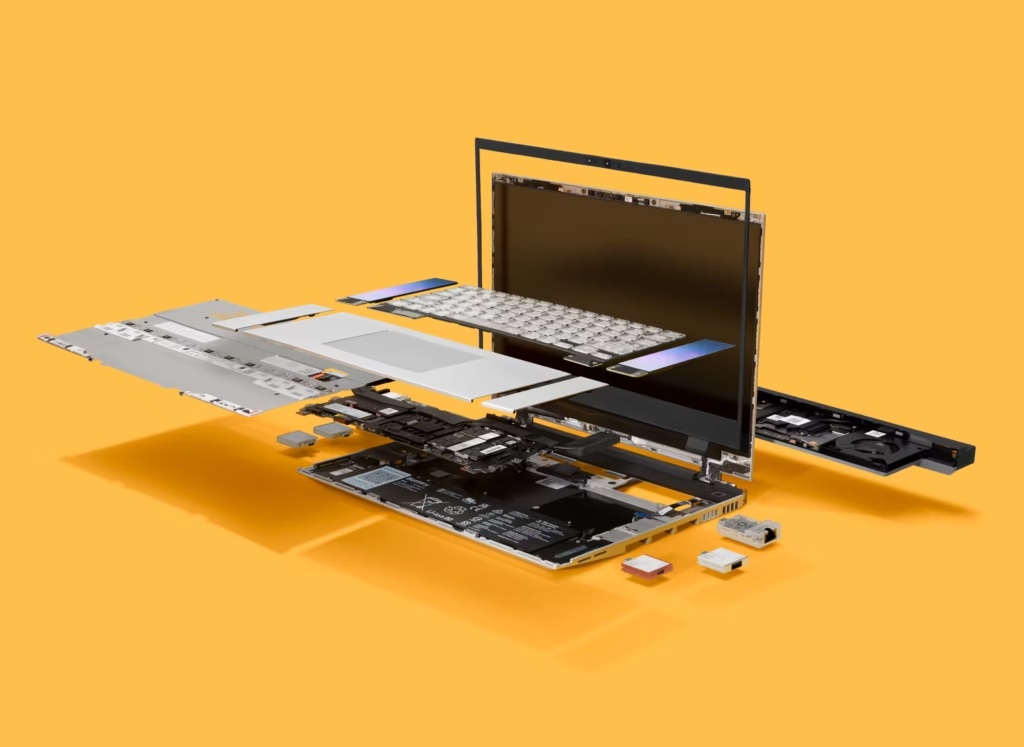
The perfect storm in the memory market is already hitting even the most community-conscious brands hard. Framework, the manufacturer of modular and repairable laptops, has stopped selling separate RAM modules in its online store to try to curb resellers and protect stock allocated for its own devices.
The company, known for its commitment to reparability and the right to repair, offers SO-DIMM modules in its Marketplace that users can install in their laptops—either as upgrades or when configuring the DIY Edition versions. But the state of the DRAM market has become so tense that Framework has been forced to make a drastic decision: almost all standalone memory kits have been removed from sale.
In a message addressed to its community, the company admits that the “memory market is at a tricky point,” and that they have had to delist loose RAM from their store to “get ahead of scalpers and preserve inventory for those buying DIY laptops.”
Artificial Intelligence is eating up DRAM production
The context behind this decision isn’t unique to Framework. The real issue originates from higher up: the AI revolution is consuming global memory manufacturing capacity.
In practice, only a few companies—Samsung, SK Hynix, Micron, among others—are capable of producing DRAM at the volumes and process nodes demanded by the industry. A huge portion of that production is being allocated to:
- Data centers for training and inference of AI models.
- GPU clusters with terabytes of memory per node.
- Large cloud and infrastructure providers that purchase long-term and at very high prices.
Companies like OpenAI and other AI giants are securing massive memory and storage supply contracts, leaving PC manufacturers and end-users in a much weaker position to negotiate prices.
The result is a market where:
- Desktop and laptop DDR5 modules are skyrocketing in price.
- Delivery times are extending.
- And any midstream point in the supply chain—such as a brand’s Marketplace—is targeted by speculators buying cheap to resell at a higher price.
From modular laptops… to fears of resellers
Under normal circumstances, Framework’s model is nearly a perfect example of how consumer hardware should be:
- Laptops that are easy to open and upgrade.
- Standard RAM and SSD modules.
- An official store with spare parts and upgrades to extend device lifespan.
But in a tense market, this same virtue transforms into a weakness: if the brand sells quality RAM at reasonable prices, it’s only a matter of time before third parties buy up all the stock to resell it at higher prices on other platforms.
To avoid this, the company has opted for an intermediate solution:
- Keeping RAM modules available, but only when purchasing a DIY laptop or as part of a full configuration.
- Removing the sale of RAM as an independent product, at least for the duration of the current situation.
It’s an unpopular move for those who saw Framework’s Marketplace as a resource to upgrade existing laptops, but it ensures that future customers won’t be left without memory options for their devices.
Price hikes on the horizon
The bad news isn’t limited to product delisting. Framework has also warned that its memory costs are going to rise, and that sooner or later, this will lead to higher prices for the modules still available.
This isn’t an isolated decision:
- Manufacturers like Minisforum have already increased prices on many of their prebuilt PCs that include RAM and SSDs.
- Major players like Lenovo are hoarding memory to ensure stock for the coming months.
Meanwhile, in the desktop segment, the market mismatch is highly evident: there are cases where a 64 GB DDR5 kit costs more than a complete PlayStation 5 console. A comparison that would have seemed absurd a few years ago but now serves as a real thermometer of how uncontrolled memory prices have become.
2026 looks worse: scarcity and high prices becoming the norm
Analysts and manufacturers agree on a less optimistic outlook: the situation won’t improve in the short term. The most likely scenarios are:
- Throughout 2026, the DRAM market will remain under intense demand pressure driven by AI.
- Prices will stay high or even keep rising.
- Small and medium-sized manufacturers will struggle more to ensure stable supply.
This affects several profiles:
- Advanced users and PC enthusiasts looking to upgrade their systems with more memory.
- Companies relying on workstations with large amounts of RAM.
- Brands like Framework whose value proposition is based on the ability to upgrade hardware over time.
In this context, rationing stock, limiting individual sales, or prioritizing certain channels are no longer anomalies but survival strategies.
What can users do in this scenario
For the end user, options are limited, but some sensible recommendations include:
- Plan upgrades ahead of time
If you know you’ll need more memory in the coming months (for virtualization, local AI, video editing, etc.), it might be wise to anticipate potential price increases. - Avoid overpaying resellers
Second-hand markets and some online marketplaces are filled with inflated kits. It’s wise to compare prices carefully and be wary of unjustified increases beyond the official PVP. - Consider balanced configurations
Jumping straight to 64 GB or more isn’t always necessary if your actual usage doesn’t demand it. In a context of skyrocketing prices, a well-utilized 32 GB system can be more reasonable. - Stay informed about manufacturer updates
Brands like Framework communicate price and availability changes with transparency. Staying alert can make the difference between buying at a “reasonable” price or missing out entirely.
A further sign of the AI era
The situation with Framework’s RAM is not an isolated case but a symptom of deep market reconfiguration amidst the AI boom.
While tech giants close billion-dollar contracts to fuel their GPU clusters, the rest of the ecosystem—from alternative manufacturers to domestic users—is forced to adapt to a new reality: memory is a strategic resource, scarce and increasingly expensive.
And even a user-focused company like Framework having to remove loose RAM from its store to combat speculators is probably one of the clearest signs of this shift.
