
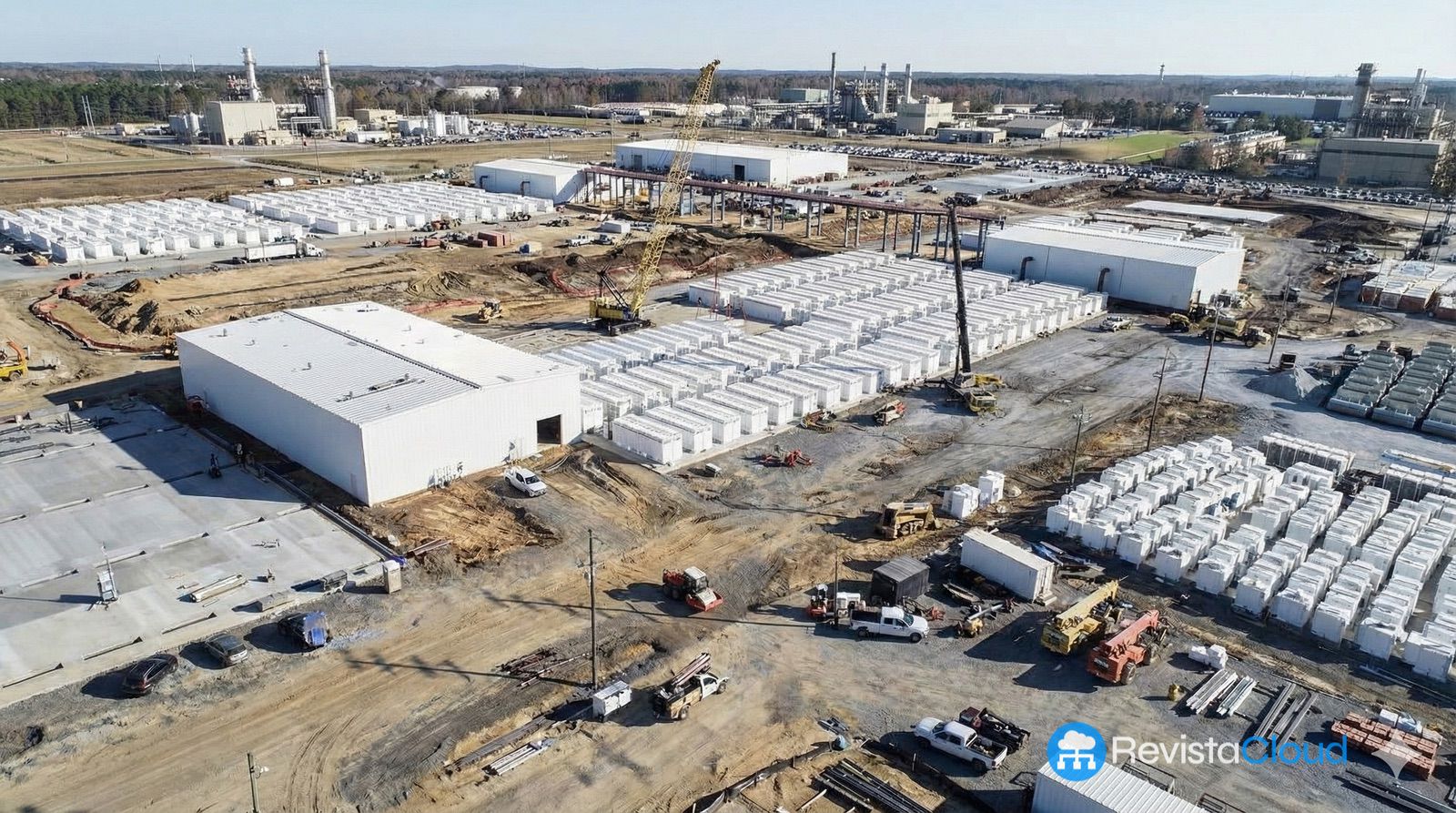
xAI has begun receiving and installing Tesla Megapack batteries on its data campus. The move, confirmed this week from the site, reflects a simple idea with major implications: in the race for Artificial Intelligence, the problem is no longer just having GPUs, but being able to turn them on with reliable, clean, and affordable energy. Large-scale batteries here appear as the “physical manifestation of vertical integration” of Elon Musk’s ecosystem — manufacturing and software supported by its own energy infrastructure.
According to the company, Megapacks are lithium-ion energy storage systems housed in industrial containers, designed for commercial and utility-scale use. Each unit integrates batteries, inverters, controls, and climate control, and connects as a plug-and-play module to the data center’s electrical system. Their function is to store excess electricity —for example, during off-peak hours or when grid capacity allows— and deliver it when AI training loads cause consumption to peak, increasing costs or stressing the network.
The bottleneck is no longer the ship, but the grid
The data center sector agrees on one diagnosis: the biggest delay for a campus isn’t installing the racks, but getting the connection point. In the U.S., interconnection timelines for new capacity can stretch between 3 and 5 years, depending on substation upgrades, grid reinforcements, and signing Power Purchase Agreements (PPAs). Meanwhile, AI projects continue to demand firm and predictable energy.
In this scenario, xAI proposes Megapacks as “buffer substations”: the campus charges the batteries during low-demand hours and discharges during critical moments, dampening the peaks that trigger Demand Charges — tariffs utilities apply based on maximum instant power. The dual goal is to reduce electrical OpEx and speed up the time-to-power without waiting for complex grid reinforcements.
Fewer peaks, more reliability… and margin per token
Large-scale training requires sustained power over weeks. However, the grid fluctuates depending on the hour and season. Without storage, data centers are subject to tariff peaks and temporal limitations imposed by the grid operator. With Megapacks, xAI smooths the load curve (peak shaving), shifts consumption to cheaper hours (time-shifting), and supports continuity during micro-cuts, which protects operations and, according to the company, reduces the effective cost per kWh consumed by the compute cluster.
The economic pitch can be summarized in a popular industry slogan: “If compute is electricity turned into tokens, every cent less per kWh increases the margin per token”. In other words, optimizing energy reduces inference and training costs and accelerates return on hardware investments.
Why it matters for the environment
xAI emphasizes that the installation improves local reliability: by charging during off-peak hours and discharging in peaks, the campus relieves the surrounding grid, lowers the likelihood that a sudden demand spike will cause restrictions or , and potentially facilitates the integration of variable renewable sources. The company also claims that its deployment protects and even enhances the quality of supply for nearby residents and businesses.
Energy as a competitive advantage
While the market continues to measure AI players by who has the most NVIDIA GPUs, the quiet war is fought over cost and energy availability. Those who control their power curve and ensure a stable electric mix —with contracts, generation, and storage— turn on their models sooner, train more hours, and produce results with fewer disruptions. From this perspective, Megapacks are not just an electrical component: they are a strategic lever.
What it solves and what it leaves out
- Solves:
- Demand peaks through planned discharges.
- Hourly energy arbitrage (buy/load cheap, use expensive).
- Short-term backup to prevent outages during micro-cuts.
- Accelerates deployment as the grid reinforcement arrives.
- Does not substitute:
- Long-term generation capacity or formal interconnection; BESS complement the grid and PPAs.
- Planning with operators: permits, fire safety, integration with protections, and coordination remain essential.
- Comprehensive sustainability management: emissions reduction depends on the electric mix used to charge the batteries.
Vertical “Musk-style” integration
The “Muskonomy” referenced by the company weaves together battery manufacturing, energy management software, and data centers with high demand. By providing storage (Tesla) and consuming it (xAI), the group internalizes part of the energy cost and risk, applying a classic vertical integration approach to the new wave of generative AI.
Implications for the sector
The deployment reinforces a trend already seen in hyperscale projects: on-site batteries as an accelerator for connection, shield against power tolls, and operational safety net. Underlying this is ongoing regulatory debate about interconnection, capacity tariffs, and BESS participation in auxiliary services markets. But the message from xAI is clear: energy is the new frontier of AI competitiveness.
Frequently Asked Questions
What exactly is a Tesla Megapack and how is it used in a data center?
It’s a large-scale lithium-ion battery system, housed in an industrial container with an inverter and controls. In data centers, it’s used to store energy and release it during demand peaks, reduce costs related to maximum power, and enhance resilience against micro-cuts.
How do batteries help “jump” the interconnection bottleneck?
While waiting for final connection approval —a process that can take between 3 and 5 years— batteries allow charging during off-peak hours and discharging during peak demand, acting as a buffer substation and avoiding exceeding temporary utility limits.
Does this mean the data center can operate without the grid?
No. BESS complement the grid: they stabilize, shift consumption, and cover short outages. For longer periods, a grid supply or on-site generation (like renewables with sufficient storage or backup generators) is necessary.
What impact could this have on the neighborhood or city where the campus operates?
By smoothing peaks, the data center reduces stress on the local grid and prevents its sudden demand from affecting others. If charged with low-cost, low-emission electricity, it can also improve the environmental profile of the campus compared to operating solely off the grid.
Source: Twitter xAI
