
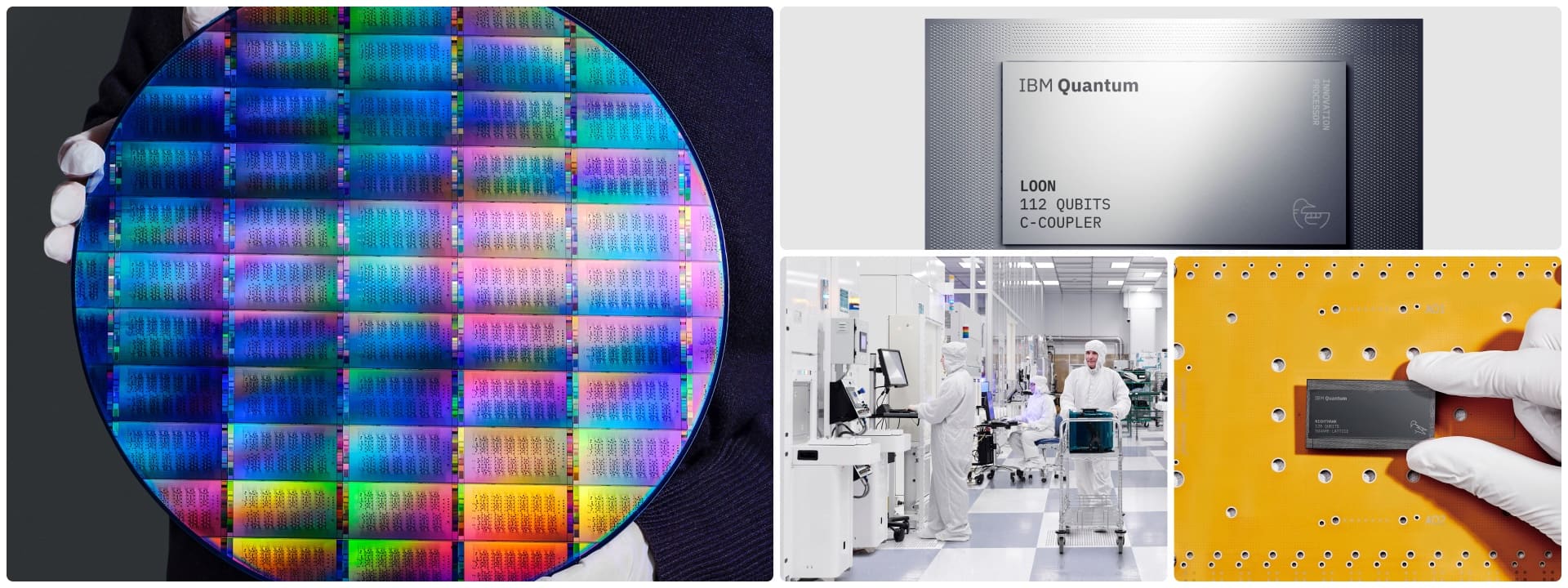
IBM has leveraged its Quantum Developer Conference to send a strong message to the sector: the company believes it is just a few years away from demonstrating a verifiable quantum advantage and building a large-scale fault-tolerant system. To support that claim, it has unveiled a new processor called IBM Quantum Nighthawk, the experimental processor IBM Quantum Loon, significant advances in Qiskit, and a major leap in quantum chip manufacturing.
The announcement sets specific dates on the calendar: by late 2026 for the first community-validated quantum advantage and 2029 for a fault-tolerant quantum computer.
Nighthawk: the new flagship on the path to quantum advantage
The highlight of the announcement is IBM Quantum Nighthawk, described as IBM’s most advanced quantum processor to date. Its architecture has been designed to work in tandem with high-performance quantum software and enable circuits that are 30% more complex than the previous generation, based on the IBM Quantum Heron processor.
Key features include:
- 120 interconnected qubits.
- 218 tunable couplers linking each qubit to its four nearest neighbors in a square grid, with over 20% more couplers than Heron.
- Capacity to run circuits with up to 5,000 two-qubit gates while maintaining low error rates.
IBM plans to deliver Nighthawk to users by late 2025, with a clear road map for progressively increasing its logical capacity:
| Year | Nighthawk Generation | Estimated Two-Qubit Gates | Main Objective |
|---|---|---|---|
| 2025 | Initial Nighthawk | ~5,000 | Advanced quantum advantage experiments |
| 2026 | Extended version | ~7,500 | First verified demonstrations of quantum advantage |
| 2027 | New iteration | ~10,000 | More complex problems in chemistry, physics, and optimization |
| 2028 | Nighthawk-based systems | up to 15,000 gates and 1,000+ qubits connected via long-range couplers | Scaling to large architectures |
The key to this roadmap is connectivity: by introducing long-range couplers, IBM aims to connect distant qubits within the same chip without increasing error rates, a crucial requirement for deep circuits with maintained fidelity.
An open tracker for quantum advantage
Looking ahead to late 2026, IBM anticipates that the first cases of verifiable quantum advantage will be recognized by the scientific community. To avoid opaque debates, the company is promoting an open quantum advantage tracker, led by the community, with contributions from:
- IBM, providing results obtained on its hardware.
- Algorithmiq, specializing in quantum algorithms for chemistry.
- Researchers from the Flatiron Institute.
- The startup BlueQubit, focused on quantum simulation and compilation.
The tracker currently collects three types of experiments:
- Observable estimation (e.g., in quantum chemistry).
- Variational problems, where circuit parameters are optimized iteratively.
- Cases with efficient classical verification, enabling comparison with high-level simulations.
The goal is twofold: transparently monitor claims of quantum advantage and, at the same time, compare the best quantum methods with the best classical algorithms available.
Qiskit: greater precision, lower costs, and a direct bridge to supercomputing
Hardware alone isn’t enough if the software doesn’t keep pace. IBM places Qiskit, its open-source quantum software stack, at the center of its strategy.
Key updates include:
- Enhanced dynamic circuits, which allow real-time circuit adaptation based on intermediate results. Tests on systems with over 100 qubits report a 24% increase in accuracy.
- A new execution model integrating error mitigation accelerated by HPC, reducing costs for obtaining accurate results by more than 100 times.
- A C API and a C++ interface for Qiskit, designed enabling users in high-performance computing (HPC) environments to program quantum algorithms natively, without leaving their classical workflows.
By 2027, IBM aims for Qiskit to include libraries specialized in machine learning, optimization, and physical simulations (e.g., differential equations, Hamiltonians) to tackle key problems in chemistry, materials science, and high-energy physics.
Loon: the laboratory for fault-tolerant quantum computing
While Nighthawk targets quantum advantage, the experimental IBM Quantum Loon processor focuses on the next major leap: fault-tolerant quantum computing, expected by 2029.
Loon is the first IBM processor to incorporate all building blocks necessary for a fault-tolerant machine:
- Multiple layers of high-quality, low-loss routing, enabling longer connections within the chip, known as “c” couplers, capable of linking distant qubits.
- Technologies to restart qubits between calculations, essential for implementing continuous error correction protocols.
- Integration with a real-time error decoding system based on classical hardware, capable of processing qLDPC error correction codes with a 10x faster speed and latencies below 480 nanoseconds.
This milestone, achieved a year ahead of schedule, is especially important: error correction requires extremely low reaction times to prevent noise from accumulating faster than it can be corrected. IBM argues that the combination of Loon and the new decoder demonstrates the feasibility of scaling qLDPC codes in high-speed, high-fidelity superconducting qubits, like those used in its platform.
300 mm fabrication: industrializing quantum computing
The third pillar of the announcement is far from labs and closer to manufacturing. IBM has begun producing its 300 mm quantum wafers at the advanced facilities of the Albany NanoTech complex in New York.
This industrial node leap has tangible effects:
- Doubling R&D speed, cutting the time needed to produce each new processor in half.
- Multiplying tenfold the physical complexity of quantum chips, enabling more qubits, more couplers, and more sophisticated geometries.
- Enabling the exploration of multiple designs in parallel, instead of iterating one by one.
In practice, IBM is applying techniques and tools from cutting-edge classical semiconductor manufacturing to the design of quantum processors, accelerating the learning cycle just as the race to scale systems intensifies.
An ambitious roadmap in an increasingly competitive sector
With Nighthawk, Loon, improved Qiskit, and the new 300 mm plant, IBM aims to position itself as a full-stack provider: hardware, software, algorithms, error correction, and manufacturing.
Their summarized roadmap is as follows:
| Year | IBM Quantum Milestone | Strategic Goal |
|---|---|---|
| 2025 | Launch of Nighthawk (120 qubits, 5,000 two-qubit gates) | Prepare for quantum advantage experiments and grow the developer base |
| 2026 | Extended Nighthawk (~7,500 gates) and first community-verified quantum advantage cases | Prove that quantum systems can outperform classical methods on specific problems |
| 2027 | Nighthawk with ~10,000 gates, Qiskit with advanced ML and optimization libraries | Target industrial problems in chemistry, materials, and combinatorial optimization |
| 2028 | Nighthawk-based systems with over 1,000+ qubits connected and 15,000 gates | Scale toward large, pre-fault-tolerant architectures |
| 2029 | First fault-tolerant quantum computer based on Loon and qLDPC codes | Run long quantum algorithms without noise destroying information |
Whether these dates will be met or how other players in the quantum ecosystem respond remains to be seen. But the message from the conference is clear: the race for advantage and fault tolerance now has concrete deadlines, and IBM aims to be at the finish line.
Frequently Asked Questions about IBM Nighthawk, Loon, and the quantum roadmap
What is IBM Quantum Nighthawk, and how does it improve upon IBM’s previous quantum processors?
Nighthawk is IBM’s new flagship quantum processor, featuring 120 qubits and 218 tunable couplers in a square grid. It offers over 20% more connectivity than the Heron family and enables circuits that are 30% more complex with up to 5,000 two-qubit gates, opening doors to more demanding problems in chemistry, optimization, and simulation.
What does “verified quantum advantage” mean, and why is IBM targeting 2026?
Verified quantum advantage is the point at which a quantum computer solves a problem better — faster, with fewer resources, or more accurately — than any known classical algorithm, and this superiority can be independently confirmed. IBM expects that, thanks to Nighthawk, Qiskit improvements, and the open quantum advantage tracker, the scientific community will confirm the first instances by late 2026.
What role does IBM Quantum Loon play in fault-tolerant quantum computing?
Loon is an experimental processor designed to test all the essential components of a fault-tolerant machine: long-range couplers in multiple routing layers, resettable qubits, and a real-time error decoding system based on classical hardware capable of processing qLDPC error correction codes with ten times the speed and latencies below 480 nanoseconds. Its goal is to validate the architecture IBM aims to build, by 2029, its first large-scale quantum computer capable of error correction during long algorithm execution.
How does the new Qiskit API in C and C++ facilitate integration with HPC environments?
The Qiskit C API and C++ interface allow developers and scientists to embed calls to quantum hardware directly into existing supercomputing applications, without switching languages or environments. This supports hybrid architectures where classical parts run on HPC clusters while quantum parts are delegated to processors like Nighthawk, leveraging HPC-accelerated error mitigation techniques that reduce the cost of obtaining accurate results by over 100 times.
