
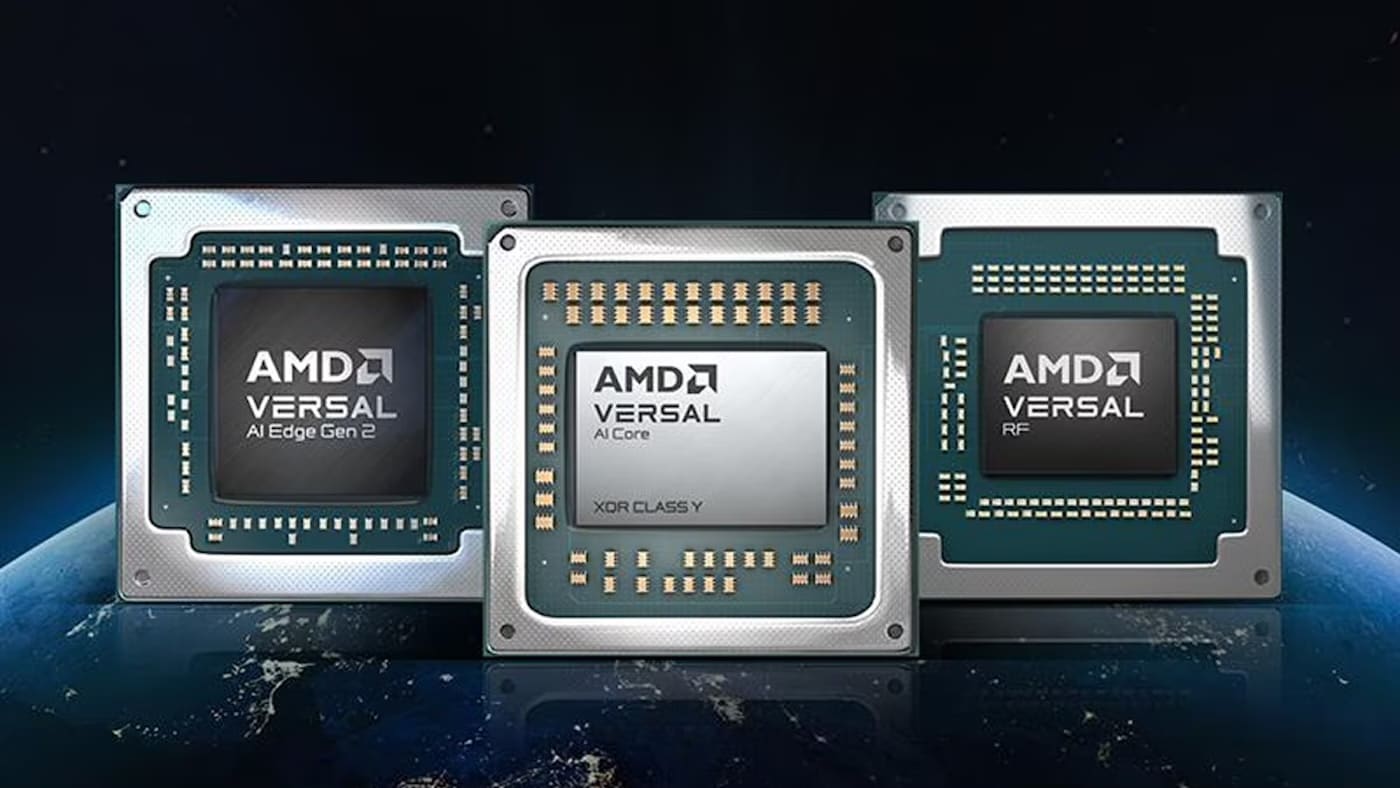
AMD wants their chips to dominate not only data centers and PCs but also geostationary orbits, lunar missions, and deep space probes. The company has announced an expansion of their “space-grade” adaptive SoC portfolio and a new organic lidless packaging (without a metal lid) designed to withstand the harshest conditions outside Earth’s atmosphere for up to 15 years of mission life.
At the heart of this move is a clear message: the next space race — both government and commercial — will require more processing power, more AI, and less custom hardware, and AMD aims to be the benchmark provider.
A new packaging designed to survive 15 years in orbit
The star of the announcement is the Versal AI Core XQRVC1902, an adaptive SoC from the Versal family tailored for AI workloads and on-board processing (on-board processing).
AMD is qualifying a new lidless organic package, with Class Y certification — the highest guarantee level for space components:
- Improved thermal management: by removing the traditional lid, the heatsink can be more directly coupled to the silicon, which is critical in satellites and probes where heat dissipation is very challenging.
- Extreme durability: the goal is missions lasting up to 15 years, typical of geostationary satellites or deep space exploration, where repairs are not an option.
This packaging won’t be limited to the XQRVC1902. AMD is also bringing it to:
- Versal RF Series (VR1602 and VR1652)
- Versal AI Edge Gen 2 (2VE3858 and 2VE3558)
The first target advanced RF front-ends; the latter, AI inference and data management at the satellite edge.
What do Classes B and Y mean in space?
AMD is seeking Class B and Class Y qualification for these devices, derived from the U.S. military specification MIL-PRF-38535, the benchmark standard for high-reliability components:
- Class B
- Designed for low Earth orbit (LEO) missions or shorter durations.
- Offers a balance between cost, lead time, and robustness.
- Suitable for commercial constellations, satellites with moderate lifespan, or experimental missions.
- Class Y
- Here, the top tier of space components: the toughest testing, screening, and documentation requirements.
- Applies to long-duration or deep space missions, where a failure could mean losing decades of work and hundreds of millions or billions of dollars.
With these qualification levels, AMD isn’t just targeting the new space market of small satellites but also government programs, defense, and large geostationary operators, where reliability comes above all.
Versal AI Core, RF, and Edge: fewer chips, more intelligence
AMD’s new space SoCs aim to significantly reduce onboard system complexity. They do this by integrating what previously required multiple ASICs and FPGAs into a single package.
Versal AI Core XQRVC1902
Designed for payload processing (e.g., high-resolution images, radar, or advanced communications):
- High-density vector compute for signal and vision algorithms.
- More system logic cells, onboard SRAM, and multi-gigabit transceivers compared to previous generations.
- Ideal for tasks like compression, encryption, filtering, and pre-processing scientific data before sending data to Earth, saving bandwidth.
Versal RF Series
The Versal RF series includes:
- High-speed RF converters.
- Dedicated signal processing blocks.
- Reconfigurable logic.
All in two space-grade monolithic devices, enabling:
- Replacing multiple discrete radio frequency cards and modules.
- Simplifying the design of telecom payloads, synthetic aperture radar (SAR), or high-capacity links.
- Reducing weight, power consumption, and failure points.
Versal AI Edge Gen 2
The Versal AI Edge Series Gen 2 XQR family is closest to the concept of an “autonomous satellite”:
- Arm Cortex-A78AE and R52 CPUs for system control and real-time tasks.
- Next-generation AI engines AIE-ML v2 for real-time inference.
- Up to 184 TOPS of AI acceleration, over 500,000 LUTs of programmable logic, and a 10x increase in scalar compute (up to around 200,000 DMIPS) compared to previous space devices.
Practically, this means a satellite can:
- Process and analyze data onboard, sending only relevant information.
- Make local decisions (e.g., prioritize images in a specific area, reconfigure observation modes, or react to events).
- Run AI models directly in orbit, with less reliance on ground processing.
From multi-chip architectures to a single adaptive SoC
A key aspect of this announcement is the impact on costs and development timelines. Traditionally, space projects relied on custom ASICs for each mission, with developments costing over $100 million and lengthy qualification cycles.
AMD proposes an alternative:
- Using standard space-grade adaptive SoCs, with much of the hardware already qualified.
- Customizing functions through reconfigurable logic and software, without redesigning the chip from scratch.
The result:
- Reduced program risk: starting from a known, tested baseline with a clear roadmap.
- Faster deployment: agencies and companies can iterate on missions and payloads using the same basic platform.
- Lower total costs: in development, testing, and certification.
In a market full of constellations and commercial missions, having “standard space components with integrated AI” is a clear competitive advantage.
Roadmap: from 2026 to 2029, a decade of new space chips
AMD’s product roadmap is clearly phased:
- Versal AI Core XQRVC1902
- Sampling scheduled for 2026.
- Fully qualified units for flight in 2027.
- Versal RF Series and Versal AI Edge Gen 2 (space-grade versions)
- Longer-term schedule: space availability in 2029.
In summary, AMD is laying out a roadmap covering the entire next decade of space missions, from the geostationary satellites in design today to the constellations and probes launching mid-2030s.
For system integrators and space agencies, this means they can plan now for missions that will leverage these SoCs, knowing they will have industry support and ongoing product availability.
AI and space: an inevitable convergence
This announcement reinforces AMD’s message that adaptive computing and AI are not confined to data centers. The company has been pushing its Xilinx heritage in space FPGAs for years, but now the focus is clearly shifting towards:
- More integration: CPU, reconfigurable logic, AI accelerators, and RF in one package.
- More intelligence onboard: deciding what to send to ground, when, and how.
- More flexibility: reconfigurable missions in flight, capable of changing operational profiles via software updates.
In an environment where LEO constellations are filling up, communications densify, and scientific missions push further away, having space computing platforms with integrated AI and long lifespan becomes a key element.
AMD aims to be the top choice when the time comes to select the “brain” of these satellites and probes.
