
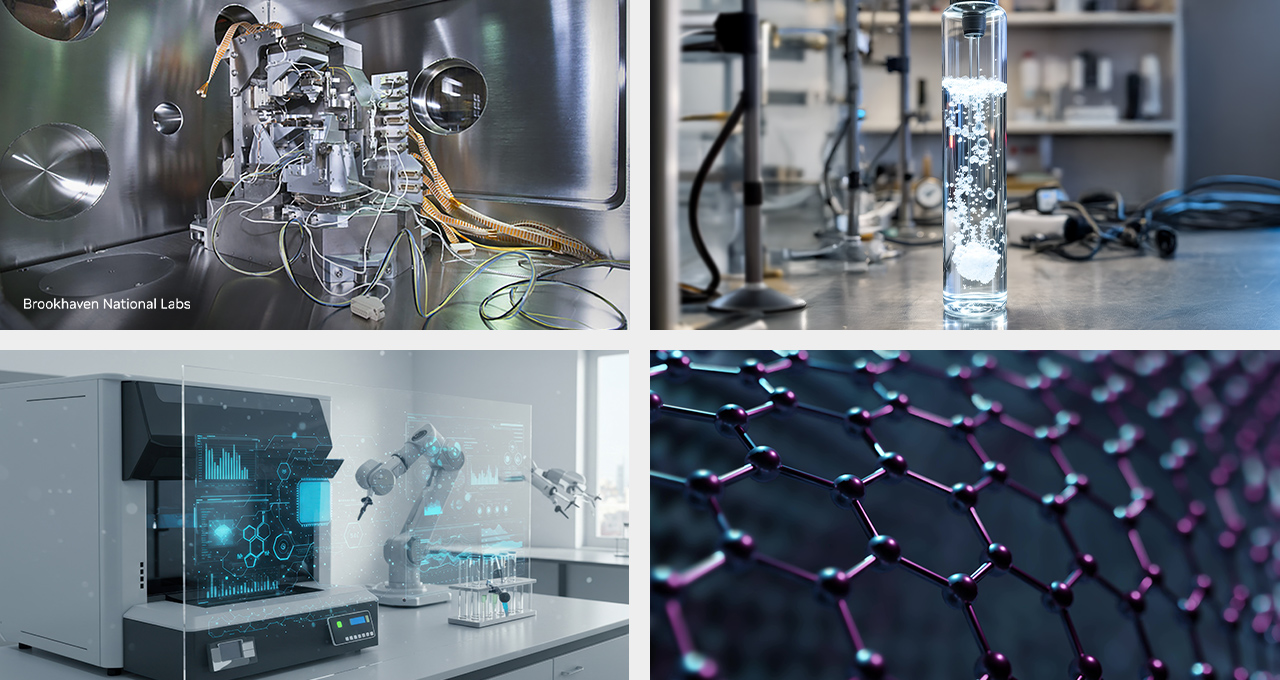
The next generation of liquid data centers, ultra-efficient OLED displays, and longer-lasting batteries will not be designed solely in the lab but also on GPUs. At SC25, held in St. Louis, NVIDIA demonstrated how accelerated computing and artificial intelligence are redefining how new materials are discovered and optimized, showcasing real projects in energy, electronics, and visualization.
The common thread among all these initiatives is the same challenge: the space of possible molecules is so vast that exploring it solely through physical experiments or traditional CPU simulations is impossible. The solution lies in combining advanced sensors, edge AI, and specialized microservices in chemistry and materials science.
Holoscan: Real-time AI for viewing matter at the nanoscale
One of the most striking examples comes from Brookhaven National Laboratory (USA), which operates the National Synchrotron Light Source II (NSLS-II), one of the world’s most advanced X-ray facilities. There, scientists use high-energy beams to study complex materials—such as batteries, microelectronics, or nanoparticles—with nanometer-scale resolution.
Each experiment generates massive volumes of data that previously required long processing times before conclusions could be drawn. This meant researchers often had to “wait until tomorrow” to know if they had targeted the right location or if the experiment needed to be repeated.
With NVIDIA Holoscan platform, NSLS-II is pushing processing to the very limit of data acquisition: the accelerated pipeline processes in real-time the data streams from detectors, providing almost instant feedback to scientists.
This has several practical implications:
- Decisions on the fly: Researchers can see within seconds if an area of the sample contains an interesting structure and adjust the experiment in real-time.
- More science per machine hour: Optimizing the use time of a synchrotron, an extremely costly infrastructure, translates into more experiments, more users served, and greater scientific return.
- Path toward autonomous experiments: The lab is already considering integrating AI models not only for image reconstruction but also to help control equipment and autonomously direct future measurement campaigns.
Operationally, Holoscan acts as a high-speed edge processing platform: it receives raw data, applies AI models and reconstruction algorithms on GPUs, and returns usable results almost instantly. A key component in a world where scientific instruments generate more data than can be manually reviewed.
ALCHEMI: AI microservices for exploring millions of molecules
While Holoscan accelerates understanding of existing materials, NVIDIA ALCHEMI focuses on designing future materials. ALCHEMI is a set of microservices and tools for chemistry and materials science integrated into the NVIDIA NIM ecosystem, aimed at helping companies and research centers scale their simulations to levels impossible with traditional approaches.
At SC25, two key microservices were highlighted:
- Batched conformer search: massive search for conformers, i.e., different spatial configurations a molecule can adopt.
- Batched molecular dynamics: batch molecular dynamics simulations to estimate how materials behave at the atomic level under various conditions.
Both microservices are designed as high-performance services running on GPUs and integrated into existing AI and HPC pipelines. The simple yet powerful idea is to enable scientists to filter large-scale, cost-effective sets of molecules that merit further physical laboratory testing.
ENEOS: liquids for data center cooling and catalysts for hydrogen
Japanese energy company ENEOS is utilizing ALCHEMI NIM microservices for two critical areas in energy transition:
- New immersion cooling liquids for next-generation data centers, where traditional air cooling begins to be insufficient for AI workloads.
- Catalysts for energy conversion processes, such as electrochemical hydrogen production.
With ALCHEMI, ENEOS can perform computational screening of between 10 and 100 million candidates in a matter of weeks. According to the researchers, they previously wouldn’t have even considered searches of this scale: time and computational capacity limitations on CPUs forced them to drastically reduce the search space and rely on chemical intuition to prioritize compound families.
Now, the logic is reversed:
- First, explore the chemical space massively using GPU-accelerated models.
- Then, analyze the results to isolate a manageable subset of promising candidates.
- Finally, only those few materials proceed to experimental testing, which is far more time- and resource-intensive.
The impact is twofold: lower R&D costs and accelerated time to market for new immersion liquids and catalysts, with direct applications in more efficient data centers and clean energy processes.
Universal Display Corporation: More efficient and sustainable OLEDs
American company Universal Display Corporation (UDC), a leader in OLED materials for screens, faces an even bigger challenge: the number of potential molecules for an OLED material is estimated at around 10 raised to the 100th power. It’s literally a chemical universe.
In this context, ALCHEMI becomes a telescope to explore that universe:
- Using the AI-accelerated conformer search microservice, UDC can evaluate billions of candidates up to 10,000 times faster than with traditional CPU-based methods.
- Top promising compounds are then re-evaluated through accelerated molecular dynamics simulations, reducing simulation times by up to 10 times per individual run.
By deploying these simulations in parallel across multiple NVIDIA GPUs, total processing time drops from days to seconds for certain use cases. This frees scientists from computational bottlenecks, allowing more focus on interpreting results and exploring new material designs.
UDC applies this approach to projects like the development of high-performance blue phosphorescent OLEDs, crucial for improving display efficiency and lifespan in mobile devices, TVs, vehicles, and virtual reality devices. An efficient blue OLED can lead to lower energy consumption, less heat, and longer battery life across millions of devices.
The company highlights that combining GPU power, ALCHEMI, and their chemical expertise enables them to completely transform the scale and speed of new material discovery, directly impacting the sustainability of consumer electronics.
Beyond isolated cases: an ecosystem of accelerated scientific software
ALCHEMI is not an isolated piece but part of a broader ecosystem of more than 150 NVIDIA CUDA-X libraries and frameworks aimed at accelerating real-world problems in science and engineering. From fluid dynamics simulations to climate models and genomic analysis, the pattern repeats: massive data, complex equations, and an urgent need to reduce computation times from weeks to hours or minutes.
In this context, the examples from Brookhaven, ENEOS, and UDC illustrate a clear trend:
- Materials science and computational chemistry are shifting from simulating a few carefully selected options to systematically exploring millions of candidates.
- AI and accelerated computing do not replace scientists but extend their intuition and expertise.
- The physical lab remains essential but now benefits from a much better filtered funnel, where each experiment has higher success prospects.
Economically and socially, this translates into more efficient data centers, sustainable electronic devices, longer-lasting batteries, and generally shorter cycles of technological innovation.
What is shown at SC25 is not just a GPU power demonstration but a roadmap for how AI and HPC are becoming essential infrastructures for 21st-century materials science.
Frequently Asked Questions
What is NVIDIA ALCHEMI and how is it used in materials science?
NVIDIA ALCHEMI is a set of microservices and AI tools designed to accelerate typical computational chemistry and materials science tasks, such as conformer searches or molecular dynamics simulations. Integrated into the NVIDIA NIM platform, it allows rapid and efficient evaluation of millions of molecular candidates, reducing the number of compounds that need physical testing in the lab.
How does NVIDIA Holoscan assist scientific facilities like NSLS-II?
Holoscan functions as a high-speed edge processing platform for ultra-fast data streams from sensors and advanced detectors. In NSLS-II’s case, it enables nearly real-time reconstruction and analysis of nanometer-scale X-ray images, allowing scientists to adjust experiments on the fly and maximize synchrotron utilization.
What advantages does GPU-accelerated AI offer over traditional CPU simulations?
GPUs are optimized for large-scale parallel processing. This capability accelerates numerical simulations and AI models by orders of magnitude compared to CPUs. For materials science, this means exploring millions or billions of candidate molecules, performing large virtual screenings, and decreasing simulation times from days to seconds in certain cases.
What is the practical impact of all this on end users?
Although ALCHEMI, Holoscan, and GPUs work largely behind the scenes, their results lead to more efficient and sustainable products: data centers consuming less energy thanks to better-designed cooling liquids, OLED displays with longer battery life and lower energy footprints, and new batteries or electronic materials with enhanced performance and reduced environmental impact.
via: blogs.nvidia
