
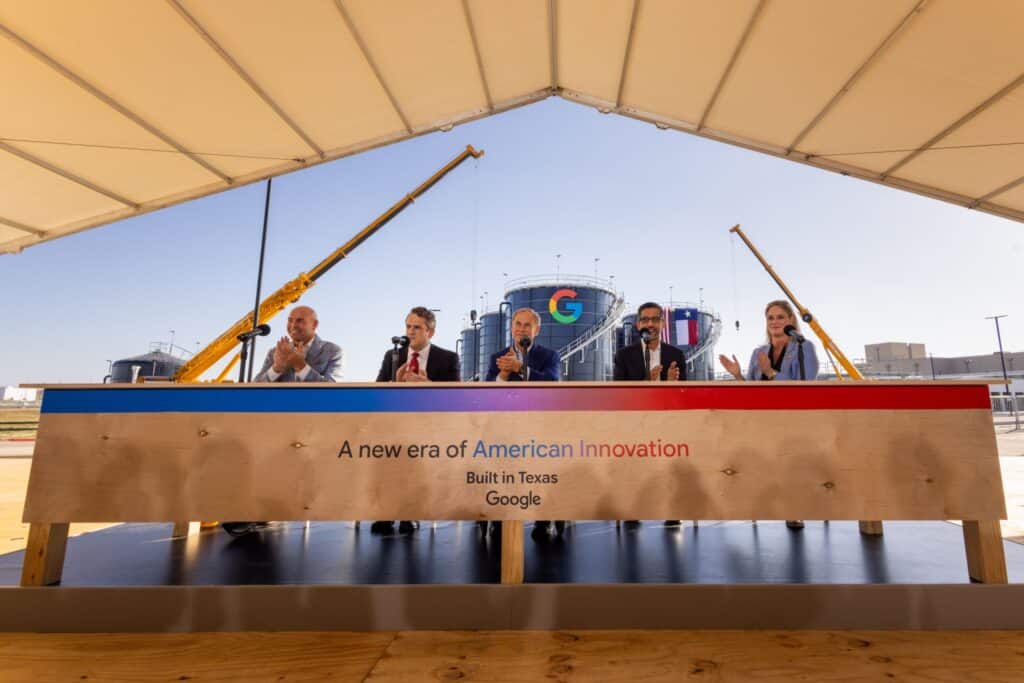
Sundar Pichai’s LinkedIn post leaves no doubt: Google wants to turn Texas into one of the world’s major hubs for its cloud infrastructure and artificial intelligence. The CEO of Google and Alphabet announced an investment of more than $40 billion through 2027 in the state, primarily in data centers and energy capacity to support AI.
Behind the enthusiastic tone of the message — “a new golden age of American innovation,” “Texas as a driver of opportunities” — lies something deeper than a simple expansion plan: it’s a strategic move in the global race for AI computing… and, incidentally, a new chapter in the debate over the energy, territorial, and economic impact of hyperscale data centers.
What exactly has Google announced in Texas?
According to Pichai himself and expanded information from local U.S. media, Google’s plan includes four main pillars:
- More data centers
- Three new data center campuses in Armstrong and Haskell counties (two of them in Haskell).
- Expansion of the existing campus in Midlothian (Ellis County) and the Google Cloud region in Dallas.
- Energy and network resilience
- Investments to “strengthen energy resilience and abundance” in the state.
- Creation of a Energy Impact Fund of $30 million starting in 2026 to support energy efficiency initiatives in local communities.
- Talent development
- Funding through Google.org for training programs for electricians.
- Goal: train more than 1,700 apprentices and electrical workers in Texas by 2030, nearly doubling the projected flow of new professionals in this sector.
- Applied AI ecosystem
- Collaborations with educational, health, and energy institutions to promote AI projects in key sectors like health, energy, and education, supported by grants and responsible AI adoption programs.
Politically, the announcement arrives with explicit backing from Governor Greg Abbott, who sees the investment as a proof of Texas’s role as a hub of innovation and employment linked to AI.
Texas, the new battleground for AI computing
Google’s move isn’t happening in a vacuum. Texas has become, in just a few years, a magnet for data centers from tech giants, driven by a combination of factors: land availability, tax incentives, presence of large electrical infrastructure, and a more permissive regulation.
Microsoft, for example, has been expanding its cloud and AI infrastructure in the state, while other tech giants and hyperscalers have also chosen the region as a base for their deployments.
The Google announcement consolidates this shift: if executed as planned, it would be the largest single-state investment by the company in the U.S. to date.
But it also amplifies a trend that concerns regulators, energy experts, and local communities: the geographical concentration of highly electricity-intensive AI workloads, often requiring significant water resources.
The other side of the “golden age”: energy, water, and territory
The official narrative promotes innovation, employment, and opportunities. But the large-scale deployment of AI data centers comes with costs:
- Electrical consumption
- Data centers already represent a growing portion of global electricity use, and AI’s rise accelerates this trend. The International Energy Agency (IEA) has warned that data center energy consumption could double by 2026, driven largely by generative AI.
- Texas, in addition, has a history of vulnerabilities in its power grid, with recent outages and energy crises. Google’s promise to “increase energy abundance” aims precisely at mitigating fears that this new demand might worsen existing issues.
- Water and cooling
- Google states that the new Armstrong and Haskell data centers will use advanced air cooling technologies, reducing water use to only essential operations on-site.
- However, environmental organizations remind us that even the most efficient solutions still require resources (water, land, energy) in regions where water stress is a structural problem.
- Land use and local impact
- The new campuses will cover hundreds of acres and alter land use in the long term. While these projects often bring jobs and economic activity, they can also create tensions related to infrastructure, housing, and public services.
Google offers stability; the market sees risk concentration
From a tech perspective, the strategy makes sense: generative AI and next-generation models require massive distributed computing capacity across strategic regions. Texas, with its connection to major electrical grids, good connectivity, and available space, fits this map.
But increasing numbers of analysts see these large-scale AI infrastructure projects as a systemic risk:
- When a few companies (Google, Microsoft, Amazon, Meta…) concentrate such power in data centers, energy, and networks, any failure or regulatory restriction could trigger cascading effects on the entire digital economy.
- The AI boom relies on debt, cheap energy, and subsidies. If any of these pillars falter, the growth model may experience sharp corrections.
In this context, Google’s $40 billion investment in Texas is both a demonstration of strength and a long-term commitment to a state positioning itself as a “AI hub” within the U.S. But it also increases dependence on the global digital infrastructure being concentrated in just a few actors and regions.
What does this mean for the tech industry?
For the tech ecosystem, Pichai’s announcement sends several clear signals:
- The race for computing accelerates
Major tech companies understand that the competitive edge in AI depends on controlling everything from chips to data centers and energy. Those who control computing will hold significant power in the AI value chain. - Data centers become an industrial policy
State and national governments compete to attract these investments with incentives, regulatory simplification, and job promises. Texas is emerging as a major winner in this race within the U.S. - Greater pressure on public infrastructure
While companies promise grid upgrades and efficiency improvements, increasing energy demand and capacity will force a rethink of policies related to planning, regulation, and sustainability. - Open debate on AI sustainability and governance
The industry promotes these projects as “future infrastructure.” But civil society, regulators, and parts of the tech community are beginning to question at what cost, who decides where centers are built, under what conditions, and with what transparency measures.
A future powered by GPUs… and political decisions
Sundar Pichai’s post may seem optimistic about investment, employment, and technological progress. But viewed through the lens of critical infrastructure, it’s something more: a display of power.
Google is signaling to the market, competitors, and governments that it’s prepared to invest historic sums to secure the compute power needed for the coming decade of AI. Texas, in turn, is solidifying its role as a key piece in that strategy.
The big question remains: will this new wave of AI infrastructure balance innovation, employment, and competitiveness with sustainability, energy resilience, and power distribution? Because what’s being built in Armstrong, Haskell, and Midlothian isn’t just server halls—it’s the physical foundation of the AI economy.
And like all critical infrastructure, its benefits — and risks — will extend beyond these campuses.
via: LinkedIn
