
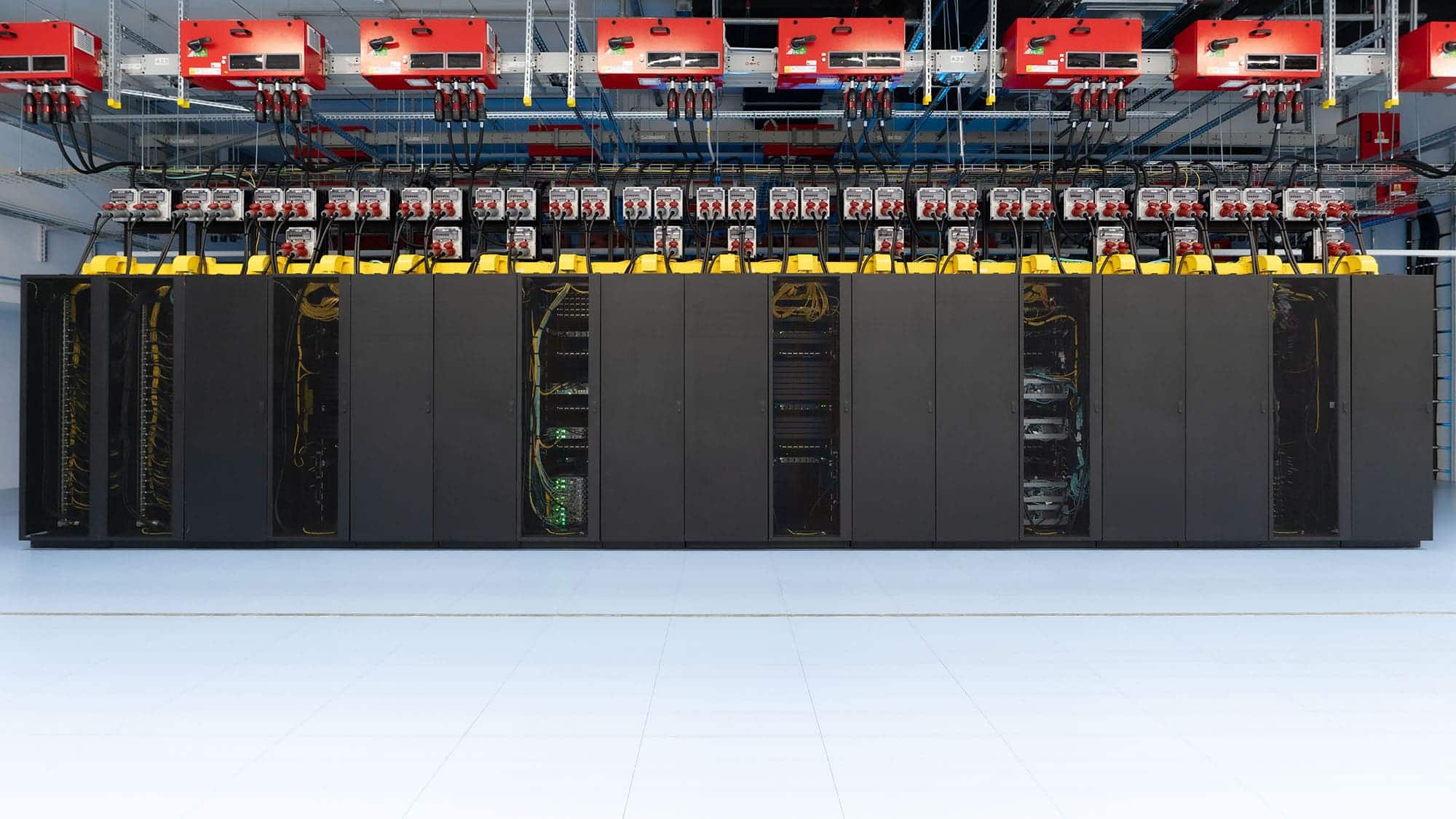
Paderborn University has broken into the top tier of global high performance computing (HPC) with “Otus,” its new supercomputer. Not only for raw power but, above all, for energy efficiency: the system has just debuted in fifth place on the international Green500 ranking, which lists the most energy-efficient supercomputers on the planet relative to their electrical consumption.
Behind the name—referencing the genus of small nocturnal birds of prey—is a machine designed for a very specific purpose: to provide the German scientific community with a massive computing resource capable of tackling the major challenges of this decade (climate, materials, AI, energy…) without exploding energy bills or carbon footprints.
A beast with 142,656 cores and 108 GPUs
Otus is part of the infrastructure of the Paderborn Center for Parallel Computing (PC2), the university’s parallel computing center. According to official data from the institution itself, the system integrates:
- 142,656 processor cores, based on the latest AMD “Turin” CPUs.
- 108 high-performance GPUs, geared toward AI workloads and massively parallel simulations.
- An IBM Spectrum Scale storage system with 5 petabytes of capacity, prepared to handle enormous scientific data flows.
The machine was developed by Lenovo in collaboration with pro-com Datensysteme GmbH, combining the manufacturer’s expertise in HPC systems with the specific needs of PC2. The result is a platform that, according to the university, doubles the computational power of the previous system “Noctua 2,” elevating PC2 to a new level within the German academic supercomputing ecosystem.
Energy efficiency as a requirement, not an afterthought
What sets Otus apart is not just its power but how it delivers it. The machine has been designed from the outset with energy efficiency as a central criterion:
- 100% renewable electricity: all energy powering the supercomputer comes from renewable sources, making its operation carbon-neutral in terms of direct CO₂ emissions.
- Efficient cooling: the system uses indirect “free air” cooling, leveraging environmental conditions to reduce the reliance on intensive mechanical refrigeration.
- Reuse of waste heat: the heat generated by the compute nodes is not wasted; it is channeled to heat university buildings, closing part of the campus’s energy loop.
This combination of efficient design and clean energy has allowed Otus to rank fifth on the Green500 list, which benchmarks supercomputers not only by performance but also by the number of operations they perform per watt consumed.
In a context where supercomputing and AI are driving up the electricity consumption of data centers worldwide, Otus exemplifies that not all power has to mean energy wastage.
A national resource for science, industry, and AI
Although physically installed at Paderborn University, its use extends far beyond the local environment. Otus is part of the National High-Performance Computing (NHR) alliance, a network of academic supercomputing centers providing HPC resources to universities nationwide.
Access operates under a typical academic supercomputing scheme:
- Research teams submit project proposals, justifying their need for HPC resources.
- Requests are evaluated independently, based on scientific and technical criteria.
- Approved projects receive “compute time” on Otus, managed through automated queues to maximize system utilization.
The applications are as diverse as modern science itself:
- Atomic-level simulations in physics and chemistry.
- Climate and fluid dynamics models, crucial for studying climate change or energy efficiency in transportation.
- Optimization of maritime routes and other complex logistical challenges.
- Training high-complexity AI models, including more sustainable approaches to AI.
For university president Matthias Bauer, supercomputing has become “essential to addressing current challenges,” from basic science to applications with direct economic and societal impact.
Hardware design: a living laboratory for new architectures
An important aspect of Otus is that it is conceived not just as a “compute service” but also as a testbed for experimenting with new system architectures.
The supercomputer can be expanded with up to 100 FPGAs (field-programmable gate arrays), reprogrammable devices that enable experimentation with specialized accelerators, new network architectures, or customized workflows for particular scientific applications.
This makes Otus especially interesting for:
- Research groups working on computer architecture and parallel systems.
- Developers of new AI algorithms seeking to explore dedicated acceleration outside traditional GPUs.
- University-industry joint projects aiming to develop prototypes with potential for commercial hardware.
In other words, Otus is not just “a big server” but a living laboratory where innovative ideas can be tested and may influence future data center designs.
A €14 million project with a long-term vision
The acquisition of Otus was funded through the NHR alliance, with a joint investment of around €14 million, shared equally by the German federal government and the state of North Rhine-Westphalia.
These projects are planned with a multi-year perspective:
- The lifespan of a supercomputer at this level is typically between 5 and 7 years before being superseded by newer generations.
- During that period, the goal is to maximize resource utilization, but also to train talent in parallel programming, large-scale AI, and HPC infrastructure management.
- The accumulated experience supports the development of future systems, both in Paderborn and other NHR centers.
Otus’s rapid entry into the top 10 of HPC centers in Germany consolidates Paderborn as a key player within the national ecosystem and reaffirms the country’s commitment to supercomputing that combines power, community access, and sustainability.
Beyond Otus: a sign of where supercomputing is headed
Otus exemplifies a clear global trend:
- Large HPC systems are becoming critical infrastructure for science, industry, and increasingly, generative artificial intelligence.
- Energy pressures and decarbonization targets mandate that each new supercomputer be significantly more efficient than its predecessor.
- The line between traditional HPC and large-scale AI is increasingly blurred: GPUs, high-speed networks, and massive storage systems serve both to simulate molecules and train language models.
In this context, Otus is more than a local milestone; it demonstrates how extreme computational power can be deployed with a sustainable design, opening infrastructure to researchers nationwide.
For the European HPC community and tech industry, it signals that the race for energy-efficient supercomputing is not just about reaching the next exaflop but about doing so within the energy and climate realities of the 21st century.
via: uni-paderborn
