
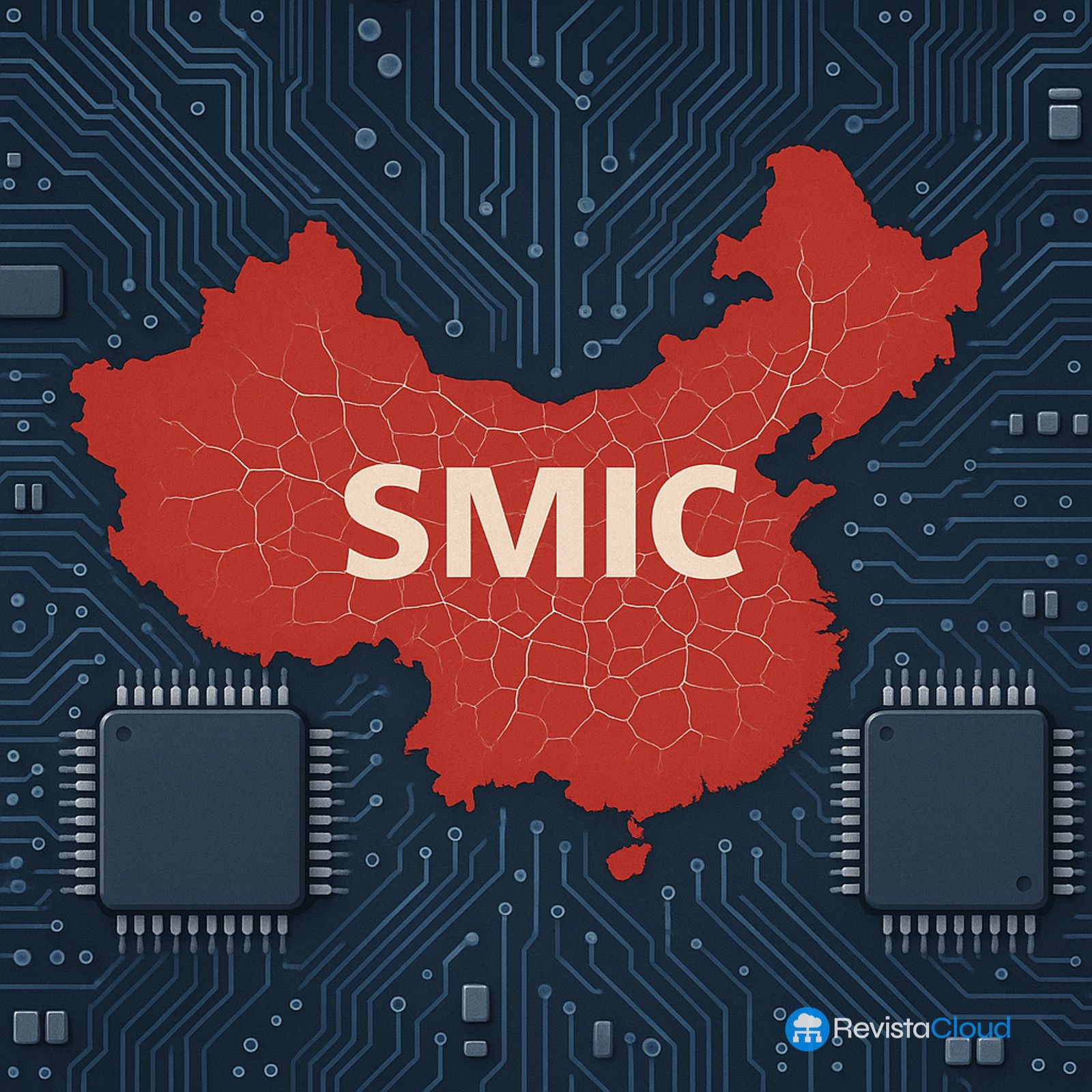
China has taken another step in its pursuit of technological independence. The Beijing government has mandated that the country’s public data centers must use more than 50% domestically produced chips, reflecting the urgency to reduce reliance on foreign semiconductors amid the ongoing technological rivalry with the United States.
This measure, confirmed by industry advisors and cited by specialized media, originated from guidelines published in March 2024 by the Shanghai province, which stipulated that “the adoption of national computing and storage chips in the city’s intelligent centers should exceed 50% by 2025.”
What initially seemed like a regional pilot program has become a national policy in 2025.
—
From Shanghai to the rest of the country: a policy that becomes a mandate
Shanghai’s early guidelines, endorsed by the National Development and Reform Commission (NDRC) and the Shanghai Communications Administration, laid the groundwork for a more ambitious policy: strengthening China’s artificial intelligence computing capacity.
With support from the Ministry of Industry and Information Technology (MIIT), these directives have evolved into nationwide regulations. Now, any public data center operating in China must ensure that at least half of its processors are from Chinese manufacturers.
—
A direct response to Washington’s bans
This move comes at a time of increasing technological tension. Since 2022, the U.S. has progressively tightened export controls on advanced semiconductors, banning the sale to China of high-performance chips such as Nvidia’s H100 and H800 GPUs, which are crucial for training generative AI models.
Although recently Nvidia’s H20 chips have received approval for sale in China, Beijing has questioned their security in critical networks, an accusation that the American company has strongly denied.
In response to these restrictions, China is accelerating its push for domestic chips, even though they are still one step behind their Western counterparts in power and efficiency.
—
Rise of intelligent data centers
Beijing’s efforts are not limited to chip design. Parallel to this, the country has promoted massive construction of intelligent computing centers capable of aggregating computational resources for the local AI industry.
According to data cited by MIT Technology Review, over 500 new data center projects were announced between 2023 and 2024 in provinces such as Inner Mongolia and Guangdong.
These hubs aim not only to support major Chinese tech companies but also to serve as strategic infrastructure for sectors like banking, medical research, and defense.
—
Technical challenge: coexistence of domestic and foreign chips
The 50% mandate presents challenges. Many Chinese AI models have been trained within the Nvidia CUDA ecosystem, which is the de facto standard in AI.
Transitioning to domestic chips involves working with alternative platforms like Huawei CANN, requiring adaptation of existing models to operate on different architectures, a process known as “model portability,” which is complex and costly.
An industry source acknowledged that “AI data centers in China face increasing adaptation challenges,” as most engineers are accustomed to Nvidia hardware.
—
Huawei, iFlytek, and the alliance with SiliconFlow
Despite the difficulties, some Chinese companies have made significant advances.
– iFlytek, sanctioned by the U.S., has openly announced it trains its AI models using Huawei chips.
– SiliconFlow, in collaboration with Huawei, has presented research demonstrating how their Ascend chips and the Cloud Matrix 384 data center architecture outperform Nvidia’s H800 GPU in executing DeepSeek R1 models more efficiently.
These advances suggest that, although still lagging in large-scale training, Chinese chips are becoming increasingly competitive in inference tasks and deploying pre-trained models.
—
A strategic race toward technological autonomy
Beyond technological efficiency, Beijing views control over the chip supply chain as equivalent to national sovereignty.
With the expansion of generative AI and the enormous energy consumption of its data centers, dependence on foreign suppliers is seen as an unacceptable risk.
The goal is clear: develop a domestic ecosystem combining domestically manufactured chips, local software, and autonomous data centers.
—
Comparison with the West
While China imposes quotas on domestic chips, the approach in the U.S. and Europe centers on attracting foreign factories:
– TSMC (Taiwan) is building plants in Arizona and Germany.
– Intel receives subsidies to build factories in Ohio and Poland.
– Europe promotes its own European Chips Act, focusing on next-generation semiconductors.
Western strategies aim to diversify suppliers and guarantee manufacturing capacity, whereas China is directly pursuing substitution of foreign reliance with local production.
—
Conclusion: an inevitable path or a threat to competitiveness?
The key question is whether Chinese chips can match Nvidia’s or AMD’s level within the next five years. Meanwhile, the 50% mandate for data centers underscores that, for Beijing, technological independence is not optional but a state objective.
The challenge is enormous: enabling hardware, software, and AI models to operate seamlessly within a single ecosystem, amidst ongoing geopolitical pressures and Western bans that continue to shape the race.
