
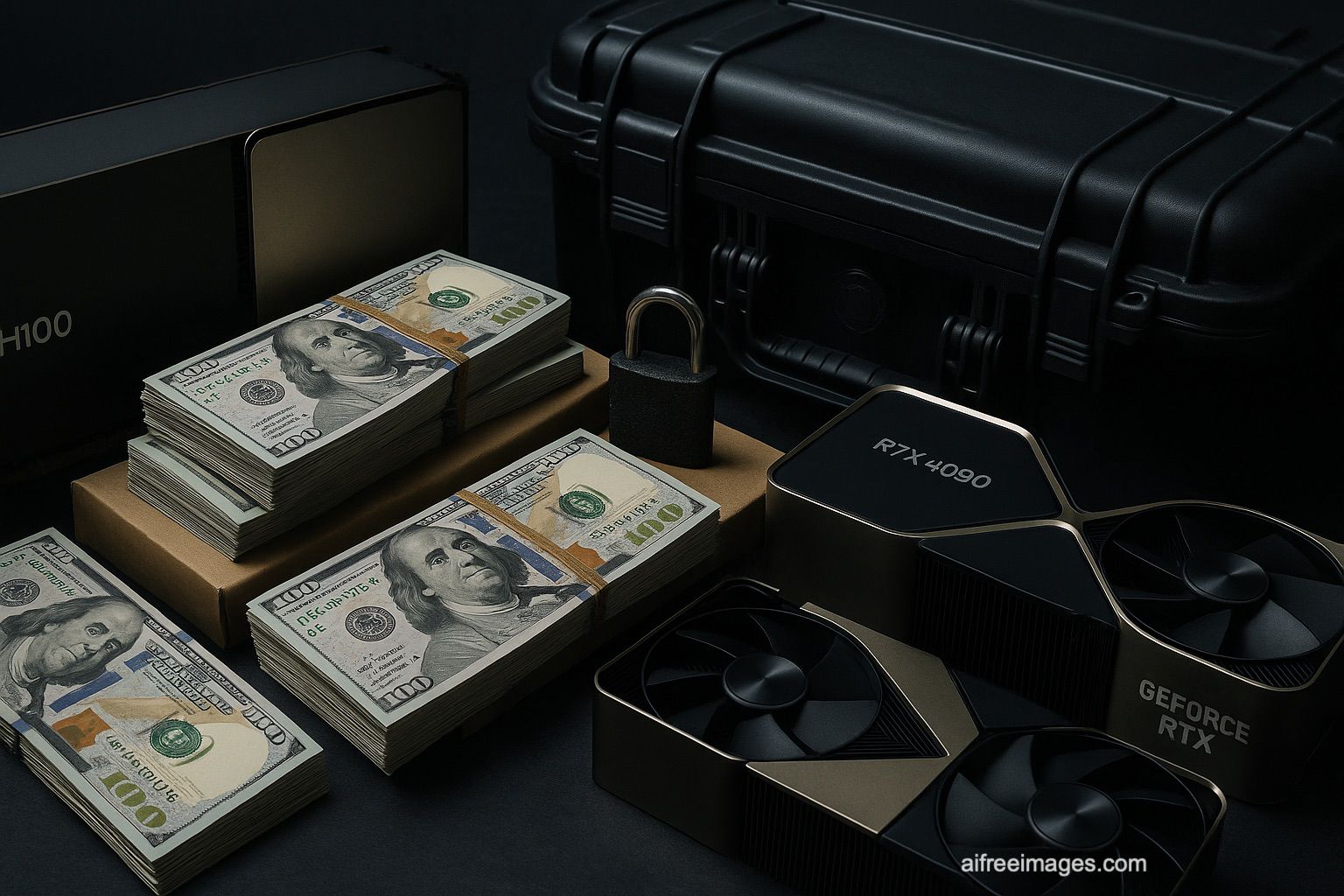
A 3.5-hour documentary published by Gamers Nexus on YouTube has revealed what many suspected but few had thoroughly investigated: an international network of NVIDIA GPU smuggling, institutional corruption, and geopolitical tensions that are reshaping the global race for artificial intelligence.
Titled “The NVIDIA AI GPU Black Market,” the film covers everything from US export restrictions to how GPUs have become as strategically valuable as oil or lithium.
The root of the issue lies in the surge of generative AI following the launch of ChatGPT and its successors. The demand for high-performance GPUs—especially NVIDIA’s A100 and H100—has skyrocketed. Originally designed for data centers and supercomputing, these cards now form the backbone of most large-scale AI models.
At the same time, the US government banned the export of these GPUs to China to slow its development of advanced AI and maintain strategic advantage. The immediate consequence was the creation of a multimillion-dollar black market, where a single GPU could sell for up to four times its official price.
The documentary illustrates how this smuggling is not just an isolated phenomenon:
– People crossing borders with GPUs hidden in suitcases or attached to their bodies.
– Camouflaged servers transporting graphics cards in concealed compartments.
– Hong Kong and Singapore becoming logistical hubs for smuggling.
– Cases where Chinese officials and state-owned companies allegedly facilitated illegal GPU entry.
Meanwhile, US authorities have reportedly hidden trackers in shipments of chips and servers to trace this parallel market.
Why such interest? Because access to NVIDIA GPUs now determines which country can lead the AI revolution. Without hardware, models simply don’t exist.
China, which holds 50% of the world’s AI researchers, depends critically on these GPUs. According to the documentary, Chinese state and private organizations may have tolerated or even encouraged smuggling to stay competitive.
The scarcity has prompted efforts to modify gaming GPUs like the RTX 4090—adding more VRAM—to make them usable for AI tasks. Even GPUs restricted by sanctions, such as the RTX 4090D or the upcoming RTX 5090D V2, can be altered to restore near-original performance.
This questions the effectiveness of sanctions: the grey market always finds a way.
Although NVIDIA doesn’t directly partake in the black market, the documentary suggests it benefits indirectly from unmet demand. The company has released “capped” versions for China (A800, H800, RTX 4090D) and has had to accept US agreements, such as ceding 15% of its chip sales revenue from China to the US government, as reported by the Financial Times in August 2025.
The black market figures show that high-end GPUs are significantly more expensive in China, with the NVIDIA H100 roughly tripling or quadrupling its retail price, and the A100 and RTX 4090 also seeing substantial markups.
Beyond hardware, this situation illustrates how AI has become a new technological battleground. Similar to oil in the 20th century, GPUs are now seen as strategic resources capable of shaping national economic and military power.
The Gamers Nexus documentary concludes with a key reflection: the world’s dependency on NVIDIA is so high that any restrictions, sanctions, or diversion efforts cause ripple effects across the global supply chain.
The full documentary, “The NVIDIA AI GPU Black Market,” is available on Gamers Nexus’s official YouTube channel.
Sources: elchapuzasinformatico and gamersnexus.
